
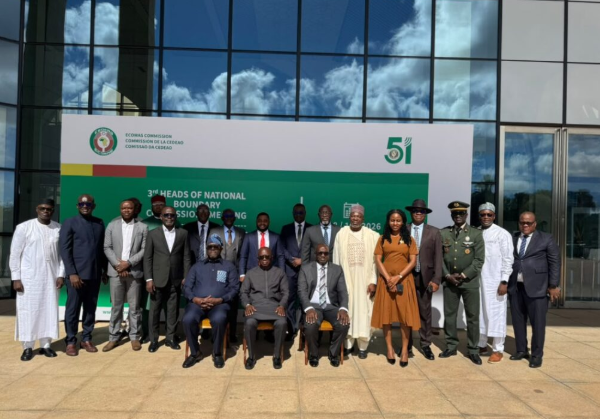
The Economic Community of West African States (ECOWAS) has published findings from the third meeting of Heads of National Boundary Commissions, held in The Gambia, highlighting continued efforts to strengthen border governance, cross-border cooperation and regional integration.
The meeting brought together representatives of national boundary authorities, the ECOWAS Commission, the African Union and development partners to assess progress on regional border-management initiatives.
Discussions focused on implementing previous recommendations, improving boundary demarcation, strengthening cooperation between neighboring countries and advancing programmes designed to support communities living along international borders.
A major focus was the ECOWAS Cross-Border Support Programme for 2023–2027, which aims to improve cooperation and development in border regions.
Strengthening Border Governance and Regional Stability
Effective border management remains an important component of West Africa’s economic and security framework.
Although ECOWAS has established regional commitments supporting the free movement of people and goods, implementation continues to depend on cooperation among national authorities.
Poorly defined boundaries, inadequate infrastructure and inconsistent administrative procedures can create obstacles to trade, transportation and community development.
Clear boundary demarcation and stronger institutional coordination can help reduce territorial disagreements, improve security cooperation and support more predictable cross-border movement.
The meeting provided an opportunity for participating countries to evaluate progress and identify areas requiring further attention.
Border Communities Must Benefit From Integration
Another important issue was the inclusion of border communities in regional development planning.
Communities located along international boundaries frequently depend on cross-border commerce, agriculture, transportation and family connections.
However, these areas may experience limited public investment, inadequate infrastructure and restricted access to essential services.
ECOWAS officials emphasized the importance of ensuring that regional border-management programmes consider the needs of these populations.
The Cross-Border Support Programme for 2023–2027 provides a framework for strengthening cooperation while encouraging development initiatives that benefit local communities.
Successful implementation could help transform border regions from administrative dividing lines into areas of shared economic opportunity.
What This Means for African Integration
ECOWAS is one of the African Union’s eight recognized Regional Economic Communities and plays an important role in advancing continental integration.
Its border-management initiatives are closely connected to the African Union’s broader objectives of facilitating trade, improving regional connectivity and promoting the movement of people.
However, agreements alone cannot guarantee effective integration.
Governments must establish functioning institutions, coordinate border procedures and invest in infrastructure that makes regional movement more efficient.
Improved border governance could also support implementation of the African Continental Free Trade Area by reducing practical obstacles to regional commerce.
The Bigger Question: Will Regional Commitments Produce Results?
The findings from the meeting in The Gambia highlight continued institutional cooperation, but the central challenge remains implementation.
Will ECOWAS member states make measurable progress in boundary demarcation?
Can the Cross-Border Support Programme deliver tangible improvements before its 2027 conclusion?
And will border communities experience greater economic opportunities as a result?
These questions are important because regional integration must ultimately produce benefits beyond government institutions.
Conclusion
The third meeting of Heads of National Boundary Commissions represents another step in ECOWAS’s efforts to strengthen regional cooperation and improve border governance.
By focusing on boundary management, cross-border development and community participation, the organization is addressing practical challenges that influence trade, security and mobility.
For West Africa, the real measure of progress will not be the number of regional agreements adopted, but whether people and businesses can move across borders more safely, efficiently and productively.
As Africa pursues the ambitious project of bringing 55 sovereign nations together through continental integration, ECOWAS’s experience demonstrates that successful cooperation must be built not only in conference rooms, but also at the borders connecting African communities.