
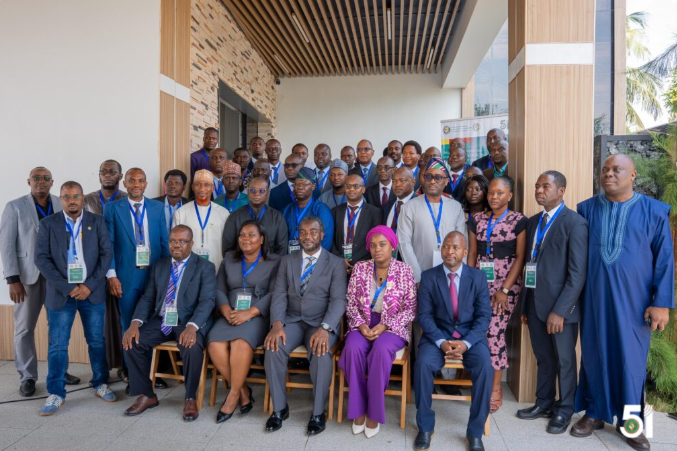
The Economic Community of West African States (ECOWAS), in collaboration with the West African Monetary Agency (WAMA), has opened a technical meeting in Lomé, Togo, aimed at harmonizing monetary and financial statistics across West Africa.
The meeting brings together financial and statistical specialists from national central banks, including representatives of the Central Bank of West African States (BCEAO), the Central Bank of Nigeria (CBN), and the Bank of Ghana.
The discussions represent another technical step in ECOWAS’s broader efforts to strengthen regional economic coordination, improve financial transparency, and support the long-term objective of monetary integration among West African countries.
Establishing Common Financial Reporting Standards
A central focus of the meeting is the examination of a draft regional metadata framework designed to improve consistency in how monetary and financial information is collected, classified, compiled, and reported.
Metadata refers to the definitions, methodologies, classifications, and reporting procedures used to produce statistical information.
Although West African central banks regularly publish monetary and financial statistics, differences in national reporting systems can make comparisons between countries difficult.
These differences may involve how financial institutions are classified, how monetary aggregates are calculated, and how financial assets and liabilities are reported.
A harmonized framework could help participating institutions develop more consistent statistical practices, making it easier for policymakers to compare financial developments across national economies.
Such improvements are particularly important in a region where countries operate under different monetary arrangements and financial regulatory systems.
Why Nigeria, Ghana, and the BCEAO Matter
The participation of the Central Bank of Nigeria, the Bank of Ghana, and the BCEAO highlights the diversity of West Africa’s monetary landscape.
Nigeria operates its own national currency, the naira, while Ghana maintains the Ghanaian cedi.
Meanwhile, the BCEAO manages monetary policy for the eight countries belonging to the West African Economic and Monetary Union (WAEMU), which share the West African CFA franc.
These different monetary systems present coordination challenges for ECOWAS, particularly when regional institutions attempt to evaluate inflation, money supply, banking developments, and financial stability across participating countries.
Establishing comparable financial statistics would provide regional policymakers with a stronger foundation for assessing economic performance and identifying financial risks.
It could also help governments and monetary authorities develop policies based on more reliable regional information.
Implications for the ECOWAS Single Currency Ambition
The technical discussions in Lomé are relevant to ECOWAS’s longstanding ambition to establish a common regional currency, frequently referred to as the Eco.
Although harmonizing financial statistics does not itself establish a monetary union, consistent economic data is an important requirement for evaluating whether participating countries meet agreed monetary convergence criteria.
These criteria concern issues such as inflation, fiscal performance, public financing, and economic stability.
Without comparable statistics, regional institutions may face difficulties determining whether countries are progressing toward common monetary objectives.
A unified statistical framework could therefore strengthen the technical infrastructure needed for future monetary coordination.
However, the development of common reporting standards should not be confused with a decision to introduce the Eco or an agreement on a currency launch date.
The Lomé meeting concerns statistical harmonization rather than the immediate implementation of a regional currency.
Strengthening Financial Transparency and Investor Confidence
Beyond monetary integration, improved financial statistics could offer broader economic benefits.
Governments, financial institutions, businesses, and international investors depend on reliable economic information when evaluating market conditions and investment opportunities.
Inconsistent statistical reporting can complicate comparisons between countries and create uncertainty about economic developments.
More standardized reporting could make it easier to monitor banking-sector trends, evaluate monetary conditions, and identify emerging financial vulnerabilities.
For ECOWAS, this could also support efforts to strengthen cross-border financial cooperation and improve the quality of regional economic surveillance.
However, achieving these benefits will depend on whether participating institutions formally adopt the proposed framework and implement consistent reporting practices.
The Challenge of Implementation
While developing a common statistical framework is an important technical objective, implementation may prove more difficult.
West African countries have different financial institutions, statistical capabilities, technological infrastructure, and national reporting requirements.
Harmonization may require additional staff training, improvements in data-management systems, and sustained cooperation among central banks.
Regional institutions will also need to establish procedures for maintaining consistent reporting standards as financial markets evolve.
The outcome of the Lomé discussions will therefore be important in determining whether the draft framework can move toward practical implementation.
WDS Perspective: Monetary Integration Begins With Reliable Information
For When the Dust Settles (WDS), the significance of this meeting extends beyond technical financial reporting.
Africa is attempting something unprecedented in scale: bringing 55 sovereign countries together through continental economic integration, supported by the African Union and its eight Regional Economic Communities.
Within that broader experiment, ECOWAS faces the challenge of coordinating economies with different currencies, monetary policies, financial institutions, and development priorities.
The Lomé meeting illustrates an essential principle of regional integration: countries must first establish common ways of measuring economic performance before they can effectively coordinate monetary policy.
A shared currency may attract greater public attention, but reliable financial statistics provide part of the institutional foundation necessary for deeper economic cooperation.
The central question is whether ECOWAS and its member states can translate technical agreements into consistent national practices.
If successful, the harmonization effort could strengthen regional economic surveillance, support financial cooperation, and contribute to the longer-term development of West Africa’s monetary integration framework.
For ECOWAS, the challenge is not simply agreeing on common statistical standards. It is ensuring that those standards are implemented across different national financial systems.
The road toward West African monetary integration may ultimately depend as much on the quality of economic information as on decisions about a future common currency.