
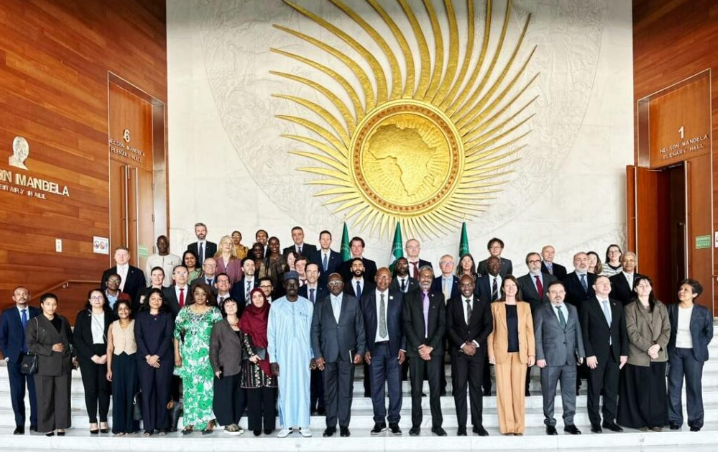
Addis Ababa, Ethiopia — November 2, 2026
The Economic Community of West African States (ECOWAS) has identified the insufficient ratification of the African Union Protocol on Free Movement of Persons as a significant obstacle to Africa’s efforts to achieve deeper continental integration.
The concern was highlighted following consultations held on October 30, 2026, in Addis Ababa, Ethiopia, where representatives of Africa’s Regional Economic Communities (RECs) met with diplomatic partners to review cooperation with the African Union and discuss challenges affecting the continent’s integration objectives.
According to information published by ECOWAS on November 2, the discussions underscored the importance of strengthening coordination between regional organizations and continental institutions.
The meeting was a consultation on existing integration challenges and did not constitute a new ratification of the protocol.
Free Movement Remains a Major Integration Challenge
The African Union’s Protocol on Free Movement of Persons, adopted in 2018, is intended to facilitate the movement of African citizens across national borders while supporting rights of residence and establishment under an agreed continental framework.
The agreement forms part of the African Union’s broader Agenda 2063 vision, which seeks to establish a more integrated, prosperous and interconnected Africa.
However, implementation has faced difficulties because the protocol has not received sufficient ratifications to enter into force.
Although African governments have repeatedly expressed support for continental integration, translating these commitments into binding legal frameworks remains a challenge.
The Addis Ababa consultation brought renewed attention to the difference between adopting continental policies and securing the national approvals necessary to implement them.
ECOWAS Experience Offers Lessons for Continental Integration
West Africa provides an important example of regional efforts to facilitate cross-border movement.
ECOWAS adopted its own Protocol on Free Movement of Persons, Residence and Establishment in 1979, creating a legal framework intended to allow citizens of member states to travel, reside and pursue economic opportunities throughout the community.
The regional framework has supported cross-border mobility, commercial activity and social connections among West African populations.
Nevertheless, practical challenges remain, including inconsistent border procedures, administrative restrictions, security concerns and differences in national implementation.
These experiences illustrate the difficulties associated with extending freedom-of-movement arrangements across the entire African continent.
Unlike ECOWAS, which developed its framework within a smaller regional grouping, the African Union must coordinate the policies and legal systems of 55 member states with different national priorities and administrative capacities.
Why Freedom of Movement Matters for African Economic Integration
Freedom of movement is closely connected to Africa’s ambitions for economic transformation.
The African Continental Free Trade Area (AfCFTA) seeks to expand trade, encourage industrial development and strengthen regional value chains by reducing barriers between African economies.
However, moving goods more efficiently across borders is only one component of economic integration.
Businesses also depend on the ability of workers, entrepreneurs, technicians, investors and service providers to travel between countries.
Greater mobility could support several important economic objectives:
- Regional trade: Easier business travel can help companies establish commercial relationships across borders.
- Employment opportunities: Workers may gain greater access to regional labor markets, subject to national laws.
- Industrial development: Manufacturers and service providers can benefit from improved access to specialized skills.
- Small business expansion: Entrepreneurs and informal traders may face fewer administrative barriers when entering neighboring markets.
- Regional cooperation: Greater mobility can strengthen educational, professional and cultural exchanges.
Without complementary arrangements governing the movement of people, the benefits of continental trade integration may be more difficult to realize fully.
Regional Economic Communities Remain Central to the AU’s Integration Strategy
The African Union recognizes eight Regional Economic Communities as building blocks of continental economic integration.
These organizations are:
- Economic Community of West African States (ECOWAS)
- East African Community (EAC)
- Southern African Development Community (SADC)
- Common Market for Eastern and Southern Africa (COMESA)
- Intergovernmental Authority on Development (IGAD)
- Economic Community of Central African States (ECCAS)
- Arab Maghreb Union (AMU)
- Community of Sahel–Saharan States (CEN-SAD)
Each organization operates within a different political, economic and institutional environment.
Some have developed relatively advanced arrangements for regional mobility, while others continue to face substantial implementation challenges.
The October 30 consultation provided an opportunity to review cooperation between these regional institutions, diplomatic partners and the African Union.
Greater coordination could help align regional mobility policies with continental objectives, although national governments retain responsibility for ratifying and implementing the relevant agreements.
The Challenge of National Sovereignty and Continental Ambition
The slow progress of the AU Free Movement Protocol reflects a broader issue confronting African integration: how to reconcile national sovereignty with shared continental objectives.
Governments must consider border security, migration management, employment regulations, identification systems and administrative capacity when evaluating freedom-of-movement commitments.
These concerns do not necessarily contradict the objectives of integration, but they can influence the pace and scope of implementation.
For the African Union, the challenge is developing frameworks that accommodate legitimate national responsibilities while enabling African citizens to benefit from closer economic and social cooperation.
The October 30 consultation highlighted this continuing tension without announcing a new legal breakthrough.
WDS Perspective: Integration Must Move Beyond Political Commitments
From the perspective of When the Dust Settles, the ECOWAS announcement illustrates one of the central challenges facing Africa’s integration experiment.
The African Union is attempting to coordinate 55 sovereign countries through common institutions, shared policies and continental development objectives.
The eight Regional Economic Communities are essential to that undertaking because they provide existing structures through which countries can test, negotiate and implement regional cooperation.
However, the existence of agreements does not automatically produce integration.
The AU Free Movement Protocol demonstrates the distinction between continental ambition and practical implementation.
Africa’s leaders have established a vision for a continent where people, goods, services and investment can move more freely. Achieving that vision requires national legislative action, administrative coordination and functioning border systems.
ECOWAS has accumulated decades of experience with regional mobility, but its experience also shows that legal commitments must be supported by consistent implementation.
The broader question is whether African governments can build on regional arrangements to establish a more coherent continental system.
Looking Ahead
The Addis Ababa meeting represents another step in institutional dialogue between the African Union, Regional Economic Communities and diplomatic partners.
Its significance will depend partly on whether subsequent consultations contribute to concrete action by national governments.
For the AU Free Movement Protocol, the immediate issue remains securing the ratifications necessary for entry into force.
Beyond ratification, governments would also need to develop effective implementation arrangements to translate the agreement into practical benefits for African citizens.
The central question for African integration is no longer simply whether governments support freedom of movement in principle, but whether they are prepared to establish the legal and institutional arrangements necessary to make it a continental reality.