
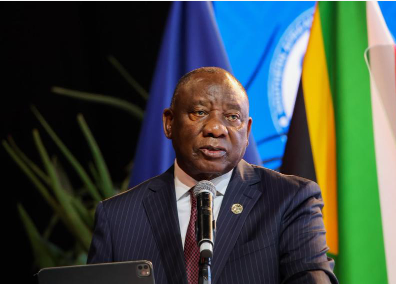
EL-ALAMEIN, Egypt — October 3, 2026 — South African President Cyril Ramaphosa is set to represent the Southern African Development Community (SADC) at the 8th African Union Mid-Year Coordination Meeting on Sunday, October 4, placing Southern Africa’s regional priorities at the center of discussions over how the African Union and its Regional Economic Communities can better coordinate the continent’s integration agenda.
Ramaphosa will participate in his capacity as Chairperson of SADC, a position South Africa assumed at the 46th SADC Summit in August. SADC has 16 member states, meaning Ramaphosa arrives at the continental meeting not simply as South Africa’s president but as the current political chair of one of Africa’s eight AU-recognized Regional Economic Communities.
The meeting in El-Alamein, Egypt, will bring together Heads of State and Government from the AU Bureau, chairpersons of the Regional Economic Communities and Regional Mechanisms, heads of AU organs and development partners including the United Nations Economic Commission for Africa and African Development Bank.
A Meeting About Who Implements Africa’s Integration Agenda
The Mid-Year Coordination Meeting occupies an important position in the architecture of African integration.
According to SADC, it serves as the principal platform for engagement between the African Union, the RECs and Regional Mechanisms, with a focus on institutional coordination, harmonizing policy implementation and advancing the objectives of the AU’s Agenda 2063.
That distinction is significant.
Many of Africa’s largest integration initiatives are agreed at the continental level, but their implementation depends heavily on cooperation among the AU, the RECs and individual member states.
The October 4 meeting will therefore assess progress in implementing the Division of Labour between the AU, RECs, Regional Mechanisms and member states. South Africa’s Presidency says the objective is to strengthen coordination, synergies and the principle of subsidiarity across the different levels of African governance.
For Ramaphosa, that means participating in discussions that address a fundamental question confronting African integration: How should responsibilities be divided between continental institutions, regional organizations and sovereign governments so that continental decisions translate into implementation?
SADC Brings a 16-Country Perspective
Ramaphosa’s participation also illustrates why the Regional Economic Communities are central to the AU’s integration model.
Rather than attempting to coordinate implementation separately with every African government on every issue, the AU recognizes eight RECs as important building blocks of continental integration.
SADC provides that regional framework for Southern Africa.
As SADC Chair, Ramaphosa will therefore bring the perspective of a regional organization whose members face shared challenges involving trade, industrialization, infrastructure, energy, water, transport and regional security.
SADC Executive Secretary Elias M. Magosi will also participate in the meeting alongside Ramaphosa, according to the regional organization.
AfCFTA, Infrastructure and Security on the Agenda
The discussions are expected to extend beyond institutional arrangements.
According to South Africa’s Presidency, leaders will evaluate progress in implementing the African Continental Free Trade Area (AfCFTA) and receive updates on efforts to accelerate infrastructure development related to water and sanitation.
They are also expected to consider African Union efforts to prevent and address conflicts, including measures to strengthen continental early-warning mechanisms.
The meeting will additionally review the role of the African Union Development Agency-NEPAD (AUDA-NEPAD) in accelerating regional and continental integration.
These discussions connect directly to the broader challenge of implementation.
An agreement such as the AfCFTA establishes a continental framework, but functioning continental trade ultimately depends on regional and national implementation involving customs systems, transport corridors, border procedures, payment systems, infrastructure and domestic regulations.
The same principle applies to infrastructure and security: continental strategies frequently require regional institutions and national governments to turn broad commitments into operational programs.
South Africa’s SADC Chairship Adds Another Dimension
Ramaphosa’s role at the meeting comes less than two months after South Africa assumed the SADC chairship.
When accepting the position in August, Ramaphosa emphasized deeper regional economic integration and industrialization as priorities for South Africa’s leadership of the organization.
That creates an important connection between SADC’s regional agenda and the continental discussions taking place in Egypt.
The challenge is not simply determining what Africa wants to achieve through Agenda 2063. Increasingly, the question is which institution is responsible for delivering each part of that agenda and how those institutions coordinate their work.
From Continental Decisions to Regional Implementation
Africa’s integration project involves an unusual institutional challenge: coordinating 55 AU member states, eight recognized Regional Economic Communities and numerous continental and regional institutions while preserving the sovereignty of individual countries.
The Mid-Year Coordination Meeting is one mechanism designed to manage that complexity.
For SADC, Ramaphosa’s participation means Southern Africa will have a direct voice in discussions over the relationship between continental policy and regional implementation.
The significance of Sunday’s meeting may therefore depend less on new declarations than on whether African institutions can improve the machinery required to carry out decisions that have already been made.
For the continent’s integration agenda, that distinction is critical.
The question increasingly facing the African Union and its Regional Economic Communities is not only what Africa has agreed to do — but how Africa turns those agreements into action.