
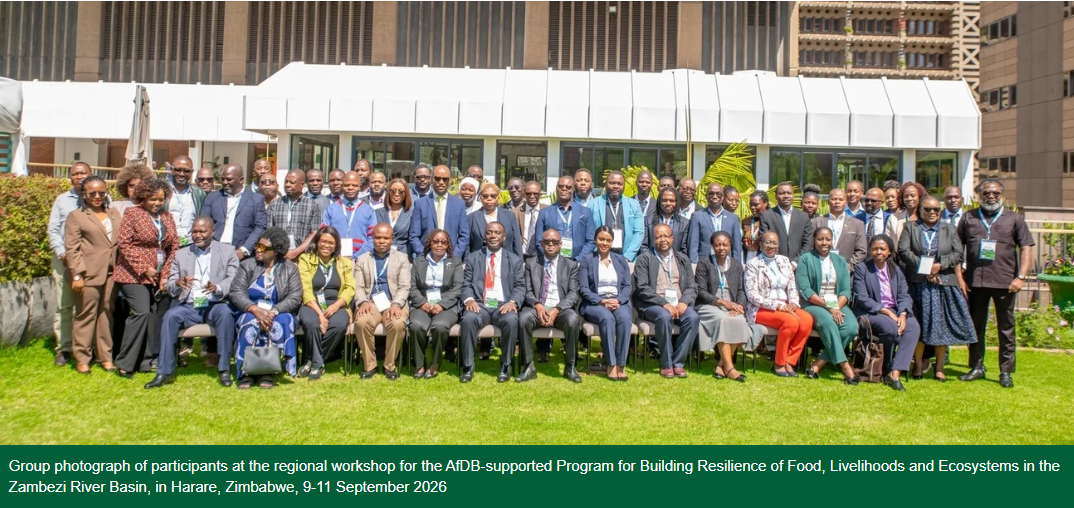
Eight countries sharing the Zambezi River Basin are moving toward a coordinated regional approach to climate resilience, agreeing on priorities for a proposed $130 million programme focused on strengthening food, water and energy security across one of Africa’s most important river systems.
The initiative, supported by the African Development Bank, highlights an increasingly important reality for African regional integration: some of the continent’s biggest development challenges cannot be effectively addressed by individual countries acting alone.
The Zambezi River crosses national boundaries, connects communities and economies, supports agriculture and hydropower generation, and provides water to millions of people across Southern Africa. Climate change, however, is placing increasing pressure on these interconnected systems.
The eight Zambezi Basin countries are Angola, Botswana, Malawi, Mozambique, Namibia, Tanzania, Zambia and Zimbabwe.
Their cooperation around the proposed climate-resilience programme reflects the transboundary nature of the challenges facing the basin.
Connecting Food, Water and Energy
Rather than treating agriculture, water management and electricity generation as separate issues, the programme is designed around the relationship between the three.
Water from the Zambezi Basin supports agricultural production and irrigation. The same river system also supports major hydropower facilities that contribute electricity to national and regional power systems.
When rainfall patterns change or prolonged drought reduces water levels, the consequences can therefore spread across several sectors simultaneously.
Farmers may have less water available for crops. Hydropower generation can decline. Governments can face greater pressure on electricity supplies, while communities already experiencing food insecurity can become even more vulnerable.
The proposed $130 million programme seeks to strengthen resilience across these interconnected systems rather than addressing each challenge independently.
Why Regional Cooperation Matters
The initiative also demonstrates why climate adaptation is becoming an important component of African regional integration.
A drought beginning in one part of a shared river basin can affect water availability hundreds of kilometers away. Decisions involving dams, irrigation, conservation and water withdrawals in one country can potentially influence conditions elsewhere in the basin.
National borders therefore cannot provide the primary framework for managing a shared river system.
Effective management requires countries to coordinate policies, exchange information, plan infrastructure and develop common approaches to protecting shared resources.
The Zambezi provides a practical example of what regional integration can mean beyond treaties, summits and declarations.
Integration can also mean governments jointly managing the physical systems their economies depend upon.
Energy Security Is Part of the Equation
The Zambezi Basin also has major significance for Southern Africa’s energy security.
Hydropower facilities connected to the river system contribute substantial electricity generation to the region. That makes changing rainfall patterns and water availability an economic issue as well as an environmental one.
Periods of severe drought can reduce reservoir levels and constrain electricity generation, potentially affecting households, businesses, mines, factories and other industries.
Strengthening the climate resilience of the basin can therefore contribute to a broader objective: creating more reliable regional economic infrastructure.
This connection between water and electricity also demonstrates why climate adaptation increasingly overlaps with Africa’s development and industrialization strategies.
Food Security Across Borders
Agriculture represents another critical component.
Millions of people throughout the wider Zambezi region depend directly or indirectly on agriculture for income and food. Climate shocks—including droughts, floods and increasingly unpredictable rainfall—can reduce agricultural production and disrupt rural livelihoods.
Coordinated investment in climate-resilient agriculture and water management could help countries improve their ability to respond to those shocks.
Regional cooperation may also make it easier for governments and institutions to coordinate early-warning systems, agricultural planning and responses to drought or flooding.
That becomes particularly important when several neighboring countries experience climate pressures simultaneously.
From National Climate Policy to Regional Climate Resilience
The African Development Bank-backed initiative points toward a broader shift in how climate adaptation can be approached across Africa.
Climate change is frequently discussed through national commitments and national adaptation plans. But many of Africa’s most important natural systems are regional.
River basins cross borders. Electricity grids increasingly connect neighboring countries. Agricultural markets depend on regional transport corridors. Drought and flooding can affect several countries simultaneously.
This means climate resilience increasingly requires institutions capable of coordinating across borders.
The Zambezi Basin offers a clear example.
Angola, Botswana, Malawi, Mozambique, Namibia, Tanzania, Zambia and Zimbabwe have different national priorities and economic circumstances, but they share an environmental system whose future affects them collectively.
A Practical Test of Regional Integration
The proposed $130 million programme should therefore be viewed as more than a climate project.
It is also a test of whether regional cooperation can produce coordinated action around shared African resources.
If countries can jointly strengthen water management, food systems and energy resilience across the Zambezi Basin, the approach could provide useful lessons for other transboundary river systems across the continent.
Africa’s integration agenda is often measured through trade agreements, free-movement protocols and regional institutions.
But climate change is creating another measure of integration: whether neighboring countries can jointly manage the resources and infrastructure upon which their populations depend.
The Zambezi River does not stop when it reaches a national border.
Neither does drought.
Neither does flooding.
And neither do the economic consequences when water, food and energy systems come under pressure.
The cooperation among the eight Zambezi Basin countries therefore represents an important example of why Africa’s climate response may increasingly have to become a regional response.
For the Zambezi Basin, the question is no longer simply how each country adapts individually.
It is how eight countries sharing one vital river system can build resilience together.