
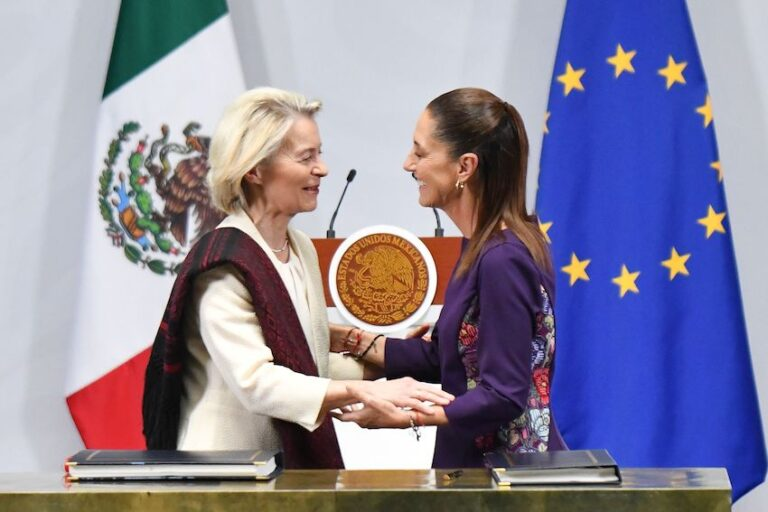
Mexico and the European Union have formally signed a long-awaited modernized free trade agreement, updating a framework that has been in place since 2000, in a move aimed at strengthening economic ties and reducing reliance on the United States.
The agreement was concluded at a high-level summit involving Mexican leadership and top EU officials. It expands the scope of the existing trade relationship beyond goods to include services, digital trade, investment flows, and government procurement, while also easing tariff barriers on a wide range of agricultural and industrial products.
Officials from both sides framed the deal as a strategic effort to diversify trade partnerships at a time of heightened global economic uncertainty and renewed protectionist policies from Washington. The agreement is widely viewed as part of a broader shift in global trade alignment, as major economies seek to hedge against U.S. tariff policy under President Donald Trump.
Mexico, which conducts the majority of its trade with the United States, has faced ongoing pressure from tariffs affecting key exports such as automobiles, steel, and agricultural goods. The European Union has also confronted elevated duties and trade friction with Washington, prompting renewed urgency to secure alternative trade channels.
European Commission officials said the deal is expected to significantly increase bilateral trade volumes over the coming years, with projections suggesting strong export growth on both sides. Mexico anticipates a major expansion of its exports to Europe by 2030, while EU exporters are expected to benefit from improved market access in Latin America’s second-largest economy.
The agreement still requires ratification by the European Parliament before it can fully enter into force.
Economists say the pact reflects a broader global trend of “de-risking” trade exposure from dominant economic powers, particularly the United States, as geopolitical competition reshapes international commerce.