
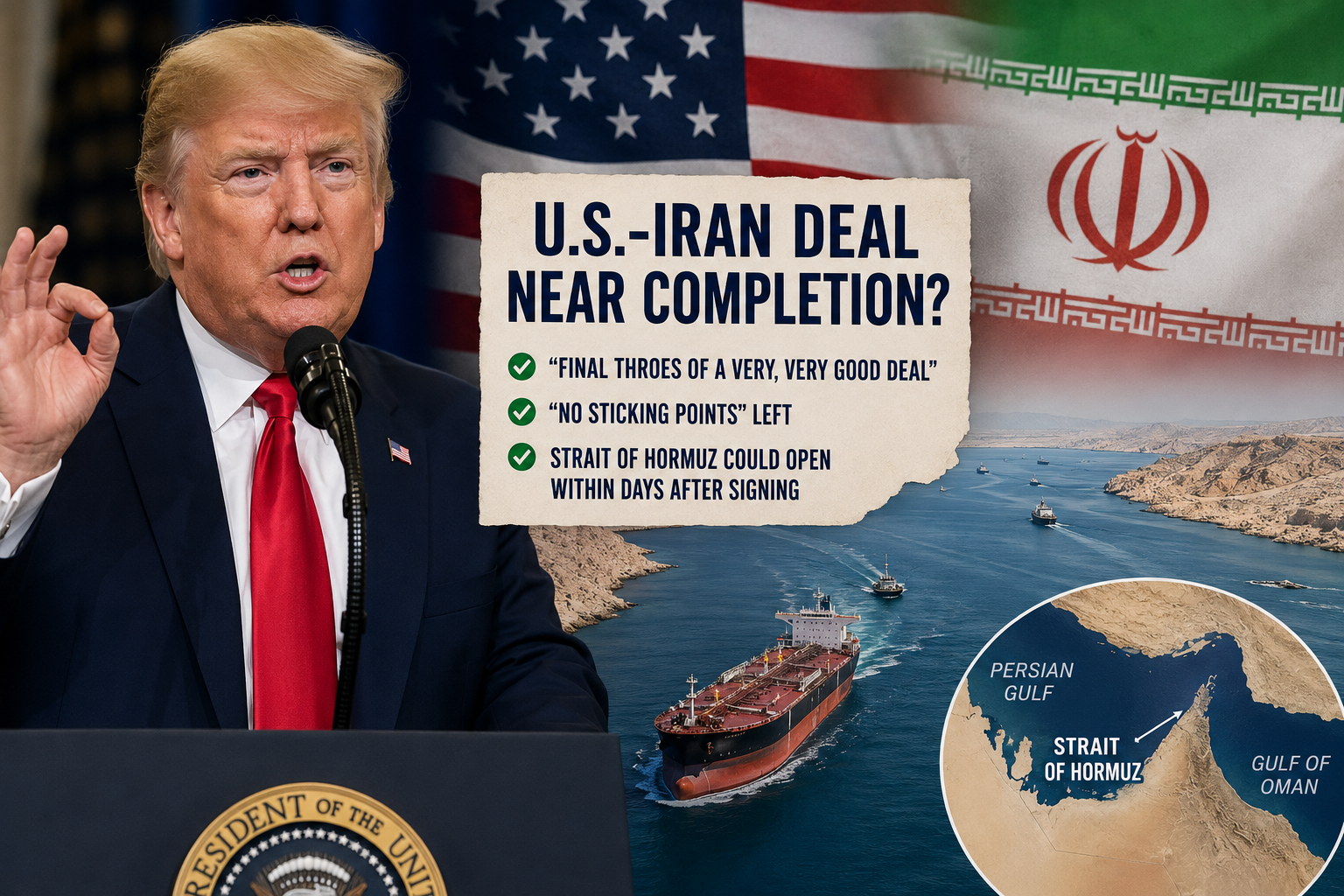
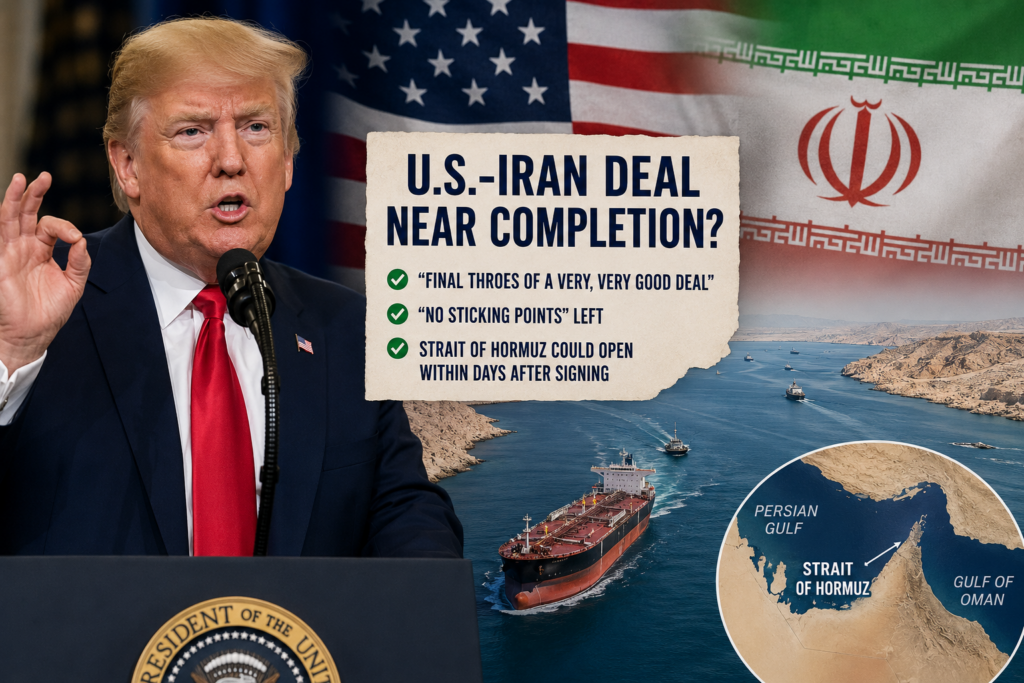
WASHINGTON, D.C. — President Donald Trump said Tuesday that the United States and Iran are nearing the completion of a major agreement that could lead to the reopening of the strategically critical Strait of Hormuz within days.
Speaking to reporters, Trump expressed confidence that negotiators had overcome the remaining obstacles in the talks.
“We’re in the final throes of what will be a very, very good deal,” the president said, adding that there were “no sticking points” left to resolve.
Trump indicated that if the agreement is finalized, the Strait of Hormuz — one of the world’s most important maritime energy corridors — could reopen fully within “two or three days.”
The narrow waterway, which connects the Persian Gulf to the Gulf of Oman and the Arabian Sea, is a vital artery for global energy supplies. Roughly one-fifth of the world’s oil consumption typically passes through the strait, making any disruption a major concern for international markets.
The president’s remarks come amid months of heightened tensions involving the United States, Iran, and regional actors. Efforts to secure a diplomatic settlement have intensified following repeated disruptions to shipping traffic and broader instability across the Middle East.
Despite Trump’s optimistic assessment, there has been no official announcement confirming that a final agreement has been signed. Iranian officials have yet to publicly endorse the president’s timeline or confirm that negotiations have reached their conclusion.
Analysts caution that diplomatic negotiations involving sanctions relief, security guarantees, and nuclear-related issues often remain vulnerable to last-minute complications, even when leaders publicly project confidence.
Nevertheless, Trump’s comments fueled hopes that a breakthrough may be imminent. Financial markets and energy traders are closely monitoring developments, as a reopening of the Strait of Hormuz could ease concerns over global oil supplies and reduce upward pressure on energy prices.
If an agreement is ultimately reached, it could represent one of the most significant diplomatic developments in the Middle East in recent years, with implications extending far beyond the region’s borders.
For now, however, the prospect of a deal remains just that: a prospect. The final outcome will depend not on public statements, but on whether negotiators can transform apparent momentum into a formally ratified agreement.