
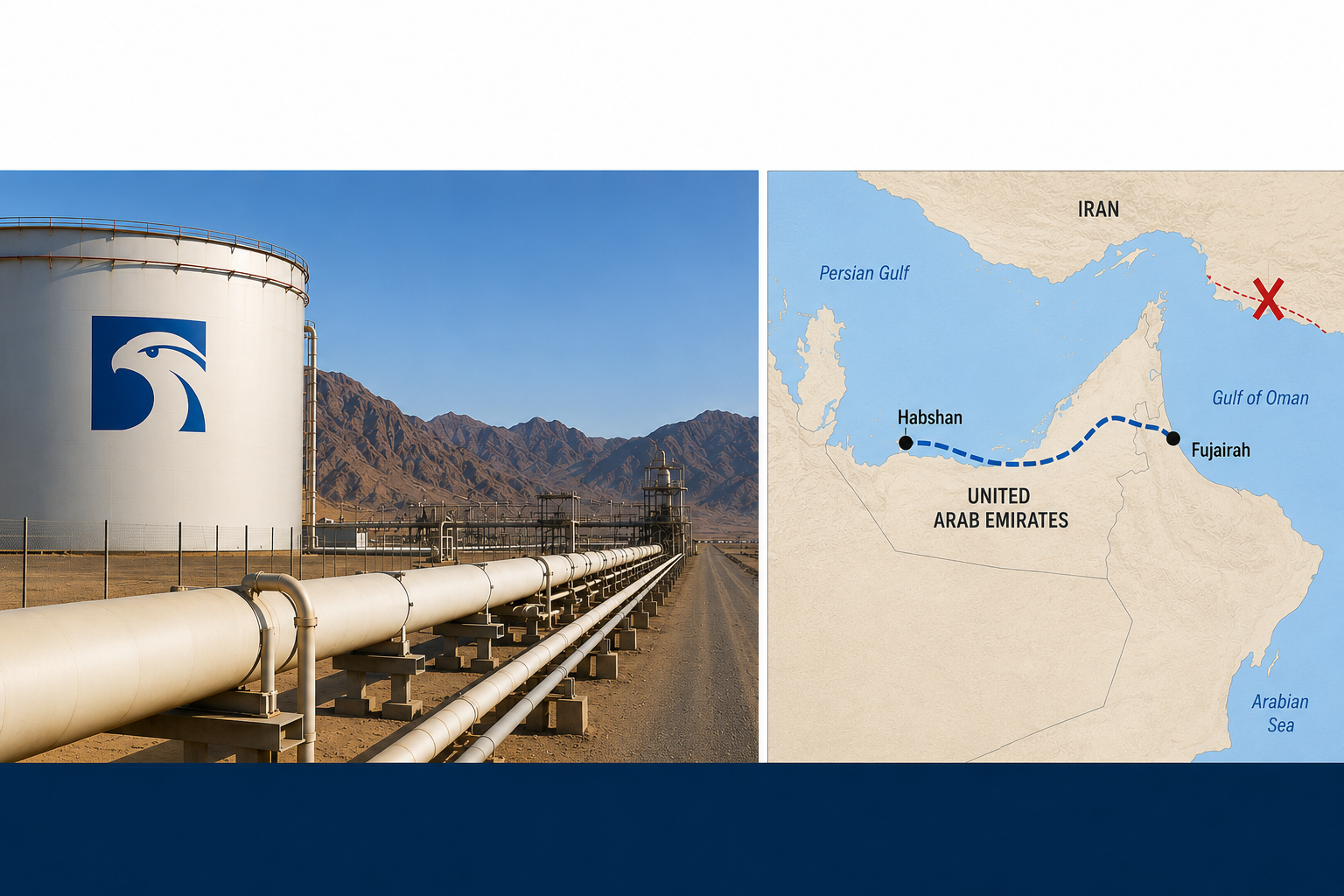
DUBAI, United Arab Emirates — The United Arab Emirates is accelerating construction of a major oil pipeline expansion designed to bypass the strategically vital Strait of Hormuz, with officials targeting completion by 2027 in a move that could reshape energy flows across the Middle East.
The project, overseen by the Abu Dhabi National Oil Company (ADNOC), will expand the country’s existing export infrastructure linking Abu Dhabi’s oil fields to the eastern emirate of Fujairah on the Gulf of Oman. Once operational, the upgraded system is expected to double the UAE’s ability to export crude oil without relying on the narrow maritime chokepoint through which a significant share of the world’s energy supplies normally passes.
ADNOC Chief Executive Sultan Ahmed Al Jaber recently disclosed that the project is already about 50 percent complete and that work is being accelerated to meet the 2027 target date.
The expansion comes amid heightened concerns over the vulnerability of the Strait of Hormuz, one of the world’s most important energy transit routes. Roughly one-fifth of global oil consumption has historically moved through the waterway connecting the Persian Gulf to the Gulf of Oman and the Arabian Sea. Regional instability and repeated disruptions to shipping have renewed interest among Gulf producers in developing alternative export routes.
Unlike some neighboring countries that remain heavily dependent on the strait, the UAE has operated the Habshan–Fujairah pipeline since 2012. The current line allows crude oil to be transported directly from inland production facilities to Fujairah, avoiding the need for tankers to sail through Hormuz. The new expansion is expected to significantly increase that capacity and strengthen the country’s energy security.
Analysts say the project could enhance the UAE’s position as a reliable supplier to international markets, particularly in Asia, while reducing the geopolitical risks associated with maritime bottlenecks in the Gulf.
The pipeline expansion also reflects a broader regional trend. Gulf energy producers have increasingly explored infrastructure projects aimed at diversifying export routes and minimizing exposure to disruptions in the Strait of Hormuz.
If completed on schedule, the enhanced pipeline network could become one of the most strategically important pieces of energy infrastructure in the Middle East, reinforcing the UAE’s role as a key player in global oil markets while providing a critical alternative to one of the world’s most sensitive shipping corridors.