
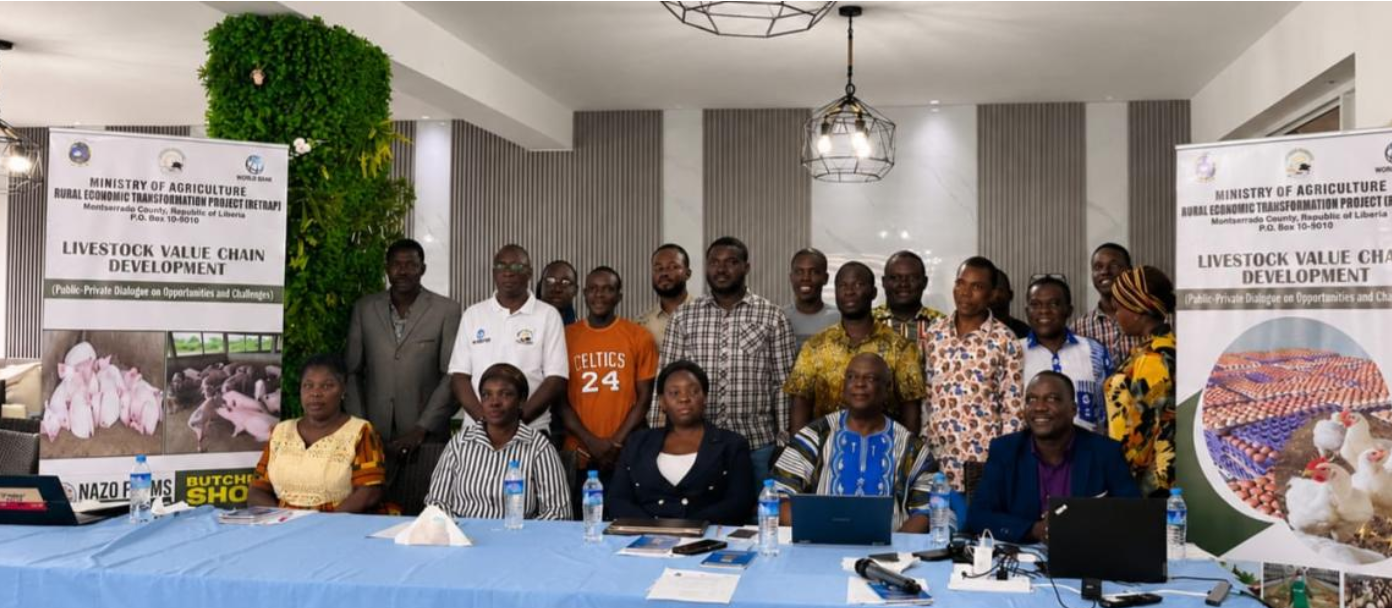
MONROVIA, Liberia — August 8, 2026 — The Government of Liberia is stepping up efforts to expand domestic poultry and livestock production, bringing together farmers, businesses, financial institutions, and development partners to identify solutions to some of the biggest challenges facing the country’s agricultural sector.
The Ministry of Agriculture, through its Rural Economic Transformation Project (RETRAP), launched a week-long Public-Private Dialogue focused particularly on strengthening Liberia’s poultry and piggery value chains. The initiative is intended to develop a shared roadmap for increasing production, improving access to markets, and attracting greater private investment into the livestock industry.
Farmers, Businesses and Government at the Same Table
The first phase of the dialogue brought together more than 30 participants representing Montserrado, Margibi, Bomi, Grand Cape Mount and Gbarpolu counties. A second session is expected to include stakeholders from Bong, Nimba, Lofa and Grand Gedeh counties.
Participants include farmers, agribusinesses, processors, marketers, small and medium-sized enterprises, financial institutions, government agencies and development partners.
Rather than simply discussing the problems facing farmers, the Ministry says participants are expected to develop policy briefs, recommendations and action plans that can guide future government and private-sector interventions.
The dialogue will also examine ways of improving market connections between farmers and buyers, increasing investment opportunities and making Liberia’s poultry and piggery industries more competitive.
Major Challenges Still Confront Farmers
Liberian poultry and livestock producers continue to face several obstacles that limit their ability to expand production.
Among the challenges identified by the government are limited access to financing, inadequate veterinary services, difficulties obtaining quality animal feed and unreliable access to markets.
Addressing these problems could be critical if Liberia hopes to build a livestock industry capable of competing with imported products.
RETRAP Program Officer James T. Moore said the government sees livestock production as having the potential to become an important contributor to food security, employment and economic development.
The government believes stronger cooperation between farmers, businesses, financial institutions and public agencies could help create an agricultural system in which producers have better access to financing, technical support and reliable markets.
Reducing Liberia’s Dependence on Imported Food
The initiative also connects to a larger economic challenge facing Liberia: increasing the amount of food produced domestically.
Expanding poultry and livestock production could allow more of the money Liberians spend on food to circulate within the domestic economy instead of supporting production abroad.
A stronger poultry industry, for example, creates economic activity beyond the poultry farm itself. Farmers need feed, veterinary services, transportation, equipment, processing, refrigeration, packaging and distribution.
That means agricultural expansion has the potential to support businesses and employment across a much wider supply chain.
The same applies to piggery and other livestock production.
For rural communities in particular, expanding these industries could provide additional income opportunities while helping establish more commercially sustainable farming operations.
Government Pursuing Broader Agricultural Expansion
The poultry and piggery dialogue is part of a broader government effort to strengthen domestic agriculture.
The Ministry of Agriculture recently announced the arrival of 200 Muturu cattle from Guinea and Mali as part of efforts to revitalize Liberia’s livestock sector and increase national food production. The government has also been pursuing initiatives involving commercial pepper production, coffee development and support for smallholder farmers.
These programs fall within the government’s Liberians Feed Yourselves Agenda, which seeks to increase domestic food production and reduce the country’s dependence on imports.
From Dialogue to Production
The larger question will be whether the discussions produce measurable changes for farmers.
Participants are expected to establish regional working groups and mechanisms for monitoring implementation of agreed actions. Investment roundtables and the sharing of successful farming models are also included in the dialogue.
For Liberia, the opportunity extends beyond simply producing more chickens or livestock.
If domestic production expands successfully, the country could strengthen food security, create jobs for young people, generate opportunities for rural entrepreneurs and retain more agricultural spending within the Liberian economy.
But achieving those results will require turning the recommendations coming from the public-private dialogue into financing, infrastructure, veterinary support, reliable markets and practical assistance that reaches farmers.
The success of the initiative, therefore, may ultimately be measured not by how many meetings are held, but by whether Liberian farmers are able to produce more food—and whether Liberian consumers increasingly find locally produced poultry and livestock products in their markets.
Official sources: Liberia Ministry of Agriculture | Liberia Ministry of Information