
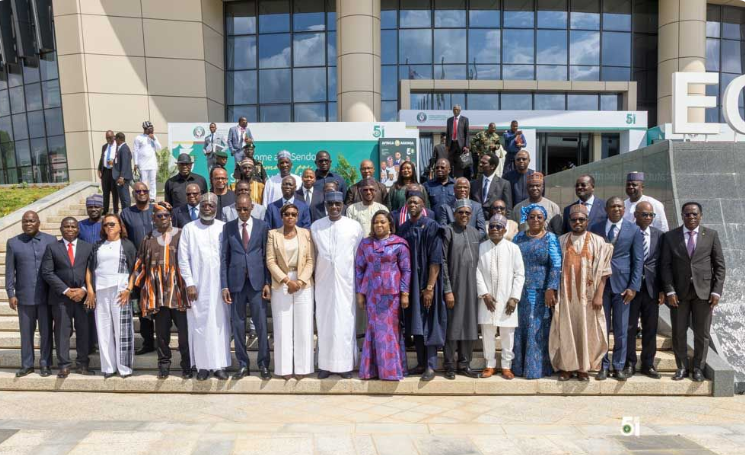
ABUJA, Nigeria — September 1, 2026 — A new chapter begins at the Economic Community of West African States as General Birame Diop of Senegal officially assumes office today as President of the ECOWAS Commission, taking charge at a particularly challenging moment for West African regional integration.
Diop was appointed during the July 19 ECOWAS Summit, with his term scheduled to begin September 1. ECOWAS marked the leadership transition on August 31 with a formal welcoming and farewell ceremony for incoming and outgoing statutory appointees.
His arrival places him at the center of several major challenges confronting the regional organization.
Among the most pressing are terrorism and violent extremism, regional security, economic integration, institutional credibility, and ECOWAS’s evolving relationship with Burkina Faso, Mali and Niger, the three members of the Alliance of Sahel States, or AES, that formally withdrew from ECOWAS in January 2025.
A New Leadership Era After the AES Split
The relationship between ECOWAS and the AES could become one of the defining issues of Diop’s presidency.
Although Burkina Faso, Mali and Niger are no longer ECOWAS members, geography and regional economic ties mean the two blocs continue to share important interests involving trade, transportation, migration, infrastructure and security.
Diop’s military and security background could also draw particular attention as ECOWAS confronts terrorism and instability across parts of West Africa.
But security will not be his only challenge.
ECOWAS is also attempting to strengthen economic integration through Vision 2050, improve regional agricultural and food systems, expand intra-African trade through the African Continental Free Trade Area, and make regional integration more relevant to ordinary West African citizens.
The Commission’s new leadership will therefore have to balance immediate security concerns with ECOWAS’s longer-term economic and political integration agenda.
The Future of ECOWAS
Diop takes office more than five decades after ECOWAS was established in 1975 and at a time when the organization is being forced to reconsider what regional integration should look like following the departure of three member states.
The central question facing the new Commission may therefore extend beyond managing individual crises.
It is whether ECOWAS can rebuild confidence in regional institutions, demonstrate tangible benefits of membership and create a stronger sense of shared West African interests.
For General Birame Diop, September 1 marks more than the beginning of a new term.
It places him at the head of ECOWAS during what could become a consequential period in determining the future direction of West African integration.