
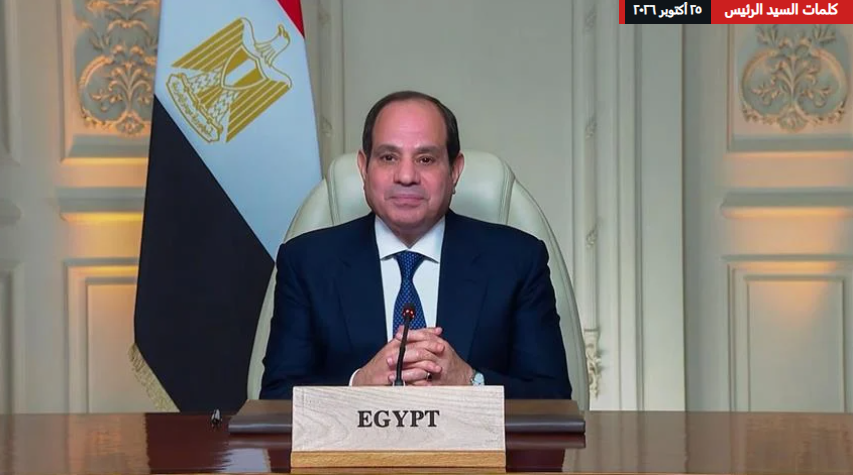
CAIRO, EGYPT — Egyptian President Abdel Fattah el-Sisi has called for stronger cooperation among Nile Basin countries, emphasizing the importance of water security, international law, and coordinated development during his opening address at the ninth Cairo Water Week.
The president highlighted Egypt’s dependence on the Nile River, describing water security as a fundamental national priority while urging countries sharing the river basin to pursue development through consultation and cooperation.
His remarks focused particularly on relations among Egypt, Sudan and Ethiopia, three countries whose economic development and water-management priorities are closely connected through the Nile River system.
Balancing National Development and Regional Water Security
El-Sisi emphasized that Nile Basin countries should be able to pursue economic development without undermining the water security of neighboring states.
The issue remains particularly important because the Nile supports agricultural production, electricity generation, industrial activity and food security across northeastern Africa.
For Egypt, the river represents an essential source of freshwater. Ethiopia views the Nile’s hydropower potential as an important component of its electricity and economic development strategy, while Sudan has significant agricultural and water-management interests.
These competing priorities demonstrate the challenges of managing shared natural resources across sovereign national boundaries.
Water Cooperation and African Regional Integration
Beyond national water security, the president’s remarks raise broader questions about regional economic cooperation.
The Nile Basin connects countries with different development priorities, economic structures and infrastructure requirements. Decisions affecting upstream water resources can have consequences for downstream agricultural production, electricity systems and long-term economic planning.
Regional institutions, including the Nile Basin Initiative and the African Union, provide important frameworks for dialogue and cooperation on transboundary development challenges.
However, the effectiveness of these arrangements depends on sustained consultation, technical cooperation and agreements that participating governments can implement.
Why This Matters for Africa
Water security is increasingly connected to Africa’s wider development and regional integration objectives.
Reliable water supplies are essential for agricultural productivity, industrial expansion, energy generation and economic stability.
Disagreements over shared water resources can complicate cross-border cooperation, while effective water-management arrangements can create opportunities for coordinated infrastructure development and regional investment.
The Nile Basin therefore represents an important test of whether African governments can reconcile national sovereignty with the practical requirements of regional cooperation.
WDS Perspective: A Test of Africa’s Integration Experiment
For When the Dust Settles (WDS), the central issue extends beyond relations among Egypt, Sudan and Ethiopia.
Africa is undertaking an unprecedented continental integration experiment, seeking to bring together 55 sovereign nations with different economic interests, political systems and development priorities.
The Nile Basin illustrates one of the fundamental challenges of that undertaking: how countries can protect their national interests while cooperating over resources that cross international borders.
The question is not simply whether governments recognize the importance of cooperation, but whether regional institutions can help translate that recognition into practical, lasting arrangements.
The larger question remains: Can African countries develop shared approaches to managing essential natural resources while preserving national sovereignty and advancing regional economic integration?
That question will remain central to the future of Nile Basin cooperation and Africa’s broader integration agenda.