
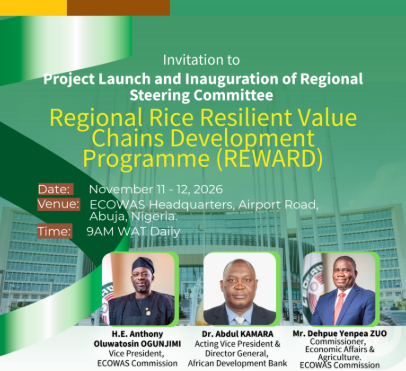
ABUJA, Nigeria — The Economic Community of West African States (ECOWAS), with support from the African Development Bank (AfDB), has announced the planned launch of a major regional agricultural initiative designed to strengthen rice production, expand processing capacity, and improve food security across West Africa.
The approximately $650 million Regional Rice Resilient Value Chains Development Programme (REWARD) was scheduled for launch on November 11, 2026, in Abuja, Nigeria.
The programme represents an ambitious effort to address one of West Africa’s persistent agricultural challenges: increasing domestic rice production while developing the infrastructure, financing, and regional supply chains needed to reduce dependence on imported rice.
The initiative is intended to benefit ECOWAS member countries and countries belonging to the Alliance of Sahel States (AES), highlighting the importance of agricultural cooperation across West Africa despite evolving political and institutional relationships.
Strengthening West Africa’s Rice Production
Rice is a major staple food throughout West Africa, consumed by millions of households and supporting livelihoods across agricultural communities.
Although the region possesses significant agricultural resources, domestic rice production faces challenges involving irrigation, mechanization, storage facilities, access to financing, and processing infrastructure.
These limitations can affect agricultural productivity and leave regional markets exposed to fluctuations in international food prices.
The REWARD programme aims to address these structural weaknesses by strengthening the rice value chain, from cultivation and harvesting to processing, distribution, and market access.
Rather than concentrating exclusively on increasing agricultural output, the initiative seeks to develop a more integrated rice industry capable of supporting farmers, processors, transport operators, and agricultural businesses.
A stronger regional rice industry could also create employment opportunities, particularly for young people and women participating in agricultural production and related enterprises.
However, the scale of these benefits will depend on the programme’s implementation, financing arrangements, and participating countries’ ability to develop the necessary infrastructure.
A $650 Million Investment in Agricultural Development
The programme’s approximately $650 million financial scale signals the importance ECOWAS and its development partners place on agricultural transformation.
Support from the African Development Bank connects the initiative to broader continental efforts to improve food security, expand agricultural productivity, and strengthen African agricultural markets.
The programme is intended to support improvements across several interconnected areas, including agricultural production, processing capacity, resilient value chains, and regional food distribution.
Investment in these areas could help address obstacles that prevent locally produced rice from competing effectively in regional markets.
For example, increased production alone may not deliver lasting food security if farmers lack reliable transportation, adequate storage, efficient processing facilities, or access to buyers.
Developing the entire value chain could allow more agricultural value to remain within West African economies.
The announced $650 million programme value should not be interpreted as confirmation that all financing has been disbursed or that implementation activities have begun. Those outcomes require separate verification.
Agricultural Cooperation Between ECOWAS and the Sahel
One of the programme’s most significant regional dimensions is its intended inclusion of countries belonging to both ECOWAS and the Alliance of Sahel States.
Burkina Faso, Mali, and Niger formally withdrew from ECOWAS in January 2025 and have pursued closer cooperation through the AES.
Despite this institutional separation, the countries remain geographically and economically interconnected with their West African neighbors.
Agricultural trade, transportation networks, food distribution, and cross-border markets continue to connect communities throughout the region.
The inclusion of AES countries in the intended programme coverage illustrates how agricultural development can create opportunities for practical regional cooperation even when political relationships are complicated.
Food security challenges do not stop at national borders.
Drought, flooding, rising transportation costs, and disruptions to agricultural markets can affect several countries simultaneously.
Coordinated agricultural investment may therefore provide benefits that individual national programmes would struggle to achieve independently.
The precise participation arrangements for AES countries, however, will depend on the programme’s approved operational framework.
Reducing Dependence on Imported Rice
For decades, West African governments have sought to expand domestic rice production and reduce vulnerability to international food markets.
Imported rice remains an important component of food supplies in several countries, creating exposure to changes in global prices, shipping costs, exchange rates, and international supply chains.
The REWARD programme is designed to help strengthen the region’s capacity to produce and process more of the rice consumed within its own markets.
Achieving this objective will require more than expanding cultivated land.
Farmers need access to improved agricultural inputs, reliable water supplies, modern equipment, and affordable financing.
Processing businesses require dependable electricity, efficient machinery, quality-control systems, and transportation networks capable of moving agricultural products between production areas and consumer markets.
Regional coordination could also help improve the movement of rice across borders, particularly where production surpluses in one country could support demand in another.
These improvements would contribute to the broader objective of developing a more resilient and competitive West African agricultural economy.
Connecting Rice Production to African Economic Integration
The programme also has implications beyond agriculture.
Regional food value chains are an important component of Africa’s economic integration agenda, including the African Continental Free Trade Area (AfCFTA) and the African Union’s Agenda 2063.
A more productive West African rice industry could support regional commerce by connecting farmers, processors, financial institutions, logistics providers, and consumers across national borders.
Such connections can encourage investment in agricultural infrastructure and help establish more reliable regional supply networks.
However, stronger production capacity will need to be accompanied by progress on trade facilitation, transportation infrastructure, product standards, and market access.
Without these complementary improvements, agricultural producers may continue facing difficulties selling their products beyond local markets.
The REWARD programme therefore presents an opportunity to examine whether regional agricultural financing can translate into measurable economic integration.
From Programme Announcement to Implementation
The planned Abuja launch represents an important institutional milestone, but the success of REWARD will ultimately be determined by its implementation.
Important questions remain concerning how financing will be distributed, which projects will receive priority, how participating countries will coordinate activities, and what measurable outcomes the programme is expected to deliver.
Progress will need to be assessed through indicators such as increased rice production, improved processing capacity, reduced post-harvest losses, stronger regional trade, and improved access to affordable food.
As of this report, the information provided establishes that the programme was scheduled for launch on November 11, not that the launch ceremony has been completed or that funding has been released.
Further official announcements will be needed to confirm those developments.
Why This Matters for Africa’s Regional Integration
For ECOWAS and the African Development Bank, REWARD represents an opportunity to connect agricultural development with regional economic cooperation.
For farmers and agricultural businesses, it could create opportunities to expand production, improve market access, and participate in stronger regional supply chains.
For governments, it offers a potential pathway toward reducing food-import vulnerability while supporting employment, rural development, and economic resilience.
And for West Africa’s wider integration agenda, the programme raises an important question:
Can a $650 million regional agricultural investment help transform West Africa from a collection of largely separate rice markets into a more connected, productive, and food-secure regional economy?
The answer will depend not simply on the programme’s financial commitments, but on whether participating countries can turn those commitments into functioning agricultural infrastructure, competitive industries, and measurable improvements in food security.
For now, REWARD stands as an ambitious proposed step toward a more resilient West African food system.