
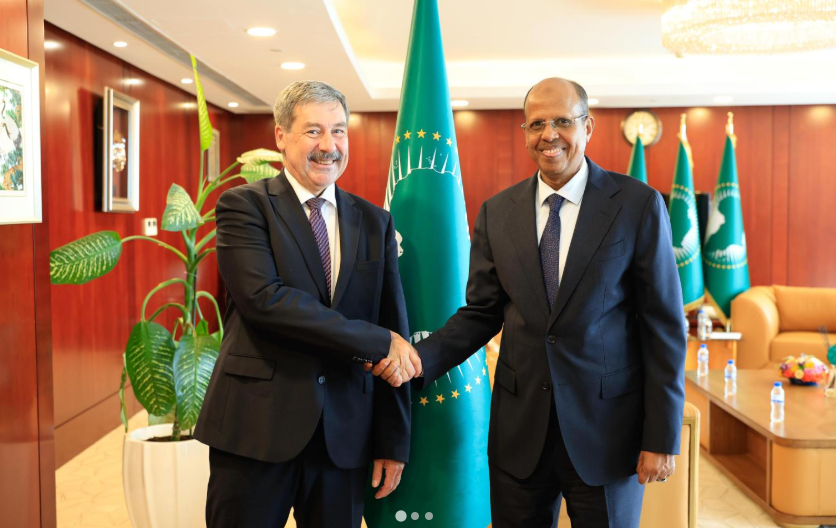
ADDIS ABABA, ETHIOPIA — African Union Commission Chairperson Mahmoud Ali Youssouf has held discussions with Organisation for Economic Co-operation and Development (OECD) Deputy Secretary-General František Ružička aimed at strengthening economic cooperation and advancing Africa’s industrial development agenda.
The meeting focused on establishing a more structured partnership between the African Union and the OECD, with particular attention to investment mobilization, industrialization, trade facilitation, digital transformation, and reforms to international economic governance.
Central to the discussions was Africa’s longstanding challenge of exporting raw materials while capturing a limited share of the economic value generated through processing, manufacturing, and the production of finished goods.
Chairperson Youssouf emphasized the importance of African countries moving beyond dependence on raw-material exports and developing stronger domestic industries capable of generating employment, increasing export revenues, and supporting sustainable economic growth.
The two institutions also discussed finalizing a memorandum of understanding that would identify implementation priorities and establish timelines for future cooperation.
Although the discussions signal growing institutional engagement, a finalized agreement and specific financial commitments have not yet been announced.
Africa Seeks to Move Beyond Raw-Material Exports
Africa possesses substantial natural resources, including minerals critical to energy technologies, agricultural commodities, and raw materials used in global manufacturing.
However, many African economies continue to face structural challenges associated with exporting commodities that undergo further processing and manufacturing outside the continent.
This economic pattern can limit opportunities for industrial employment, technology development, and domestic value creation.
For example, African countries producing minerals used in batteries and renewable-energy technologies may receive greater economic benefits by developing domestic refining, component manufacturing, and related industrial activities.
Similarly, agricultural producers could potentially increase export earnings by expanding food processing, packaging, and manufacturing operations within their own economies.
The African Union’s emphasis on value addition reflects a broader effort to transform Africa’s position in international supply chains.
Rather than participating primarily as suppliers of raw materials, African governments are seeking to build competitive industries capable of producing higher-value goods for domestic, regional, and international markets.
Achieving this transformation will require reliable electricity, transportation infrastructure, access to affordable financing, skilled workers, and industrial policies that encourage long-term investment.
Investment Mobilization Becomes a Central Priority
One of the principal areas identified for cooperation between the African Union and OECD is investment mobilization.
Industrial development requires substantial capital to establish factories, modernize transportation networks, expand energy infrastructure, and support emerging industries.
Many African countries face challenges attracting long-term investment because of financing costs, infrastructure limitations, regulatory uncertainty, and perceived investment risks.
A stronger AU–OECD partnership could create opportunities for policy cooperation aimed at improving investment conditions and supporting industrial development strategies.
The OECD’s experience in investment policy, economic research, governance standards, and international economic cooperation could contribute technical expertise to these efforts.
However, policy cooperation should not be confused with a direct financial commitment.
At this stage, the proposed partnership has not established specific investment amounts, financing mechanisms, or confirmed industrial projects.
The effectiveness of any future agreement will depend on whether institutional cooperation translates into practical initiatives that help African economies attract productive investment.
Trade Facilitation and the African Continental Free Trade Area
Trade facilitation was another major priority identified during the discussions.
This issue is particularly important as African countries continue efforts to implement the African Continental Free Trade Area (AfCFTA).
The AfCFTA seeks to expand trade among African economies by reducing trade barriers, improving market access, and encouraging the development of regional value chains.
However, industrialization and continental trade integration are closely connected.
African manufacturers need access to raw materials, intermediate goods, transportation networks, and consumer markets across national borders.
A factory producing processed agricultural goods, for example, may depend on packaging materials from one African country, machinery components from another, and distribution networks extending across several regional markets.
Efficient customs procedures, compatible product standards, and reliable transportation corridors could make these production networks more competitive.
Cooperation between the AU and OECD could support policy analysis and institutional coordination related to these challenges.
Nevertheless, meaningful progress will depend primarily on African governments implementing trade reforms, improving infrastructure, and addressing administrative obstacles that continue to restrict cross-border commerce.
Digital Transformation and Industrial Competitiveness
Digital transformation also featured among the priorities discussed by the two institutions.
Digital technologies increasingly influence manufacturing, logistics, financial services, customs administration, and international trade.
For African economies seeking to expand industrial production, improvements in digital infrastructure could help businesses reduce operating costs, increase productivity, and connect with regional and international markets.
Digital customs systems, electronic trade documentation, and modern payment platforms could also help facilitate cross-border commercial activity.
However, the benefits of digital transformation are not automatic.
Many African countries continue to face challenges involving broadband connectivity, electricity reliability, digital skills, cybersecurity, and access to affordable technology.
A future AU–OECD cooperation framework could potentially support policy development and knowledge sharing in these areas.
The challenge will be ensuring that digital transformation contributes to productive economic activity rather than becoming an isolated technology initiative disconnected from industrial development.
Reforming International Economic Governance
The discussions also addressed reforms to international economic governance, an issue of growing importance within the African Union’s engagement with global institutions.
African governments have repeatedly emphasized the need for stronger representation in international economic decision-making and more equitable access to development financing.
Questions concerning international lending arrangements, sovereign debt, investment standards, and global economic governance directly influence the continent’s development opportunities.
For many African economies, high borrowing costs and limited fiscal resources can restrict investment in infrastructure and industrial development.
Greater cooperation with the OECD could provide another channel for dialogue on economic policies and international governance reforms.
However, the African Union and OECD have different institutional structures and mandates.
The African Union represents its member states’ continental priorities, while the OECD primarily provides economic analysis, policy standards, and a forum for cooperation among its members and partners.
A successful partnership would therefore require clearly defined objectives that respect African development priorities while identifying areas where OECD expertise can provide practical support.
What the Proposed Memorandum of Understanding Could Deliver
The planned memorandum of understanding represents an important potential next step in formalizing cooperation between the two institutions.
According to the information released about the discussions, the proposed agreement would identify implementation priorities and timelines.
Such a framework could help move cooperation beyond general policy discussions toward more structured activities.
Possible areas of cooperation include investment-policy support, industrial-development research, trade-facilitation initiatives, and technical exchanges on digital transformation.
However, these possibilities should not be interpreted as approved projects or confirmed commitments.
The actual scope of cooperation will become clearer once the memorandum is finalized and its implementation arrangements are publicly established.
Important questions remain concerning which institutions will be responsible for delivering activities, how progress will be measured, and whether financial resources will be available to support agreed priorities.
Why This Matters for Africa’s Eight Regional Economic Communities
The proposed AU–OECD partnership also carries potential implications for Africa’s regional integration agenda.
The African Union recognizes eight Regional Economic Communities: ECOWAS, EAC, ECCAS, IGAD, SADC, COMESA, AMU, and CEN-SAD.
These organizations play important roles in coordinating regional trade, infrastructure development, investment policies, and economic cooperation.
Industrial development across Africa will require stronger connections between national economies and regional markets.
For example, regional manufacturing networks could allow raw materials produced in one country to be processed in another and incorporated into finished products elsewhere on the continent.
Such arrangements could support industrial specialization, create employment, and expand intra-African trade.
However, developing these networks will require coordination between national governments, regional institutions, and continental bodies.
A future AU–OECD agreement could potentially contribute policy expertise to this process, but the current discussions do not establish specific commitments involving the eight Regional Economic Communities.
The Bigger Picture: Can Africa Build Industries That Capture More of Its Own Economic Value?
The meeting between Chairperson Youssouf and Deputy Secretary-General Ružička reflects a fundamental question facing Africa’s economic transformation.
Can the continent move from exporting raw materials toward building industries that process resources, manufacture finished products, and compete in global markets?
The African Union’s industrialization ambitions are closely connected to its broader integration agenda under Agenda 2063.
Africa is undertaking an ambitious experiment: coordinating the development priorities of 55 sovereign nations while building stronger continental institutions and regional economic relationships.
Industrialization could become one of the most important measures of whether that integration effort delivers meaningful economic results.
Stronger manufacturing industries could create employment, support technological development, expand regional trade, and reduce dependence on commodity exports.
However, realizing those opportunities will require more than international partnerships and policy declarations.
African governments will need to improve energy supplies, strengthen transportation systems, develop skilled workforces, support local enterprises, and create investment conditions that encourage domestic production.
International partners may contribute financing, research, and technical assistance, but the long-term direction of industrial development will depend on African policy choices and implementation.
Conclusion: From Diplomatic Engagement to Industrial Results
The discussions between the African Union Commission and OECD represent a potential step toward stronger economic cooperation.
Their focus on investment, industrialization, trade facilitation, digital transformation, and international economic governance addresses several challenges central to Africa’s development.
Yet the proposed partnership remains at a preliminary stage.
No finalized memorandum of understanding, specific financing commitments, or implementation projects have been established in the information provided.
The next significant development will be the completion of an agreement containing clearly defined priorities, responsibilities, and timelines.
For the African Union, the measure of success will not simply be whether another international partnership is established.
It will be whether that partnership helps African countries attract productive investment, expand domestic processing and manufacturing, and retain a greater share of the economic value generated from their resources.
Africa’s industrial future will ultimately depend not on how much raw material it exports, but on how successfully it transforms those resources into competitive industries, skilled employment, and sustainable economic growth.
Source basis: Supplied information concerning the African Union Commission–OECD meeting. Meeting date, official statement, and final agreement status have not been independently verified. October 14, 2026, is the article preparation date.