
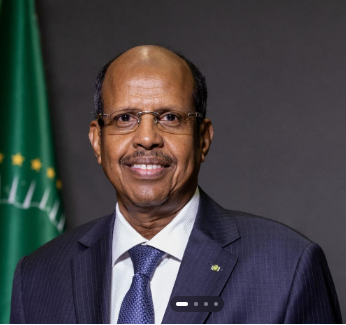
Moscow, Russia — African Union Commission Chairperson Mahmoud Ali Youssouf has emphasized the need for stronger agricultural investment and industrial cooperation during a high-level Russia–Africa Agro-Industrial Alliance event in Moscow.
The gathering, organized in cooperation with the Russian Association of Fertilizer Producers, focused on opportunities to strengthen agricultural production, expand access to fertilizers and develop partnerships between African countries and Russian agricultural industries.
Speaking at the event, Youssouf highlighted Africa’s enormous agricultural potential while warning that inadequate infrastructure, limited irrigation and insufficient investment continue to constrain food production across the continent.
Despite possessing substantial agricultural resources, Africa continues to depend heavily on imported food products.
The Chairperson cited limited irrigation coverage as a major obstacle to improving productivity, particularly in regions where farmers depend on seasonal rainfall.
He also pointed to Africa’s approximately $100 billion annual food import bill as evidence of the need to strengthen domestic production and agricultural value chains.
Youssouf called for greater investment in irrigation systems, agricultural research, fertilizer availability, modern farming technologies and workforce development.
Russia–Africa Agricultural Cooperation
The proposed cooperation offers opportunities for Russian companies and African governments to expand investment in fertilizer production, agricultural infrastructure, technical training and technology transfer.
Russia is a major international fertilizer producer, making agricultural inputs an important area of potential cooperation.
However, the long-term value of such partnerships will depend on whether they help African countries build sustainable domestic industries and reduce dependence on imported agricultural products.
Agriculture and African Economic Integration
Agricultural transformation is closely connected to the African Union’s wider objectives under Agenda 2063 and the African Continental Free Trade Area (AfCFTA).
Greater domestic food production, improved storage facilities, fertilizer manufacturing and agricultural processing could strengthen trade among African countries while creating employment opportunities.
Regional Economic Communities could also play a significant role by coordinating agricultural markets, improving cross-border transportation and encouraging investment in regional food supply chains.
These developments could help African countries move beyond exporting raw agricultural commodities toward producing higher-value processed goods.
WDS Perspective: Partnership or Continued Dependence?
For Africa, the central question is not simply whether Russia can supply additional fertilizers or agricultural technology.
It is whether international partnerships can contribute to Africa’s long-term agricultural independence.
Investments that support local fertilizer manufacturing, irrigation infrastructure, scientific research, workforce training and African-owned processing industries could strengthen the continent’s productive capacity.
However, partnerships centered primarily on imported inputs and foreign technology risk maintaining existing dependencies.
The African Union’s challenge will be to translate international cooperation into measurable improvements in agricultural productivity, industrial development and regional food security.
The bigger picture: Africa’s agricultural future will depend not only on the partnerships it establishes, but also on its ability to transform those partnerships into domestic production, regional trade and sustainable economic development.
For the African Union and its eight Regional Economic Communities, agricultural industrialization represents another important test of whether continental integration can deliver tangible economic benefits to Africa’s 55 member states.