
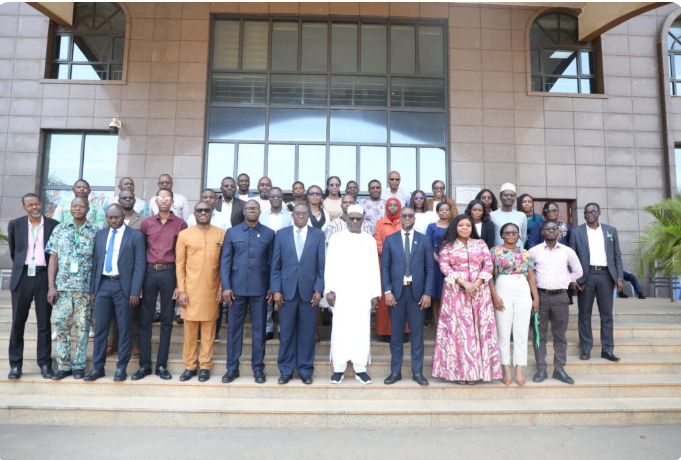
LOMÉ, TOGO — The Economic Community of West African States (ECOWAS) is strengthening parliamentary oversight of its regional agricultural and food security initiatives as a delegation of ECOWAS parliamentarians conducts a working mission to the Regional Agency for Agriculture and Food (RAAF) in Lomé, Togo.
The mission, scheduled for October 27–29, 2026, is intended to provide parliamentarians with a clearer understanding of the agency’s mandate, achievements, operational challenges and implementation of regional programmes designed to strengthen food security across West Africa.
Particular attention is being directed toward two initiatives: the ECOWAS STOCKS II project and the West African School Feeding Modernisation Programme.
The visit reflects a broader effort to ensure that regional agricultural policies are supported by effective implementation, institutional accountability and measurable outcomes.
Examining Regional Food Security Initiatives
Food security remains one of West Africa’s most significant development challenges.
The region faces recurring pressures from climate variability, agricultural production constraints, supply chain disruptions and economic instability.
These challenges have increased the importance of coordinated regional responses that extend beyond individual national agricultural policies.
The Regional Agency for Agriculture and Food serves as an important institution in supporting the implementation of ECOWAS agricultural policies and regional food security initiatives.
Through its work, the agency contributes to regional cooperation intended to improve agricultural development, strengthen food systems and support vulnerable populations.
The parliamentary delegation’s visit provides an opportunity to examine how these objectives are being translated into operational programmes.
ECOWAS STOCKS II: Strengthening Regional Food Resilience
One of the principal initiatives under review is the ECOWAS STOCKS II project.
The project is associated with efforts to strengthen regional food security mechanisms, including the management and coordination of food reserves.
Regional food reserves are particularly important in West Africa, where droughts, floods, insecurity and market disruptions can affect food availability across national borders.
A coordinated regional system can potentially help participating countries respond more effectively to food emergencies by improving preparedness and cooperation.
For ECOWAS, the challenge extends beyond establishing food security mechanisms. It also involves ensuring that those mechanisms are adequately financed, effectively managed, and capable of responding when emergencies occur.
The parliamentary mission is expected to improve lawmakers’ understanding of the project’s implementation and institutional arrangements.
However, the delegation’s final assessment and any recommendations have not yet been announced.
Modernising School Feeding Across West Africa
A second major focus of the mission is the West African School Feeding Modernisation Programme.
School feeding initiatives occupy an important position at the intersection of education, nutrition, agriculture and social protection.
Well-designed school meal programmes can help address nutritional needs among children while supporting school participation.
They can also create opportunities for local farmers when food procurement systems are connected to domestic agricultural production.
For West African countries, strengthening these connections could generate benefits beyond the classroom.
Greater coordination between schools, agricultural producers, food suppliers and public institutions could support local economic activity while improving the reliability of school meal programmes.
The modernisation initiative therefore represents an opportunity to examine how regional cooperation can strengthen national school feeding systems.
The parliamentary delegation’s review is particularly significant because the long-term effectiveness of such programmes depends on financing, procurement practices, institutional coordination and accountability.
Parliamentary Oversight and Regional Accountability
Beyond agriculture and nutrition, the mission highlights an important dimension of West African regional integration: parliamentary oversight.
Regional organisations frequently announce ambitious strategies, development programmes and institutional commitments.
However, the effectiveness of these initiatives ultimately depends on implementation.
Parliamentary engagement can provide an additional layer of scrutiny by examining how regional institutions carry out their responsibilities and whether programmes are producing their intended results.
The ECOWAS Parliament’s engagement with the Regional Agency for Agriculture and Food illustrates how regional institutions can contribute to accountability beyond the adoption of policies.
By examining programme implementation, parliamentarians can identify operational challenges, assess institutional priorities and better understand where additional regional cooperation may be required.
Such oversight is particularly important for initiatives involving public resources and essential services, including food security and child nutrition.
Implications for West African Integration
The mission also illustrates how regional integration extends beyond trade agreements, customs arrangements and the movement of goods.
Food security is inherently regional.
Agricultural production in one country can affect food availability and prices in neighboring countries. Climate shocks, transportation disruptions and insecurity can create consequences across multiple national economies.
Similarly, improvements in agricultural supply chains and coordination of food reserves can produce benefits that extend beyond national borders.
School feeding programmes may also advance regional development objectives by linking agricultural production, education, and social protection.
For ECOWAS, these initiatives demonstrate the importance of building institutions capable of coordinating practical responses to shared challenges.
However, the success of regional cooperation cannot be measured solely by the existence of programmes or agreements.
It must also be evaluated through implementation, institutional performance and measurable improvements for the populations those programmes are intended to serve.