
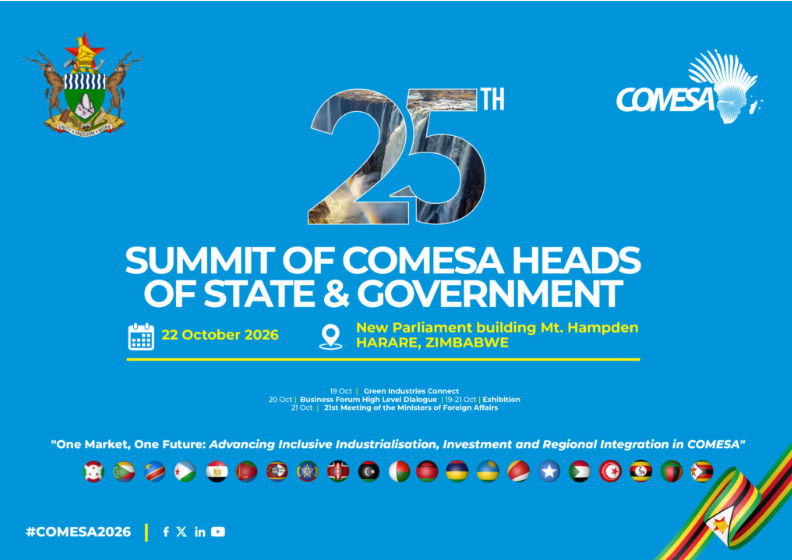
Zimbabwe’s President Emmerson Mnangagwa takes over COMESA chairmanship as regional leaders push for stronger economic integration, digital trade and financial cooperation.
The Common Market for Eastern and Southern Africa (COMESA) has formally adopted and launched its Medium-Term Strategic Plan 2026–2030, marking a new phase in the regional bloc’s efforts to strengthen economic integration, expand trade and improve cooperation among member states.
At the 25th COMESA Heads of State and Government Summit, leaders also adopted the organization’s 2025 Annual Report and recommendations addressing non-tariff trade barriers and the development of regional value chains involving critical minerals.
The decisions reflect COMESA’s continuing efforts to move regional integration beyond policy commitments toward practical economic cooperation.
Progress in Digital Trade and Regional Infrastructure
The summit communiqué highlighted several developments intended to make cross-border trade more efficient.
Electronic Certificates of Origin have been rolled out in six member states, helping modernize the documentation used to verify where traded goods originate.
The Regional Food Balance Sheet is now operational in 10 member states, supporting improved access to agricultural supply information and regional food security planning.
COMESA also reported the completion of pilot testing for a cross-border digital retail payment platform along the Malawi–Zambia corridor.
The payment initiative could help reduce transaction barriers for businesses and individuals conducting trade across national borders.
Leaders Push for Fewer Trade Barriers
Regional leaders called for accelerated implementation of the COMESA Business Visa, expansion of the Simplified Trade Regime and stronger regional payment systems.
These initiatives are intended to make it easier for businesses, particularly small-scale traders, to operate across member states.
Leaders also emphasized the importance of developing regional value chains around critical minerals, potentially allowing African countries to capture more economic value through processing, manufacturing and industrial cooperation.
On financing, member states were encouraged to pursue sustainable arrangements, including operationalization of the proposed COMESA Common Market Levy.
Such a mechanism could help strengthen the organization’s financial capacity to implement regional programmes.
Zimbabwe Takes Over COMESA Leadership
The summit also produced a leadership transition.
Zimbabwean President Emmerson Mnangagwa was elected Chairperson of the COMESA Authority, succeeding Kenyan President William Ruto.
Zambian President Hakainde Hichilema was elected Vice-Chairperson.
The new leadership will oversee a period in which COMESA seeks to translate its 2026–2030 strategic priorities into measurable economic outcomes.
Why This Matters for African Integration
COMESA’s decisions highlight the importance of regional institutions in advancing the African Union’s broader continental integration objectives.
Improved digital payment systems, harmonized trade documentation, stronger agricultural information systems and reduced trade barriers could make it easier for African businesses to operate across borders.
These efforts also complement the objectives of the African Continental Free Trade Area (AfCFTA), which seeks to expand trade and economic cooperation across Africa.
However, the central challenge remains implementation. The adoption of strategic plans and recommendations does not automatically guarantee that every member state will introduce the necessary reforms.
WDS Perspective: From Regional Commitments to Practical Integration
For When the Dust Settles (WDS), the significance of the COMESA summit lies in the distinction between institutional commitments and operational progress.
The rollout of electronic trade certificates, functioning food information systems and pilot-tested cross-border payments demonstrates that some regional integration initiatives are moving beyond the planning stage.
At the same time, the proposed Business Visa, Common Market Levy and expansion of regional trade arrangements still require further implementation.
Africa’s broader integration experiment involves coordinating 55 sovereign countries through the African Union and its regional economic institutions.
COMESA’s new strategic plan represents another step in that process.
The question now is whether its member states can turn these institutional advances into lower trading costs, stronger regional industries, increased investment and greater economic opportunities for African citizens.
The success of COMESA’s 2026–2030 strategy will ultimately be measured not by the number of agreements adopted, but by how effectively those agreements improve economic cooperation across the region.