
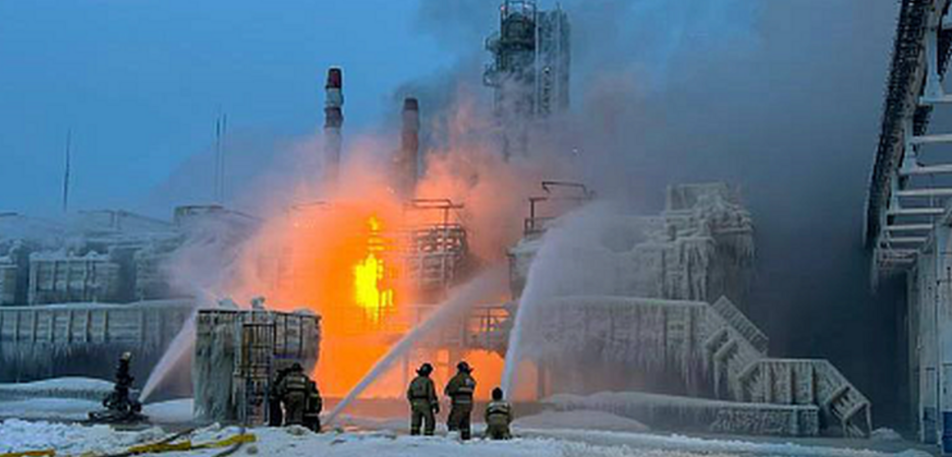
ST. PETERSBURG, Russia — Ukraine launched one of its most significant long-range drone attacks of the war on Saturday, striking a major oil terminal in St. Petersburg and targeting military infrastructure in Russia’s northwest, according to Ukrainian officials and reporting by the BBC.
Ukrainian President Volodymyr Zelensky announced the operation on social media, stating that Ukraine’s defense forces had successfully hit “port oil infrastructure that generates revenue for Russia’s war.” He also revealed that Ukrainian forces struck what he described as an “important military target” in Kronstadt, a strategically important naval base near St. Petersburg.
According to the BBC, the oil terminal in St. Petersburg was indeed struck during the overnight attack after the broadcaster verified footage and other evidence from the scene.
The attack represents one of Ukraine’s deepest strikes into Russian territory, with Zelensky noting that the targets were located approximately 850 kilometers (528 miles) from Ukraine’s border.
Russian Officials Confirm Oil Terminal Strike
Aleksandr Beglov acknowledged that St. Petersburg came under what he called a “massive” Ukrainian drone assault. He confirmed that the city’s oil terminal was hit but reported that there were no casualties.
Beglov said Russian air defenses intercepted 72 Ukrainian drones over St. Petersburg and the surrounding Leningrad region. He urged residents of the city—home to more than five million people—to remain indoors until the drone threat had ended and warned that mobile internet services could experience disruptions during the emergency response.
Strategic Energy Infrastructure Targeted
Ukraine’s military described the damaged oil terminal as one of Russia’s largest petroleum facilities, capable of producing approximately 12.5 million tonnes of petroleum products annually.
The strike is consistent with Ukraine’s broader strategy of targeting Russian energy infrastructure that supports Moscow’s military operations. Over recent months, Ukrainian long-range drone attacks have increasingly focused on fuel depots, oil refineries, and storage facilities inside Russia, with officials in Kyiv arguing that these sites provide critical financial and logistical support for Russia’s war effort.
Video released by Zelensky appeared to show a drone approaching its target before a massive column of black smoke rose into the sky following the impact. While the full extent of the damage has not yet been independently assessed, the BBC confirmed that the oil terminal was struck.
Naval Base Also Reportedly Hit
Ukraine’s military also claimed responsibility for striking the Kronstadt naval base, home to key elements of Russia’s Baltic Fleet.
Russian authorities have not publicly confirmed or commented on Ukraine’s claim that military facilities in Kronstadt sustained damage.
Dispute Over Kostyantynivka Continues
The drone strikes came as Ukraine and Russia continued to dispute control over the eastern Ukrainian town of Kostyantynivka.
On Friday, Russian President Vladimir Putin claimed that Russian forces had established control over the town during June but provided no evidence to support the assertion.
Ukraine firmly rejected that claim.
Military spokesman Maj. Andriy Kovalyov told the BBC that Kostyantynivka remains under the control of Ukraine’s Defense Forces, although he acknowledged that small Russian infantry groups had infiltrated some frontline positions.
“We have cases of infiltration by small infantry groups deep into the combat formations of our forces,” Kovalyov said. “These groups are being identified and destroyed.”
Later Saturday, Zelensky responded directly to Putin’s statement on Telegram.
“If Kostyantynivka is now under Russian control, then Putin will probably have no problem meeting me there and finding diplomatic solutions to finally end the war. But still, he will not cross the front line: the truth is very different from Putin’s words.”
Kostyantynivka is considered one of several heavily fortified towns forming Ukraine’s defensive “fortress belt” in the eastern Donetsk region, much of which remains occupied by Russian forces.
War Enters Another Phase
Saturday’s operation highlights Ukraine’s growing ability to conduct precision long-range drone strikes hundreds of kilometers inside Russian territory. By targeting both energy infrastructure and military installations, Kyiv continues to expand its campaign aimed at disrupting Russia’s logistical capabilities while increasing pressure far beyond the front lines.
The conflict began with Russia’s full-scale invasion of Ukraine in February 2022. More than four years later, Russia continues to occupy approximately 20% of Ukrainian territory, while fighting remains intense across multiple fronts and both sides continue to escalate long-range attacks on strategic targets.