
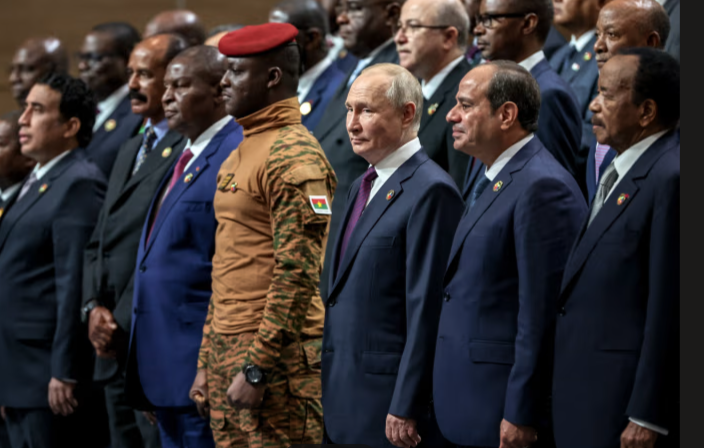
Russian Foreign Minister Sergei Lavrov’s visit to Niamey for the Russia–Alliance of Sahel States (AES) ministerial meeting is more than another diplomatic engagement. It is another visible sign that the governments of Mali, Burkina Faso, and Niger are deepening their strategic partnership with Moscow while distancing themselves from the West.
According to the Russian Foreign Ministry, Lavrov’s visit includes bilateral meetings with the foreign ministers of the three AES countries. Malian officials have also welcomed what they describe as President Vladimir Putin’s continued support for the alliance. The message is unmistakable: Russia is becoming the preferred external partner of the military governments that now dominate much of the central Sahel.
This development should surprise no one.
Over the past several years, the military leaders of Mali, Burkina Faso, and Niger have portrayed France as the principal obstacle to their countries’ sovereignty. French troops were expelled, military cooperation was suspended, and anti-French rhetoric became a central feature of public discourse. Although the three governments stopped short of completely severing diplomatic relations with France, they made it abundantly clear that they wanted to end the era of French security dominance in the region.
The more consequential decision, however, was their withdrawal from the Economic Community of West African States (ECOWAS). Rather than working through the region’s long-established political and economic institutions, the three governments chose to establish the Alliance of Sahel States as an alternative regional bloc.
That decision represented a major geopolitical shift. Yet it also raised an obvious question: if these countries were distancing themselves from traditional Western partners and breaking away from ECOWAS, where would they turn instead?
The answer has become increasingly clear.
Russia has stepped into the vacuum with military cooperation, diplomatic backing, and promises of respecting what it calls the sovereignty of African states. For the AES governments, Moscow offers security assistance without the political conditions often attached by Western governments. It is therefore hardly surprising that Russia’s influence continues to grow across the Sahel.
What is perhaps more surprising is the enthusiasm with which many young Africans have embraced this new alignment.
Across social media, military leaders who seized power through coups are frequently portrayed as heroic revolutionaries liberating Africa from colonial influence. Russian flags have become symbols of resistance, while criticism of military rule is often dismissed as defending Western interests.
This romanticization deserves closer scrutiny.
History teaches that replacing one foreign partner with another is not the same as achieving genuine independence. Sovereignty is strengthened by accountable institutions, economic development, strong democratic governance, and effective public administration—not simply by changing geopolitical allies.
Likewise, military governments should ultimately be judged by measurable outcomes rather than by slogans. Citizens deserve improved security, functioning schools and hospitals, economic opportunity, infrastructure, and a credible path back to constitutional government. Those are the standards by which any government should be evaluated, regardless of whether its closest partner is Paris, Moscow, Beijing, Ankara, or Washington.
Many Africans have legitimate grievances with France’s long post-colonial influence in parts of the continent. Those concerns should not be dismissed. But rejecting one external power does not automatically guarantee that another will better serve Africa’s long-term interests.
The excitement surrounding the AES and its growing partnership with Russia reflects a generation eager for change. That desire is understandable. What remains uncertain is whether this geopolitical realignment will produce the prosperity, stability, and democratic accountability that millions of Africans continue to seek.
As Lavrov meets with the leaders of the Alliance of Sahel States in Niamey, the symbolism is powerful. Whether it ultimately proves transformative for the people of the Sahel will depend not on diplomatic ceremonies or geopolitical rhetoric, but on results.