
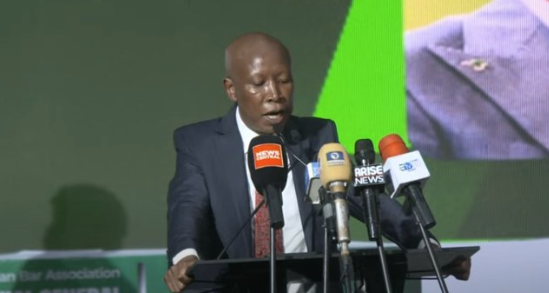
ENUGU, Nigeria — South African opposition leader Julius Malema has called for sweeping political and economic integration across Africa, urging the continent to embrace a single presidency, a common currency, and the removal of borders for African citizens.
Malema made the remarks while delivering the keynote address at the Nigerian Bar Association Annual General Conference in Enugu, Nigeria, where legal professionals, policymakers, business leaders, and academics gathered to discuss governance, democracy, and Africa’s future.
Speaking before delegates, Malema argued that Africa’s long-term prosperity depends on greater continental unity rather than continued fragmentation.
“We demand one Africa, we demand a borderless Africa, we demand an Africa with one president, one currency, one military command, with one parliament,” Malema said during his address.
He also advocated for unrestricted travel among African nations, saying Africans should not require visas to visit other countries on the continent.
Malema urged African governments to strengthen economic cooperation by processing the continent’s abundant natural resources locally instead of exporting raw materials for manufacturing abroad. He said greater collaboration between Nigeria and South Africa—the continent’s two largest economies—could help drive industrialization and accelerate the implementation of the African Continental Free Trade Area.
According to reports from Nigerian media, Malema emphasized that Africa possesses the human and natural resources necessary to become a global economic power but has yet to fully capitalize on its potential due to political divisions and economic dependence on external partners.
His vision reflects longstanding Pan-African ideals championed by leaders including Kwame Nkrumah, who advocated for a “United States of Africa,” and former Libyan leader Muammar Gaddafi, who also promoted the creation of a single African government, currency, and military command.
While the African Union has taken steps toward greater integration through initiatives such as the AfCFTA and protocols supporting the free movement of people, the establishment of a single African president or common currency is not currently official AU policy.
Malema’s remarks have renewed discussion over the future of African integration, with supporters arguing that deeper political and economic unity would strengthen the continent’s global influence, while critics question the practicality of implementing such ambitious reforms across Africa’s 54 sovereign states.