
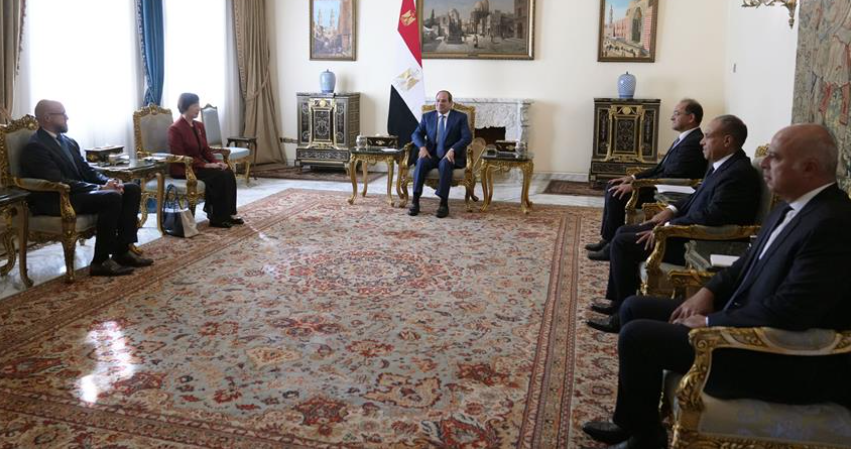
CAIRO, Egypt — September 6, 2026 — Egyptian President Abdel Fattah El-Sisi is advancing two important areas of Egypt’s development agenda, with high-level discussions focusing on international infrastructure financing and education reform.
El-Sisi met with Zou Jiayi, President and Chair of the Board of Directors of the Asian Infrastructure Investment Bank (AIIB), as Egypt continues efforts to strengthen its relationships with international development-finance institutions and attract investment into major economic projects.
The talks are significant because AIIB has emerged as an important multilateral institution financing infrastructure and sustainable development projects. For Egypt, cooperation with institutions such as AIIB provides another potential source of capital for sectors including transportation, energy, urban development and other infrastructure.
Egypt’s engagement with AIIB also reflects a broader strategy of diversifying the country’s international economic partnerships rather than depending on a limited number of traditional financing sources.
Infrastructure Is Only Half the Development Equation
At the same time, President El-Sisi’s agenda is placing attention on another critical national resource: Egypt’s young people.
According to the Egyptian Presidency, El-Sisi is also meeting with the Minister of Education and the Director of the Egyptian Military Academy, bringing education and workforce preparation into the day’s presidential agenda.
Education reform is particularly important for Egypt because of the size of its population and the large number of young Egyptians entering schools, universities and eventually the labor market.
Improving education is therefore not simply a social-policy objective. It is directly connected to economic productivity, employment, technological development and Egypt’s ability to compete in an increasingly knowledge-based global economy.
Building Infrastructure and Human Capital Together
Viewed together, the two presidential engagements highlight two sides of the same development challenge.
Countries need roads, energy systems, transportation networks and modern cities.
But those investments cannot reach their full economic potential without an educated and skilled population capable of operating businesses, developing technology, managing institutions and participating in modern industries.
International financing can help Egypt build physical infrastructure.
Education reform can help develop the human infrastructure needed to sustain it.
That connection will become increasingly important as Egypt seeks to attract foreign investment and position itself as a major manufacturing, transportation, energy and logistics center connecting Africa, the Middle East, Asia and Europe.
Why This Matters for Africa
Egypt’s engagement with AIIB also has implications beyond its national borders.
As African countries confront enormous infrastructure financing needs, institutions such as AIIB are becoming part of a more diversified development-finance landscape alongside African, Western, Gulf and other international financial institutions.
For African governments, greater competition and diversification among financing partners can potentially provide more options for funding infrastructure. But the long-term value of that financing ultimately depends on whether projects generate economic activity, strengthen regional connections and improve opportunities for citizens.
Egypt’s challenge is therefore not simply securing more financing or announcing additional education reforms.
The real test will be whether investment in physical infrastructure and investment in people reinforce one another—creating employment, improving productivity and giving Egypt’s large youth population a stronger role in the country’s economic future.