
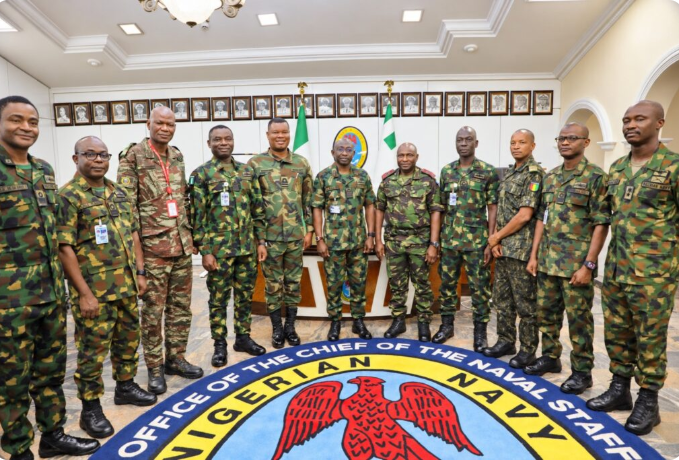
The Economic Community of West African States (ECOWAS) has reported two high-level engagements between the leadership of its Standby Force and senior Nigerian military officials, reflecting continued efforts to strengthen regional security cooperation, military preparedness and peace-support capabilities across West Africa.
According to separate announcements published by ECOWAS, Standby Force representatives held discussions with Nigeria’s Chief of Naval Staff, Vice Admiral Idi Abbas, and Chief of Army Staff, Lieutenant General Waidi Shaibu.
The meetings addressed several critical areas of regional defense cooperation, including operational readiness, intelligence sharing, joint military training, maritime security and logistical coordination.
The engagements come as West African governments continue to confront complex security challenges that require cooperation across national borders and between military institutions.
Strengthening the ECOWAS Standby Force
The ECOWAS Standby Force is a regional security mechanism established to support peace and security operations within West Africa.
It forms part of the African Standby Force framework under the African Union’s broader African Peace and Security Architecture.
Its purpose includes supporting conflict prevention, crisis response, peace-support operations and regional stabilization efforts when appropriately authorized.
However, maintaining an effective regional force requires more than formal agreements among governments.
Military units must be adequately trained, equipment must be available, communication systems must function, and participating countries must establish procedures for coordinating operations.
The latest engagements with Nigerian military leadership reflect efforts to address these practical requirements.
Maritime Security and Naval Cooperation
Discussions with Vice Admiral Idi Abbas highlighted the importance of maritime security and cooperation between regional defense institutions.
West Africa’s coastal waters are essential to international shipping, energy transportation, commercial fishing and regional trade.
The Gulf of Guinea, in particular, remains strategically important to the economic interests of several ECOWAS member states.
Threats such as maritime piracy, illegal fishing, trafficking and other transnational criminal activities require coordinated surveillance, intelligence exchanges and operational cooperation.
Strengthening relationships between the ECOWAS Standby Force and national naval authorities can contribute to improved information sharing and regional preparedness.
Nigeria’s naval capabilities make the country an important partner in broader efforts to protect maritime trade routes and strengthen security cooperation.
Army Cooperation, Joint Training and Operational Preparedness
The engagement with Lieutenant General Waidi Shaibu focused attention on the land-based operational requirements of regional security cooperation.
For the ECOWAS Standby Force to function effectively, participating military institutions must be capable of working together under coordinated operational arrangements.
Joint training provides opportunities to improve interoperability, communication, command coordination and familiarity with regional operating procedures.
Intelligence sharing is equally important, particularly when security threats extend across national borders.
Armed groups, organized criminal networks and trafficking operations frequently exploit gaps in coordination between neighboring countries.
Improved cooperation among military institutions can help governments develop a more comprehensive understanding of emerging security threats.
Nevertheless, discussions about readiness and cooperation should not be interpreted as confirmation of an imminent military intervention.
The ECOWAS announcements do not, by themselves, establish that a new deployment has been authorized.
Logistics: The Foundation of Regional Military Operations
Another significant element of the engagements was the emphasis on logistics infrastructure.
Regional security operations depend on the ability to move personnel, equipment, medical supplies, communications systems and other essential resources across national boundaries.
Without reliable logistical arrangements, even well-trained military forces may face difficulties maintaining operations.
ECOWAS has emphasized the importance of its logistics infrastructure in supporting regional peace operations.
Effective logistics planning can help improve deployment preparedness, supply management, transportation coordination and operational sustainability.
These capabilities are especially important in a region where security operations may involve considerable distances, difficult terrain and multiple national jurisdictions.
The challenge is not simply assembling military personnel from different countries, but ensuring those forces can operate together effectively when called upon.
Nigeria’s Strategic Role in West African Security
Nigeria remains a major contributor to regional security cooperation because of its military capabilities, geographic position and longstanding involvement in West African peace and security initiatives.
The country’s military institutions have historically participated in regional peace operations, including ECOWAS-led interventions and stabilization efforts.
Engagements with Nigeria’s senior naval and army leadership therefore carry institutional significance.
They provide opportunities to strengthen relationships between national defense structures and regional security mechanisms.
However, the effectiveness of the ECOWAS Standby Force ultimately depends on sustained cooperation among participating member states, adequate financing, political agreement and clearly established operational mandates.
No single country can independently resolve the region’s interconnected security challenges.
What This Means for African Regional Integration
The developments also raise an important question about the relationship between regional security and African integration.
ECOWAS is one of the eight Regional Economic Communities recognized by the African Union as building blocks of continental integration.
Although these organizations are often associated with trade liberalization, economic development and the movement of people and goods, security cooperation is another essential dimension of their responsibilities.
Regional economic integration becomes considerably more difficult when insecurity disrupts transportation corridors, restricts cross-border commerce and threatens communities.
Reliable security arrangements can help create conditions that support investment, infrastructure development and economic cooperation.
The ECOWAS Standby Force therefore represents more than a military arrangement. It is also part of the institutional framework through which West African countries seek to manage shared challenges collectively.
The Bigger Question: Can Cooperation Produce Operational Results?
The latest engagements demonstrate continued attention to military coordination, but important questions remain.
Will joint training programs produce measurable improvements in operational readiness?
Can intelligence-sharing arrangements become more consistent and effective?
Will logistics infrastructure receive the resources necessary to support sustained regional operations?
And can ECOWAS member states maintain the political coordination required to respond collectively to emerging threats?
These questions will ultimately determine whether high-level military engagements translate into stronger regional security capabilities.
For now, the meetings with Nigeria’s naval and army leadership represent efforts to reinforce cooperation rather than evidence of a newly authorized military operation.
Conclusion
ECOWAS’s engagements with Vice Admiral Idi Abbas and Lieutenant General Waidi Shaibu highlight the continuing importance of military coordination in West Africa’s regional security framework.
Operational readiness, maritime protection, intelligence sharing, joint training and logistics remain essential components of an effective regional peace and security mechanism.
The announcements also illustrate a broader reality confronting African regional institutions: cooperation must extend beyond political declarations to the practical systems needed for collective action.
For ECOWAS, the challenge is to translate institutional engagement into measurable improvements in preparedness, coordination and operational capacity.
For Africa’s wider integration project, the central question is whether sovereign states can build security institutions capable of addressing shared threats while maintaining the political cooperation necessary for regional stability.