
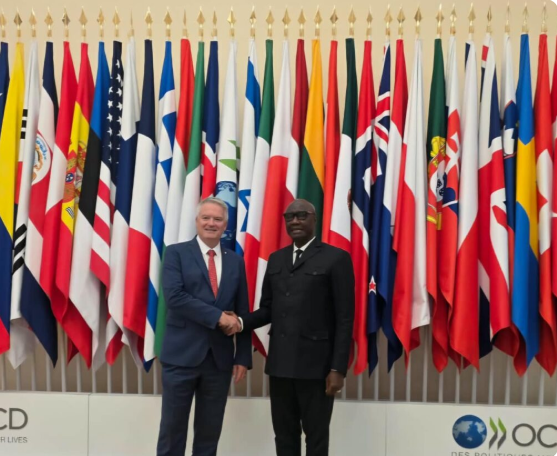
PARIS, FRANCE — ECOWAS Commission President Birame Diop met with Organisation for Economic Co-operation and Development (OECD) Secretary-General Mathias Cormann in Paris to advance cooperation on infrastructure development, investment promotion, regional trade, and monetary integration in West Africa.
The discussions focused on implementing the ECOWAS–OECD memorandum of understanding signed in October 2025, with both institutions examining ways to translate their partnership into practical economic development initiatives.
Priority areas include infrastructure connectivity, agricultural transformation, critical minerals, capital-market development, and implementation of the African Continental Free Trade Area (AfCFTA).
Strengthening Infrastructure and Regional Investment
Infrastructure development remains a major priority for ECOWAS as West African economies seek to improve transportation networks, energy connectivity, and cross-border commerce.
Improved infrastructure could reduce transportation costs, facilitate trade, and strengthen regional supply chains.
The partnership also seeks to support agricultural transformation and investment promotion, two areas considered essential for expanding industrial production and creating employment.
Cooperation on critical minerals and capital markets could help West African countries attract investment, develop domestic processing industries, and mobilize financing for long-term economic development.
ECOWAS Single Currency Returns to the Agenda
A significant element of the discussions involved potential OECD technical support for the proposed ECOWAS single-currency programme, commonly known as the Eco.
The proposed currency is intended to strengthen monetary cooperation and potentially reduce transaction costs associated with cross-border trade.
However, establishing a common currency remains a complex undertaking requiring coordination on inflation, fiscal policies, financial stability, and monetary institutions.
Technical assistance could support policy analysis and institutional preparation, but the discussions do not establish a new launch date or guarantee implementation of the currency.
Supporting the African Continental Free Trade Area
The two institutions also examined cooperation related to implementing the AfCFTA.
For West Africa, successful implementation could expand market access, encourage regional manufacturing, and strengthen trade relationships with other African economies.
However, achieving these objectives will require improvements in customs procedures, transportation infrastructure, investment policies, and regulatory coordination.
The ECOWAS–OECD partnership could provide technical expertise to support these reforms.
From Agreements to Implementation
The next phase of cooperation will involve developing a joint work programme and establishing technical coordination mechanisms.
These arrangements are expected to clarify institutional responsibilities and identify practical areas for collaboration.
However, specific project financing, implementation schedules, and measurable economic targets have not been detailed in the information provided.
The effectiveness of the partnership will depend on whether these mechanisms produce tangible improvements in investment, infrastructure development, and regional trade.
Why This Matters for African Integration
ECOWAS plays an important role in the African Union’s broader effort to strengthen economic integration across the continent.
Progress in West African infrastructure, investment, agricultural processing, and trade could support the development of regional value chains and contribute to the objectives of Agenda 2063.
The OECD partnership offers ECOWAS access to additional technical expertise and policy cooperation as it works to address longstanding economic challenges.
Nevertheless, international agreements alone cannot deliver regional integration.
The central question is whether ECOWAS and the OECD can transform their October 2025 agreement into measurable progress that reduces trade barriers, attracts productive investment, strengthens infrastructure, and brings West Africa closer to meaningful economic integration.