
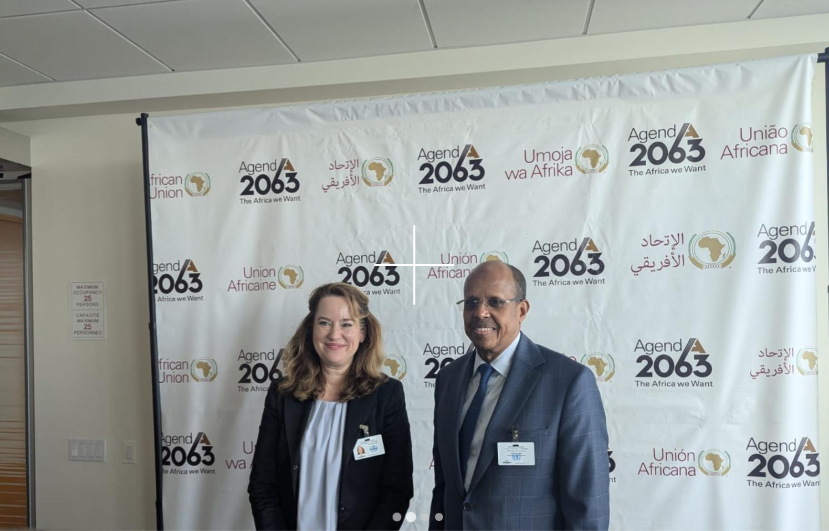
NEW YORK — September 22, 2026 — African Union Commission Chairperson Mahmoud Ali Youssouf met with Amy Pope, Director General of the International Organization for Migration (IOM), on the margins of the 81st Session of the United Nations General Assembly in New York, as migration, displacement and human mobility remain major issues confronting Africa.
According to the African Union, the discussions focused on migration governance, protection of migrants’ rights, legal migration pathways and stronger cooperation between the AU Commission and IOM. Both leaders reaffirmed their commitment to protecting the rights and dignity of migrants and strengthening international cooperation on migration.
From Migration Crisis to Migration Governance
The significance of the meeting extends beyond responding to humanitarian emergencies.
Chairperson Youssouf emphasized the importance of strengthening AU-IOM cooperation to advance safe, orderly and regular migration. The discussion also highlighted the potential contribution of the African diaspora to the continent’s development through investment, skills development and knowledge transfer.
That approach places migration within a broader African development agenda. Migration is not solely about people fleeing conflicts or attempting to reach Europe. It also involves how Africans move between African countries for employment, education, trade and economic opportunity.
The meeting therefore points toward a wider question: Can Africa develop a more coordinated continental system for managing the movement of its own people?
AfCFTA Enters the Migration Conversation
One particularly important element of the meeting was the connection between migration and African economic integration.
Youssouf highlighted the role of the African Continental Free Trade Area (AfCFTA) in advancing regional economic integration, including facilitating the movement of labour and skills across African countries.
This connection is significant because removing tariffs and expanding continental trade addresses only part of Africa’s integration challenge. Businesses also need workers, professionals, entrepreneurs and specialized skills to move more efficiently across borders.
In that sense, migration policy and economic integration are increasingly connected.
Displacement Remains a Major Challenge
The discussions are taking place as several African regions continue to experience conflict, instability and displacement.
Sudan remains one of the continent’s most serious humanitarian emergencies, while conflicts and insecurity elsewhere—including parts of the Sahel, the Horn of Africa and eastern Democratic Republic of the Congo—continue to create pressure on communities and governments.
The broader AU-UN discussions at UNGA81 have also addressed developments in Sudan, South Sudan, Somalia, Libya, the Sahel and the Democratic Republic of the Congo, demonstrating how closely questions of peace, security and displacement are connected.
IOM has identified migration governance, protection, opportunities and assistance to communities affected by crisis and displacement among its priorities during UNGA81.
The African Diaspora as a Development Partner
Another notable aspect of the AU-IOM meeting was its emphasis on the African diaspora.
Rather than viewing migration primarily through the loss of African workers and professionals, the discussion included ways the diaspora could contribute to African development through investment, knowledge transfer and skills development, while Africa works to retain critical capacities on the continent.
That approach could become increasingly important as African governments confront the challenge of creating sufficient employment opportunities for a young and growing population while also competing globally for skilled professionals.
A Continental Issue, Not Just a European One
For decades, international discussions about African migration have often concentrated heavily on irregular migration toward Europe and the Mediterranean.
The AU-IOM discussion at UNGA81 presents a broader framework.
Migration is simultaneously a humanitarian, development, economic integration, labour mobility and human-rights issue. Managing it effectively therefore requires more than border enforcement or emergency humanitarian responses.
It requires policies that protect displaced people, establish legal migration pathways, enable workers and skills to move where opportunities exist, engage the African diaspora and address the conflicts and economic pressures that force people from their homes.
The September 22 meeting did not announce a new binding agreement. Instead, it reaffirmed the intention of the African Union Commission and IOM to deepen cooperation around those objectives.
As African leaders use UNGA81 to argue for a stronger African role in shaping international institutions and global policy, migration is emerging as another area where the continent is seeking greater influence over how its challenges—and opportunities—are defined.
The central question going forward will be whether stronger AU-IOM cooperation can translate these commitments into practical systems that make migration safer, more orderly and more closely connected to Africa’s own development and integration priorities.