
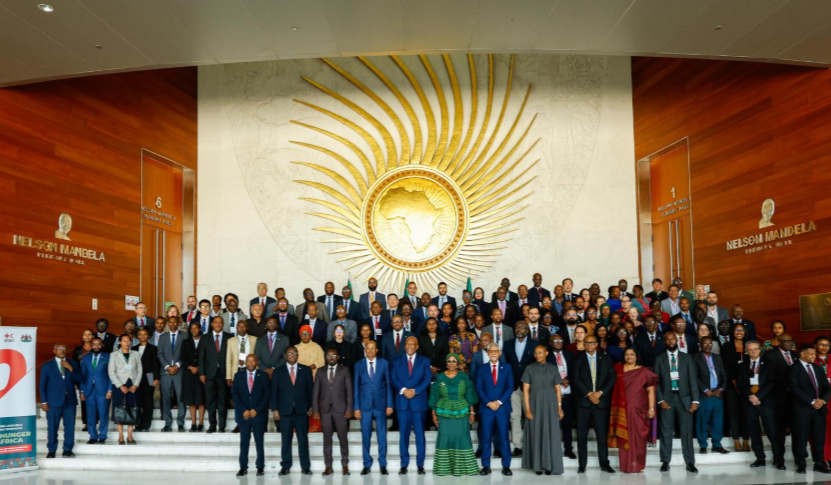
ADDIS ABABA, Ethiopia — The African Union Commission (AUC), in partnership with the International Federation of Red Cross and Red Crescent Societies (IFRC), is convening a high-level meeting in Addis Ababa aimed at accelerating Africa’s efforts to eliminate hunger, strengthen agricultural systems and build long-term food security across the continent.
Held under the theme “Advancing Durable Solutions Towards Zero Hunger in Africa,” the meeting brings together African leaders, humanitarian organizations, development partners and agricultural stakeholders to examine sustainable approaches to one of the continent’s most pressing development challenges.
Among the prominent participants are African Union Commission Chairperson Mahmoud Ali Youssouf and King Letsie III of Lesotho, who serves as the African Union’s Champion for Nutrition.
The gathering underscores a growing recognition that eliminating hunger in Africa requires more than emergency food assistance. It demands coordinated investments in agricultural productivity, climate resilience, nutrition, infrastructure and regional economic integration.
Moving Beyond Emergency Food Assistance
Africa’s food-security challenges are closely connected to climate change, agricultural underinvestment, population growth, infrastructure limitations and dependence on imported food products.
Droughts, floods and unpredictable rainfall patterns continue to threaten agricultural production in several regions, placing additional pressure on vulnerable communities.
At the same time, inadequate irrigation systems, limited access to agricultural financing, insufficient storage facilities and transportation bottlenecks restrict the ability of African farmers to increase production and distribute food efficiently.
The AU–IFRC meeting seeks to advance solutions that address these structural challenges while strengthening cooperation between governments and humanitarian organizations.
The partnership is particularly significant because the IFRC and its network of national Red Cross and Red Crescent societies have extensive experience supporting communities affected by disasters, food insecurity and climate-related emergencies.
By connecting humanitarian experience with continental agricultural policy, the initiative aims to encourage a transition from repeated emergency responses toward more resilient and sustainable food systems.
CAADP 2026–2035: Africa’s Agricultural Transformation Agenda
A central focus of the discussions is the African Union’s Comprehensive Africa Agriculture Development Programme (CAADP) Strategy and Action Plan for 2026–2035.
The strategy provides a continental framework for transforming Africa’s agrifood systems, improving food security and supporting sustainable agricultural development.
The broader CAADP agenda emphasizes increasing agricultural investment, improving productivity, strengthening food value chains and expanding opportunities for farmers and agricultural businesses.
For African governments, successful implementation will require translating continental commitments into national policies, measurable investments and practical improvements in agricultural infrastructure.
Key priorities include expanding irrigation, improving access to fertilizers and modern farming technologies, strengthening agricultural research, increasing food-processing capacity and improving transportation networks that connect rural producers with domestic and regional markets.
The strategy also provides opportunities for African countries to coordinate agricultural development across borders rather than relying exclusively on fragmented national approaches.
This coordination could become particularly important as the continent seeks to reduce its vulnerability to global food-price fluctuations and international supply-chain disruptions.
King Letsie III Highlights the Importance of Nutrition
The participation of King Letsie III, the African Union’s Champion for Nutrition, places nutritional outcomes at the center of the continent’s food-security agenda.
Food security is not simply a question of producing enough agricultural commodities. It also involves ensuring that individuals and families have reliable access to affordable, safe and nutritious food.
Malnutrition continues to affect vulnerable populations across Africa, particularly children and pregnant women.
Improving nutritional outcomes requires coordinated action involving agriculture, healthcare, education, clean water, social protection and economic development.
The involvement of the AU’s nutrition champion reinforces the importance of connecting agricultural transformation with improvements in public health and human development.
A successful continental food strategy must therefore measure progress not only through increased crop production but also through improved dietary diversity, reduced malnutrition and greater access to nutritious food.
Climate Resilience and Agricultural Financing Take Center Stage
Climate resilience is another major component of the high-level discussions.
African agricultural systems remain particularly vulnerable to changing weather patterns, especially in communities dependent on rain-fed farming.
Investments in irrigation, climate-resilient seeds, water management, agricultural insurance and early-warning systems could help reduce the impact of droughts and floods.
However, financing remains a critical obstacle.
Many smallholder farmers face difficulties accessing affordable credit, modern equipment and the capital necessary to expand production.
Strengthening agricultural financing mechanisms could support greater investment in food production, processing and distribution.
Partnerships involving governments, financial institutions, development organizations and humanitarian agencies may help mobilize resources for projects that improve long-term food security.
The challenge will be ensuring that financial commitments translate into practical improvements for farmers, rural communities and consumers.
Regional Integration: A Critical Component of Africa’s Food Security
Beyond national agricultural policies, the meeting also raises important questions about Africa’s regional economic integration.
African countries possess different agricultural strengths, climatic conditions and production capacities.
Some regions produce significant quantities of grains, while others have advantages in livestock, horticulture, fisheries or agricultural processing.
Greater cooperation among neighboring countries could allow food surpluses in one market to help address shortages in another.
However, achieving this objective requires efficient transportation corridors, compatible food-safety standards, improved border procedures and stronger regional market information systems.
The African Continental Free Trade Area (AfCFTA) provides an important framework for expanding intra-African agricultural trade.
Africa’s eight recognized Regional Economic Communities also have important roles in coordinating agricultural policies, improving cross-border infrastructure and strengthening regional food supply chains.
For example, regional cooperation through ECOWAS, COMESA, the East African Community and SADC can help support food trade, agricultural investment and responses to regional food shortages.
Reducing unnecessary trade barriers could allow African producers to reach larger markets while improving access to food across national borders.
Nevertheless, regional integration alone cannot guarantee food security. It must be accompanied by investments in production, storage, logistics and climate adaptation.
Why This Meeting Matters for Africa
The AU–IFRC initiative reflects a broader shift toward treating food security as a continental development priority rather than solely a humanitarian concern.
Africa’s agricultural potential is substantial, but realizing that potential requires overcoming longstanding structural barriers.
Continued dependence on imported food exposes countries to international price increases, shipping disruptions and foreign-exchange pressures.
At the same time, climate-related emergencies threaten domestic production and can increase competition for limited resources.
Strengthening local agricultural industries could create employment, expand rural incomes, support food-processing businesses and reduce dependence on external suppliers.
More importantly, stronger regional food systems could improve Africa’s ability to respond collectively when individual countries experience production shortages.
The Addis Ababa meeting therefore represents an opportunity to strengthen cooperation between continental institutions, national governments and humanitarian partners.
Its long-term significance will depend on whether the discussions produce sustained investment, effective implementation and measurable improvements in food security.