
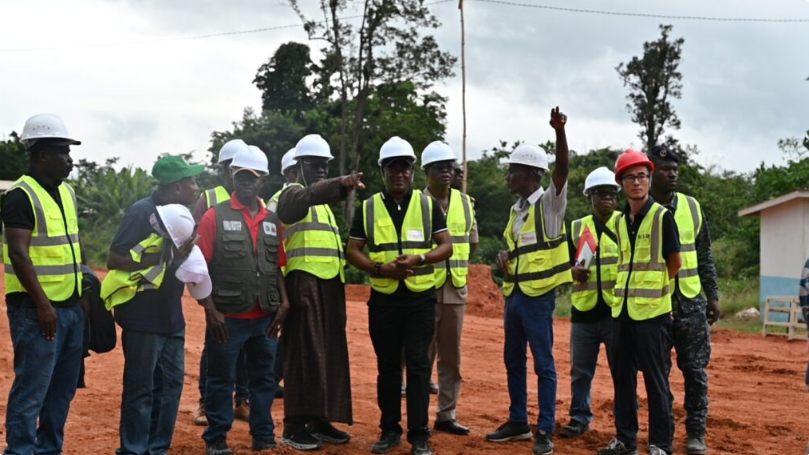
ABIDJAN, CÔTE D’IVOIRE — The Economic Community of West African States (ECOWAS) has reported that its Permanent Representative in Côte d’Ivoire led a delegation to monitor work on the Cavally Bridge project, an infrastructure initiative intended to improve transportation connectivity between Côte d’Ivoire and Liberia.
The monitoring mission reflects ECOWAS’s continuing interest in strengthening cross-border infrastructure and improving the movement of people, goods, and services across West Africa.
The Cavally River forms part of the international boundary between Côte d’Ivoire and Liberia, making transportation infrastructure in the area particularly important for communities and businesses operating along the border.
Strengthening Cross-Border Transportation
The Cavally Bridge project is significant because transportation infrastructure remains a major component of regional economic integration.
Although Côte d’Ivoire and Liberia share a border, the movement of commercial goods and travelers depends on the availability and reliability of roads, bridges, and functioning border facilities.
Improved transport connections could help reduce logistical difficulties, strengthen commercial relationships, and provide communities with better access to markets and essential services.
For small businesses, agricultural producers, and transport operators, dependable border infrastructure can create opportunities to expand commercial activity beyond national boundaries.
The ECOWAS delegation’s monitoring activities also underscore the importance of overseeing infrastructure development and ensuring that regional projects advance toward their intended objectives.
The information released does not establish a confirmed completion date, construction percentage, or final project cost.
Economic Opportunities for Côte d’Ivoire and Liberia
Côte d’Ivoire is one of West Africa’s major commercial and agricultural economies, while Liberia continues to pursue improvements in infrastructure and economic connectivity.
Stronger transportation links between the two countries could support several important economic activities.
Agricultural producers may benefit from improved access to buyers across the border, while traders could gain more reliable transportation routes for moving merchandise between communities.
Transport operators and logistics businesses could also benefit from more dependable road connections.
Beyond commercial activities, improved infrastructure may strengthen social connections among border communities that maintain longstanding family, cultural, and economic relationships.
However, the bridge’s economic benefits will depend on more than the physical structure itself. Connecting roads, border administration, customs procedures, and maintenance arrangements will also influence its effectiveness.
The Broader ECOWAS Regional Integration Agenda
The Cavally Bridge project fits within the wider ambitions of ECOWAS to develop an increasingly interconnected West African economy.
Regional integration requires more than agreements among governments. It also depends on physical infrastructure capable of supporting economic activity across national boundaries.
Bridges, highways, ports, railways, and border crossings form the transportation networks necessary for regional commerce.
When these systems are poorly connected, businesses may encounter additional transportation costs, delays, and difficulties reaching customers in neighboring countries.
Infrastructure improvements can help address these challenges, particularly when supported by coordinated customs procedures and compatible transportation policies.
The Cavally Bridge project also has implications for the African Continental Free Trade Area (AfCFTA), which seeks to expand trade among African countries.
While AfCFTA provides a continental framework for trade liberalization, physical transportation infrastructure remains essential to translating trade commitments into commercial opportunities.
Infrastructure Development and Regional Accountability
The ECOWAS monitoring mission highlights another important aspect of regional integration: institutional oversight.
Infrastructure projects require sustained coordination among governments, contractors, financing partners, and regional institutions.
Monitoring missions provide opportunities to review implementation, identify potential obstacles, and assess whether projects are progressing toward their objectives.
For ECOWAS, demonstrating tangible progress on cross-border infrastructure is important to building confidence in regional cooperation.
However, the long-term success of the Cavally Bridge project will ultimately be measured by whether it improves transportation reliability, supports economic activity, and delivers practical benefits to communities on both sides of the border.
WDS Perspective: Regional Integration Must Produce Visible Results
The Cavally Bridge project illustrates a fundamental challenge facing African regional integration.
West Africa has established institutions, economic agreements, and development strategies intended to strengthen cooperation among its countries. Yet the success of these initiatives depends heavily on practical implementation.
A bridge connecting Côte d’Ivoire and Liberia represents more than a transportation investment. It symbolizes the physical connections required to transform regional integration from political ambition into everyday economic activity.
For ECOWAS, the central question is not simply whether the bridge can be completed, but whether the surrounding transportation and border systems will allow businesses and communities to take full advantage of the connection.
The project also offers a broader lesson for the African Union’s continental integration agenda.
Bringing Africa’s 55 sovereign countries into a more interconnected economic system requires coordinated investments in infrastructure, trade facilitation, and institutional cooperation.
Regional economic communities such as ECOWAS play an important role in translating those continental ambitions into practical projects.
The real measure of success will be whether the Cavally Bridge makes crossing the Côte d’Ivoire–Liberia border easier, more reliable, and more economically productive for the people who depend on it.