
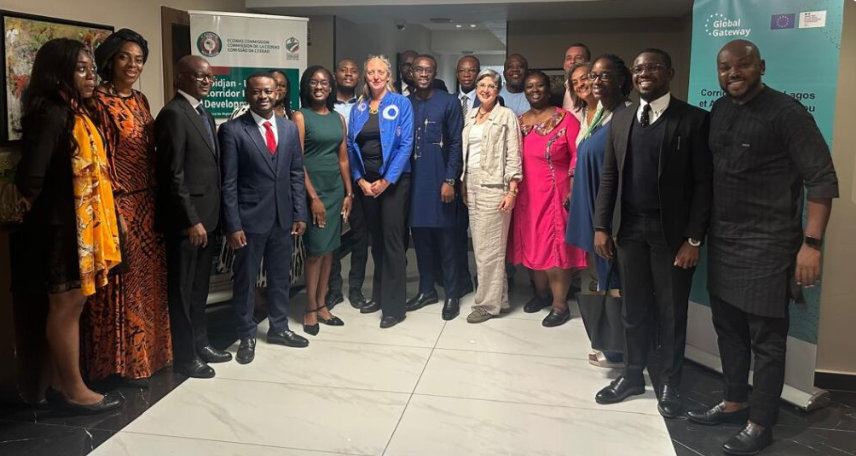
ABIDJAN, Côte d’Ivoire — The Economic Community of West African States (ECOWAS) has announced progress toward establishing a Regional Transport Observatory for West Africa, an initiative designed to improve transportation efficiency, strengthen regional trade corridors and support economic integration across West Africa.
The announcement follows a technical workshop held in Abidjan, where representatives of regional institutions, transport-corridor organizations and development partners reviewed the proposed observatory’s governance, financing, coordination and operational arrangements.
Participants validated key planning documents, including the concept note, terms of reference and proposed governance arrangements, marking an important step toward the institution’s eventual establishment.
Improving Transportation Efficiency Through Regional Data
The proposed Regional Transport Observatory would serve as a mechanism for collecting, analyzing and sharing information on transportation infrastructure, border crossings, ports and regional transport services.
By developing a coordinated regional information system, ECOWAS aims to strengthen governments’ ability to identify transportation bottlenecks, monitor corridor performance and prioritize infrastructure investments.
Transportation remains a major challenge to economic integration in West Africa. Border delays, inefficient logistics systems and inadequate infrastructure can increase the cost of moving goods between countries, reducing the competitiveness of regional businesses.
A functioning observatory could provide policymakers with more reliable evidence to assess whether transportation reforms and infrastructure investments are delivering measurable improvements.
Cooperation Beyond ECOWAS
One of the initiative’s most significant features is ECOWAS’s intention to coordinate with the West African Economic and Monetary Union (UEMOA) and the Alliance of Sahel States (AES).
Such cooperation could support a transportation monitoring framework extending across the wider West African region, including countries whose political and institutional relationships have changed in recent years.
The involvement of these regional organizations is particularly important because major West African transportation corridors connect coastal ports with landlocked Sahelian economies.
Maintaining efficient transportation networks across these territories remains essential for regional commerce, regardless of differences in institutional membership.
The proposed cooperation could therefore demonstrate how practical economic interests continue to create opportunities for coordination among West African governments.
From Planning to Implementation
With the concept note and governance arrangements validated, the next phase will focus on securing financing, deploying the necessary technical systems and strengthening institutional capacity.
However, the observatory is not yet fully operational. Its eventual effectiveness will depend on sustained funding, reliable data collection, cooperation among participating institutions and the ability of governments to translate findings into policy improvements.
WDS Perspective: Measuring the Results of African Integration
For When the Dust Settles (WDS), the proposed Regional Transport Observatory represents an important example of African regional integration moving beyond policy declarations toward practical institutional development.
The African Union’s broader integration ambitions, including the African Continental Free Trade Area (AfCFTA), depend not only on reducing trade barriers but also on ensuring that goods can move efficiently between African markets.
Regional transportation data could help ECOWAS determine whether investments in roads, ports, border facilities and logistics systems are producing meaningful economic benefits.
The initiative also highlights a wider integration question: Can West African institutions maintain effective economic cooperation across changing political boundaries?
ECOWAS’s proposed coordination with UEMOA and the Alliance of Sahel States suggests that transportation infrastructure and trade connectivity could remain areas of shared regional interest.
Ultimately, the observatory’s success will be measured not by the establishment of another regional institution, but by whether its information helps reduce transportation costs, improve border efficiency and strengthen economic connections across West Africa.
For a continent undertaking the unprecedented challenge of integrating 55 sovereign nations, institutions capable of measuring progress and identifying practical obstacles could become increasingly important.
Source: ECOWAS Commission announcement on the Regional Transport Observatory technical workshop in Abidjan, as described in the supplied briefing.
When the Dust Settles (WDS) — Examining African integration through the African Union and Africa’s eight Regional Economic Communities.