
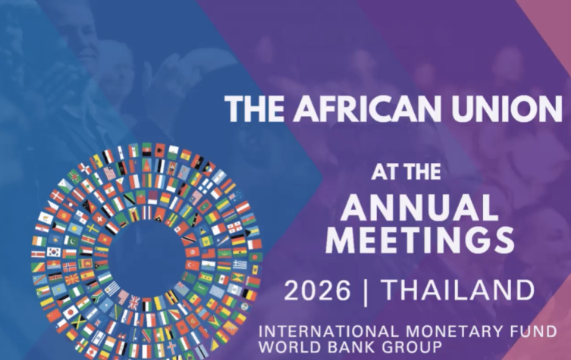
The African Union Commission is participating in the 2026 International Monetary Fund (IMF) and World Bank Annual Meetings in Bangkok, Thailand, with a focus on securing development financing and strengthening Africa’s position in the international financial system.
The AU delegation is led by Commission Deputy Chairperson Selma Malika Haddadi, who is representing the continent’s development priorities in discussions with international financial institutions and development partners.
The Commission has identified development financing, private-capital mobilization, employment creation, regional economic integration and reform of the international financial architecture as central priorities.
Africa Seeks Greater Access to Development Financing
African countries face substantial financing needs to expand infrastructure, strengthen industrial production, create jobs, and accelerate economic transformation.
However, limited access to affordable financing, high borrowing costs and debt pressures continue to complicate development efforts across parts of the continent.
The AU’s participation provides an opportunity to advocate for financial arrangements that better reflect Africa’s economic circumstances and long-term development objectives.
Mobilizing private investment is another important priority, particularly for projects involving transportation, energy, manufacturing and regional infrastructure.
Financial Reform and Regional Integration
The Commission’s agenda also reflects Africa’s broader efforts to reform international financial institutions and strengthen the continent’s voice in global economic decision-making.
These discussions are closely connected to the African Union’s Agenda 2063 and the African Continental Free Trade Area (AfCFTA), which seek to expand regional trade, industrialization and economic integration.
Improved access to development financing could help African governments invest in cross-border transportation corridors, energy networks and industrial projects that support regional markets.
The challenge will be translating international financial discussions into practical commitments that deliver affordable capital and measurable economic benefits.
A Critical Opportunity for Africa
The Bangkok meetings offer the African Union another platform to advance a coordinated continental position on development financing and international financial reform.
For African economies, the central issue is not simply attracting more investment but ensuring that financing supports productive industries, sustainable employment and long-term economic transformation.
The key question is whether international financial institutions and development partners will translate reform discussions into financing arrangements that better support Africa’s development ambitions.