
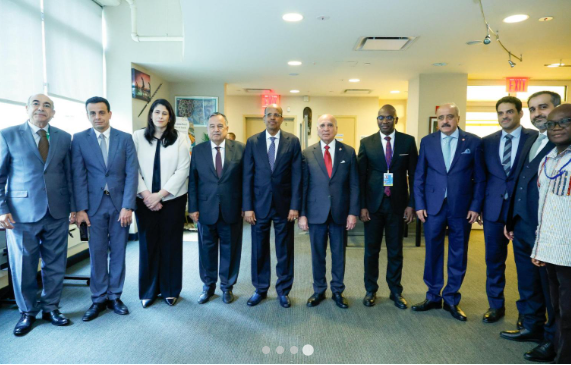
NEW YORK — September 25, 2026 — The African Union is seeking to inject new momentum into its longstanding partnership with the Arab world, with AU Commission Chairperson Mahmoud Ali Youssouf calling for a shift from diplomatic declarations toward concrete implementation in trade, investment, infrastructure, security and development.
Youssouf delivered the message during the 10th Ministerial Meeting of the Coordination Committee of the Africa-Arab Partnership, held as African and Arab officials gathered in New York during the high-level diplomatic meetings surrounding the United Nations General Assembly.
According to the African Union, Youssouf told the meeting that the partnership should be revitalized and should move “decisively from declarations to implementation.”
Nearly 50 Years of Africa-Arab Cooperation
The meeting comes at an important point in the history of Africa-Arab relations. 2027 will mark the 50th anniversary of the institutional partnership, creating an opportunity for both sides to review what has been achieved while addressing areas where political commitments have not yet translated into practical results.
Youssouf said the anniversary should provide an opportunity to give the relationship renewed strategic and practical momentum.
The Africa-Arab Partnership connects the African Union Commission and the League of Arab States, providing an institutional framework through which the two regions can coordinate on political, economic, security and development issues.
The relationship is particularly significant because Africa and the Arab world are not completely separate geopolitical regions. Several African countries are also members of the Arab League, creating an institutional bridge between the two systems.
Countries including Algeria, Comoros, Djibouti, Egypt, Libya, Mauritania, Morocco, Somalia and Sudan occupy this overlapping African-Arab geopolitical space.
That gives the partnership a dimension that goes beyond conventional relations between two regional organizations.
From Declarations to Implementation
One of the clearest messages emerging from the ministerial meeting was the need for measurable implementation.
Youssouf called for the completion of the Joint Africa-Arab Action Plan, along with clear timelines identifying priority projects and beneficiaries. He also emphasized the importance of developing sustainable financing mechanisms capable of turning political commitments into tangible outcomes.
That emphasis is significant because international partnerships can produce summits, declarations and agreements without necessarily creating corresponding projects on the ground.
The AU chairperson’s remarks suggest an effort to make implementation a more prominent measure of the Africa-Arab relationship.
According to the AU, the partnership should generate concrete benefits through several areas, including expanded trade and investment, infrastructure development, peace and security, food security, and cultural and knowledge exchange.
Trade, Investment and Infrastructure
Economic cooperation could become one of the most consequential dimensions of a renewed Africa-Arab partnership.
Arab states, particularly those in the Gulf, have increasingly become sources of investment and development financing across Africa. African countries, meanwhile, offer rapidly growing markets, significant agricultural potential, mineral resources and opportunities for large-scale infrastructure investment.
Closer institutional coordination could potentially connect those investments more directly with African continental priorities.
That becomes particularly relevant as the AU continues pursuing Agenda 2063 and African governments work to expand intra-African commerce through the African Continental Free Trade Area.
Infrastructure could provide another area of cooperation, including transportation corridors, ports, logistics networks, energy infrastructure and digital connectivity.
But the challenge will be ensuring that individual investments contribute not only to bilateral relationships but also, where appropriate, to Africa’s wider regional integration objectives.
Food and Energy Security
Food security also provides a natural area for greater cooperation.
Several Arab countries depend heavily on international agricultural markets, while Africa possesses substantial agricultural resources but continues to face challenges involving infrastructure, productivity, financing and climate resilience.
That creates potential complementarities between African agricultural development and Arab investment capital.
Energy presents another strategic connection.
Major Arab energy-producing countries possess capital, technology and experience in both traditional and increasingly renewable energy industries. African governments, meanwhile, are seeking investment to expand electricity generation, transmission infrastructure and industrial development.
How those interests are structured will help determine whether future cooperation produces primarily commercial transactions or contributes to broader African development and integration objectives.
Peace and Security
Security cooperation is another component of the relationship.
Africa and the Arab world share several interconnected security environments, particularly across North Africa, the Red Sea, the Horn of Africa and the Sahel.
Conflicts, terrorism, maritime insecurity, migration and political instability frequently cross the geographic boundaries separating Africa from the Middle East.
Closer coordination between the African Union and League of Arab States could therefore provide an additional diplomatic mechanism for addressing crises affecting both regions.
Youssouf specifically called for stronger institutional coordination between the AU Commission and the League of Arab States, particularly as preparations continue for the 5th Africa-Arab Summit.
A More Diversified African Foreign Policy
The renewed attention to the Africa-Arab Partnership also reflects a wider transformation in Africa’s international relationships.
African diplomacy is increasingly conducted through multiple external partnerships involving Europe, China, the United States, India, Türkiye, Gulf countries and other emerging economic and political partners.
For the African Union, this creates both opportunities and challenges.
Greater diversification can provide African governments with additional sources of investment, infrastructure financing, technology and diplomatic cooperation. At the same time, the effectiveness of those relationships depends heavily on whether African institutions can establish continental priorities and translate external partnerships into measurable development outcomes.
The Africa-Arab mechanism could therefore become another test of the AU’s ability to approach international partnerships through a coordinated continental framework.
The Road to 2027
The next major question is whether the renewed diplomatic attention produces implementation.
With the partnership approaching its 50th anniversary in 2027, the AU is calling for clearer priorities, financing mechanisms and project timelines rather than another cycle centered primarily on political declarations.
Youssouf said the historical connections, strategic interests and common aspirations linking Africa and the Arab world provide the basis for a more practical and results-oriented partnership. He also called for 2027 to become a year of renewal for Africa-Arab cooperation.
For African integration, the significance extends beyond relations with Arab states.
The larger question is whether Africa’s expanding network of international partnerships can increasingly support the continent’s own priorities—regional integration, infrastructure connectivity, food and energy security, expanded trade and sustainable economic development.
The 10th Ministerial Meeting has returned the Africa-Arab Partnership to the diplomatic agenda. The next stage will determine whether that renewed political attention can be converted into projects and measurable results.