
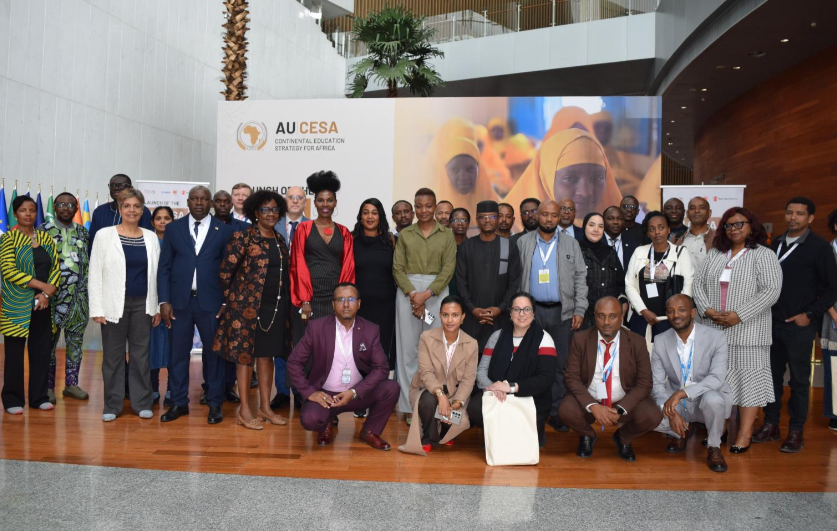
ADDIS ABABA, Ethiopia — September 21, 2026 — The African Union Commission has officially launched a new continental mechanism aimed at protecting education and ensuring that African children and young people can continue learning during conflicts, displacement, climate-related disasters and other emergencies.
The Continental Education Strategy for Africa Education in Emergencies and Resilience Cluster, known as the CESA Education in Emergencies and Resilience (EiE) Cluster, was formally launched at African Union headquarters in Addis Ababa on September 18. The AU Commission announced the results of the launch on September 21.
The initiative is a thematic cluster under the Continental Education Strategy for Africa 2026–2035 (CESA 2026–2035) and is intended to serve as a continental coordination mechanism connecting AU Member States, Regional Economic Communities and development and humanitarian partners.
Its central objective is straightforward but significant: a crisis should not automatically mean the end of a child’s education.
Moving From Emergency Response to Preparedness
Africa’s education systems face disruptions from armed conflicts, forced displacement, refugee crises, climate-related shocks, natural disasters, public-health emergencies and attacks on educational institutions.
The new mechanism is intended to help governments move beyond responding to educational disruption only after a crisis occurs. Instead, the AU is emphasizing preparedness, prevention, resilience and recovery as permanent parts of national education systems.
The AU says Member States will be encouraged to incorporate education-in-emergencies planning directly into their national education policies, budgets and coordination systems. The approach is designed to reduce dependence on fragmented, short-term emergency responses.
Sophia Ashipala, Head of the Education Division at the African Union Commission, described the initiative as a shift toward prevention, preparedness, stronger education systems and sustainable recovery. The AU particularly highlighted the effects educational crises can have on girls, displaced learners and children with disabilities.
Four Areas of Action
The initiative is being organized around four major operational areas: protection, continuity, learning recovery and inclusion, and financing and accountability.
Protection focuses on keeping schools and universities safe civilian spaces and strengthening protections for students, teachers and education personnel.
Continuity involves developing contingency plans and flexible learning systems, including digital and low-technology distance-learning options. The AU also wants academic records to become more portable so that displaced students can continue their education after crossing borders or relocating.
Learning recovery and inclusion will focus on programs that help students recover lost learning, particularly refugees, internally displaced people, returnees, girls, children with disabilities and other vulnerable learners.
Financing and accountability will encourage governments and international partners to incorporate crisis preparedness into education budgets, monitoring systems and national planning rather than treating emergency education as a separate temporary intervention.
Refugees and Displaced Children Included in National Systems
Another important element of the initiative is the AU’s emphasis on incorporating refugees and internally displaced students into national education systems.
Rather than creating separate temporary education structures whenever populations are displaced, the Cluster is intended to encourage governments to include displaced learners in national education planning, financing and data systems.
Teachers working in refugee-hosting communities and fragile environments are also expected to receive greater attention, including professional development, protection, wellbeing and psychosocial support.
The mechanism additionally covers school safety, disaster-risk reduction, climate resilience, digital learning, teacher preparedness, mental-health and psychosocial support and evidence-based emergency education policies.
From Continental Policy to Implementation
The launch produced several concrete organizational steps.
Participants formally inaugurated the Cluster, confirmed its governance arrangements, identified Member State focal points, validated its Terms of Reference and endorsed a 2026–2028 Work Plan.
A Community of Practice was also established to allow governments and partners to exchange technical knowledge, data and lessons from countries already dealing with conflict, displacement and other emergencies.
The Cluster will coordinate with other CESA initiatives covering teacher development, curriculum and assessment, digital education and artificial intelligence, gender and inclusion, and data, monitoring and accountability.
Regional Economic Communities will also have a role. Rather than replacing existing regional initiatives, the AU says the continental mechanism is intended to support coordination, knowledge exchange, evidence generation and peer learning across Africa.
Why This Matters for Africa
The significance of the initiative extends beyond education.
When conflict or disaster closes a school, the immediate consequence is missed classroom time. But prolonged disruption can produce much deeper consequences: students can fall behind, families can become disconnected from education systems, displaced children can struggle to transfer their academic records, and temporary interruptions can become permanent departures from school.
That makes education resilience part of a broader development challenge.
A continental framework could allow African countries to share approaches rather than repeatedly developing emergency systems independently. It could also help connect education planning with humanitarian response, digital infrastructure, teacher preparation, refugee policy and disaster preparedness.
The critical test, however, will be implementation at the national level.
The AU has established the continental framework, governance arrangements and 2026–2028 work plan. The next phase will depend heavily on whether Member States incorporate those commitments into their education policies, budgets, teacher-support systems and emergency-preparedness plans.
If that transition occurs, education during emergencies could increasingly become part of Africa’s normal education planning rather than something governments address only after classrooms have already closed.
The broader principle behind the initiative is that conflict, displacement or disaster should disrupt children’s lives as little as possible — and that protecting their education is part of protecting Africa’s long-term human capital and development.