
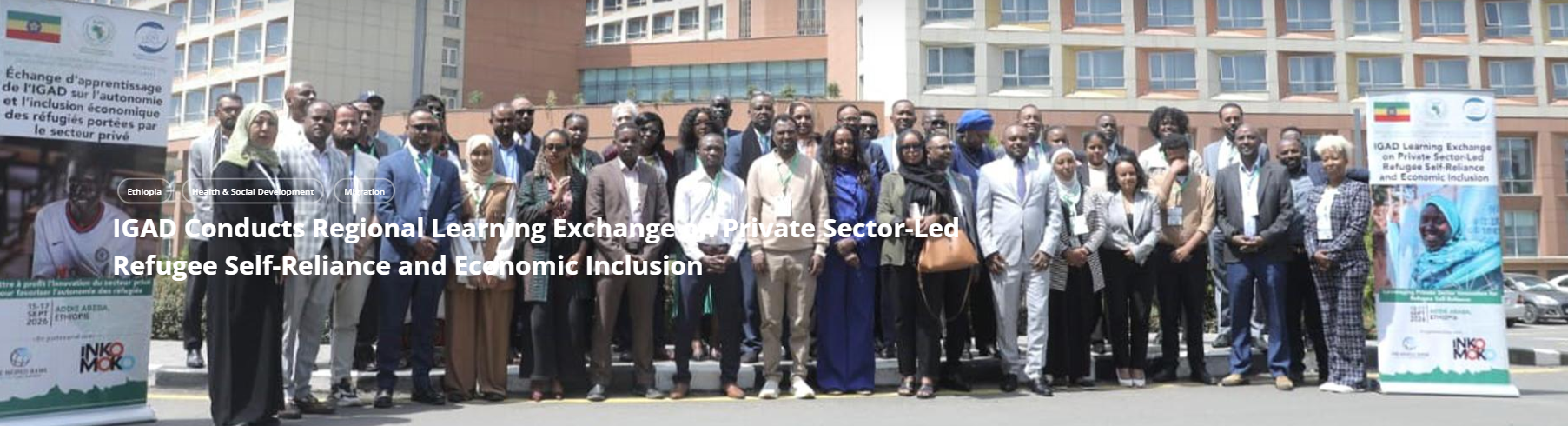
ADDIS ABABA, Ethiopia — September 19, 2026 — The Intergovernmental Authority on Development is advancing a regional approach that seeks to move refugee policy beyond long-term dependence on humanitarian assistance by expanding access to employment, entrepreneurship, finance and private-sector opportunities for refugees and the communities hosting them.
IGAD convened a three-day Regional Learning Exchange on Private Sector-Led Refugee Self-Reliance and Economic Inclusion in Addis Ababa under the theme “Leveraging Private Sector Innovation for Refugee Self-Reliance.” The gathering brought together governments, financial regulators, central banks, ministries, businesses, development finance institutions, refugee-led organizations, refugee entrepreneurs and development partners.
From Refugees as Aid Recipients to Economic Participants
At the center of the initiative is a significant policy question for the Horn of Africa: can refugees be increasingly integrated into local economies as workers, entrepreneurs, customers and business partners, rather than remaining primarily dependent on humanitarian assistance?
IGAD says the exchange is intended to accelerate private-sector-led, gender-responsive and digitally enabled pathways to employment, enterprise development, financial inclusion and self-reliance for refugees, returnees and host communities.
The approach reflects a broader shift already underway in the region. IGAD member states have been developing legal and policy frameworks intended to improve refugees’ access to employment, entrepreneurship, skills development, identification systems and financial services. But IGAD says implementation, access to financing, market integration and insufficient private investment remain significant barriers to expanding these opportunities.
Why the Private Sector Matters
Governments and humanitarian organizations alone cannot create all of the employment and business opportunities required to make large-scale economic inclusion work.
That is why IGAD is putting greater emphasis on the private sector.
Opening the exchange, Ethiopia’s Refugees and Returnees Service Deputy Director General Mulualem Desta highlighted the ability of businesses to provide capital, innovation, technology, market access and skills. He argued that sustainable refugee solutions increasingly need to connect protection with economic opportunity, dignity and self-reliance.
The idea is straightforward: if refugees have the legal ability to work but businesses are unwilling or unable to employ them, banks cannot provide appropriate financial services, entrepreneurs cannot obtain financing, and companies do not invest in refugee-hosting areas, legal reforms alone may have limited economic effect.
That makes implementation the next challenge.
Refugees as Entrepreneurs
The Addis Ababa exchange also brought refugee entrepreneurs directly into the discussion.
One example highlighted by IGAD was Fabrice Kamanzi, who began his business journey as an urban refugee in Nairobi while refugees faced substantial obstacles to registering businesses, obtaining licenses and accessing banking services. His participation illustrates the type of entrepreneurship that IGAD wants regional policies and financial systems to make easier to develop and scale.
INKOMOKO Managing Director Dawit Tilahun similarly called for a shift toward market-driven approaches that recognize refugees and host communities as entrepreneurs, consumers, employees and potential business partners.
That represents an important change in perspective.
Instead of asking only “What assistance does a refugee need?”, the economic-inclusion model also asks:
What skills does this person have? What business could this person build? What job could this person perform? And what contribution could that economic activity make to the surrounding community?
Host Communities Are Part of the Strategy
IGAD’s approach is not limited to refugees.
The regional organization repeatedly includes host communities in its economic-inclusion strategy.
That distinction matters because refugee-hosting areas can themselves face unemployment, infrastructure shortages and limited access to finance. Creating opportunities exclusively for refugees could generate perceptions of competition or unfairness among local populations.
A broader development approach seeks to expand economic opportunities for both groups.
IGAD argues that employment, entrepreneurship, finance and participation in markets can benefit refugees and host communities while contributing to local economic growth and stability.
From Humanitarian Relief to Economic Integration
The policy shift is particularly important because humanitarian resources are under increasing pressure.
In his June 2026 World Refugee Day statement, IGAD Executive Secretary Workneh Gebeyehu said humanitarian financing was contracting while displacement remained extremely high. He called for a move away from open-ended humanitarian dependency toward development-based solutions that include refugees in national systems and host communities in national planning.
This does not mean eliminating humanitarian assistance.
People fleeing war, persecution, disasters or other emergencies may still require immediate food, shelter, healthcare and protection.
Rather, the emerging approach attempts to answer the longer-term question of what happens after emergency assistance.
If displacement lasts for years, refugees need ways to support themselves, educate their children, develop skills, establish businesses and participate economically in the societies where they are living.
Regional Reforms Are Already Underway
Several IGAD countries have begun introducing reforms.
IGAD cited developments in Ethiopia, Kenya, Uganda, South Sudan and Djibouti as examples of growing momentum toward refugee economic inclusion.
Ethiopia, for example, has been working to operationalize refugees’ right to work. IGAD reported earlier this year that Ethiopia’s legal framework allows refugees to engage in formal employment, establish businesses and access financial services, although practical barriers to implementation remain.
These national reforms also fit into a wider regional framework.
IGAD’s refugee policy calls for greater access to jobs and livelihoods, skills recognition, labor-market participation and private-sector investment in areas such as infrastructure, digitalization and energy to support businesses and employment opportunities for refugees and host communities.
Turning Regional Commitments Into Results
Djibouti’s Abdulqadir Daher, who chaired the meeting, emphasized the implementation of the Kampala Declaration on Jobs, Livelihoods and Self-Reliance.
According to IGAD, he identified several requirements for progress: supportive legal and policy environments, greater participation by businesses and civil society, better access to finance and markets, and stronger regional coordination.
His message reflected the central theme emerging from the meeting: the region needs to move beyond a predominantly relief-based model toward one that incorporates economic integration and sustainable development.
What Comes Next
The Addis Ababa discussions are intended to produce more than recommendations from another regional conference.
IGAD says the outcomes will directly contribute to development of an IGAD Regional Action Plan for Private Sector Engagement, a Regional Refugee Financial Inclusion Roadmap, and policy recommendations supporting implementation of the IGAD Regional Strategy 2026–2030.
The exchange was co-financed through a partnership between the World Bank-funded IGAD Regional Project on Development Response to Displacement Impacts and Forced Displacement and INKOMOKO.
Why This Matters for Regional Integration
The larger significance goes beyond refugee policy.
The Horn of Africa has experienced repeated conflict, drought, political instability and cross-border displacement. Refugees and returnees therefore form part of the social and economic reality of the region.
If displaced people remain economically isolated for years, governments and humanitarian organizations face continuing financial pressures while human skills and entrepreneurial potential may go underused.
If refugees can legally work, establish businesses, obtain financial services and participate in local markets, the economic relationship can be different.
But success will depend on whether governments and businesses can turn regional declarations into opportunities that actually exist on the ground.
That makes the Addis Ababa exchange part of a much larger experiment underway in the Horn of Africa:
Can refugee policy evolve from managing displacement to economically integrating displaced people and the communities that host them?
For IGAD, the direction is becoming increasingly clear. The next challenge is translating that policy direction into jobs, businesses, investment, and measurable economic opportunities across the region.