
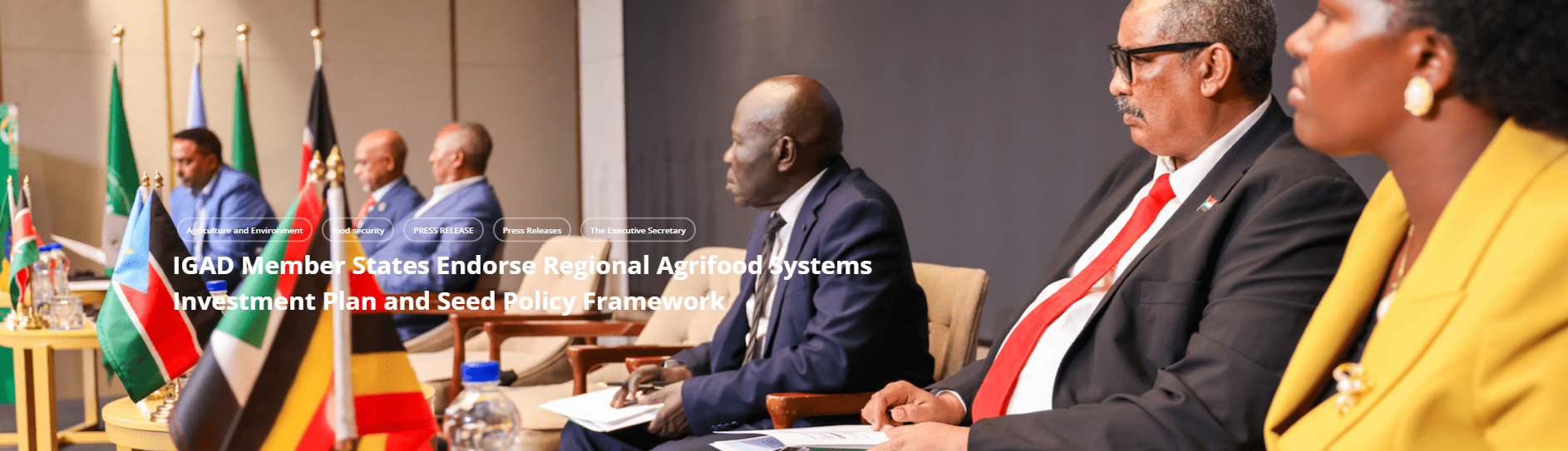
DJIBOUTI — September 20, 2026 — The Intergovernmental Authority on Development is advancing efforts to strengthen agricultural integration across the Horn of Africa, with member states endorsing two regional frameworks designed to coordinate agrifood investment and bring greater consistency to seed policies and regulations.
At the center of the initiative are the IGAD Regional Agrifood Systems Investment Plan 2026–2035 and the Regional Seed Policy and Regulatory Framework.
Together, the frameworks represent an effort to move regional agricultural cooperation beyond broad policy commitments and toward practical measures that could affect farmers, seed producers, agricultural businesses and food markets across IGAD member states.
Building a Regional Agrifood System
The Regional Agrifood Systems Investment Plan provides a longer-term framework for coordinating agricultural and food-system investment through 2035.
The significance of such regional planning is particularly important in the Horn of Africa, where food production and supply chains do not stop at national borders.
Drought, flooding, climate change, conflict and disruptions to transportation can affect several countries simultaneously. Livestock, agricultural products and other goods also move through cross-border markets.
A coordinated regional approach could therefore allow governments to address some of these challenges collectively rather than treating food security exclusively as a national issue.
For IGAD, the larger objective is to build food systems that are more productive, resilient and capable of responding to regional shocks.
Harmonizing Seed Regulations
The Regional Seed Policy and Regulatory Framework could have especially practical implications for regional integration.
Seed regulations—including certification, registration, quality standards and approval processes—can differ significantly between countries.
When national regulatory systems are incompatible, a seed variety approved in one country may face additional regulatory requirements before it can enter another market.
Regional harmonization is intended to reduce those regulatory differences.
A more compatible system could make it easier for approved, improved seed varieties to move across borders while maintaining agreed standards for seed quality and regulation.
For farmers, the potential importance is substantial. Greater regional access to appropriate seed varieties could support productivity and help agricultural communities respond to changing environmental conditions.
However, the ultimate effects will depend on how member states implement the regional framework through their national regulatory systems.
Why This Is African Integration in Practice
Regional integration is often discussed through major institutions, treaties and diplomatic summits.
But agricultural regulation demonstrates how integration can affect everyday economic activity.
If IGAD countries harmonize seed standards, coordinate agricultural investment and improve cross-border agricultural markets, farmers and businesses could increasingly operate within a regional system rather than navigating entirely separate national systems.
That is one of the fundamental ideas behind regional economic integration: reducing unnecessary regulatory barriers while creating common or compatible rules that facilitate cross-border economic activity.
Climate Resilience Adds Urgency
The initiative also has a food-security dimension.
The Horn of Africa has repeatedly faced severe droughts and other climate-related shocks. A disruption in one country’s agricultural system can contribute to wider regional pressure through food prices, migration, livestock movements and cross-border trade.
Regional coordination cannot eliminate drought or climate shocks.
But stronger agricultural markets, coordinated investment and more compatible regulatory systems can potentially give countries additional tools for responding to them.
Instead of every country attempting to strengthen its food system independently, regional planning creates opportunities for governments to coordinate investments and identify shared priorities.
From IGAD to the Continental Integration Agenda
The development also illustrates the relationship between Africa’s Regional Economic Communities and the African Union’s broader integration agenda.
IGAD is one of the eight Regional Economic Communities recognized by the African Union. Regional initiatives can therefore serve as building blocks for wider continental cooperation.
Agriculture is particularly important because successful African economic integration will require more than lowering tariffs.
Countries also need compatible standards and regulations that allow products to move efficiently across borders.
That principle is relevant to the broader objectives of the African Continental Free Trade Area, which seeks to expand intra-African commerce and create a more integrated continental market.
The Implementation Test
Endorsing regional frameworks, however, is only the beginning.
The next stage will determine their significance.
Member states will have to translate regional commitments into national policies, align regulatory systems where required, establish effective implementation mechanisms and ensure that farmers and agricultural businesses can actually benefit from the changes.
That creates an important benchmark for evaluating IGAD’s progress over the coming years.
The question is no longer simply whether countries in the Horn of Africa agree that greater agricultural cooperation is necessary.
The question is whether they can turn that agreement into functioning regional systems.
If implementation follows the ambition of the two frameworks, the Regional Agrifood Systems Investment Plan 2026–2035 and Regional Seed Policy and Regulatory Framework could become practical examples of what African regional integration looks like on the ground:
common priorities, more compatible rules, stronger cross-border markets and greater regional resilience.