
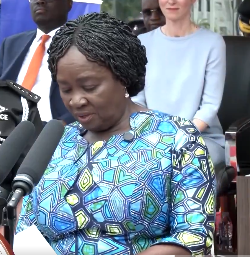
Jana Naana Opuku Agyemang
Ghanaian Vice President
Ghana is poised to become the first African nation to formalize a security and defence partnership with the European Union, a move that analysts say could reshape regional security dynamics and influence broader geopolitical alignments.
The announcement, made by EU foreign policy chief Kaja Kallas, places Ghana at the center of a new phase in Europe’s external security strategy—one that extends beyond the continent and into strategically significant regions such as West Africa.
The partnership is expected to enhance Ghana’s military capacity through training, intelligence-sharing, and logistical support. As one of the region’s most stable democracies, Ghana has increasingly been viewed as a reliable partner in addressing cross-border threats, particularly as instability deepens across the Sahel.
Countries such as Mali and Burkina Faso have faced persistent insurgencies in recent years, raising concerns about the potential spread of extremist activity դեպի coastal West Africa. Strengthening Ghana’s defensive and intelligence capabilities could position it as a frontline buffer against that expansion.
Beyond land-based threats, the agreement is also expected to address growing concerns in the Gulf of Guinea, a key maritime corridor plagued by piracy, illegal fishing, and oil theft. Increased cooperation with the EU could lead to expanded naval patrols and improved surveillance systems aimed at securing vital shipping routes.
At the regional level, the partnership may bolster the broader security framework of ECOWAS, which has faced internal divisions and mounting pressure in responding to political instability and military takeovers in parts of West Africa.
However, the development also introduces a new layer of geopolitical competition. External actors such as Russia and China have expanded their footprint across Africa in recent years, particularly in security and infrastructure sectors. The EU’s deeper engagement in Ghana may be interpreted as part of a broader effort to reassert influence in a region where global powers are increasingly active.
For the United States, the agreement presents both an opportunity and a strategic consideration. While Washington and Brussels share common goals—such as counterterrorism and regional stability—the EU’s growing role could gradually shift the balance of influence in West Africa. At the same time, the partnership may open the door for closer coordination through institutions like AFRICOM, particularly in joint training and intelligence-sharing initiatives.
Ultimately, the Ghana–EU security pact reflects a broader trend in which African nations are diversifying their international partnerships amid evolving global risks. As the agreement moves toward formalization, its impact is likely to extend beyond Ghana’s borders, shaping the future of security cooperation in West Africa and redefining the role of external actors on the continent.