
The African Union is preparing to confront one of the most important challenges facing continental integration: how to finance its institutions, peace and security operations, and long-term development priorities without excessive dependence on external funding.
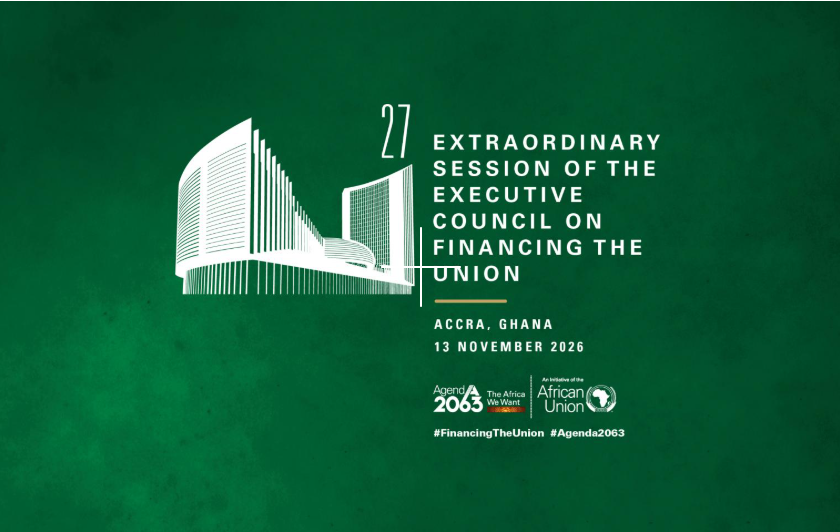
The African Union has announced its 27th Extraordinary Session of the Executive Council, dedicated to financing the Union, in Accra, Ghana. The gathering is expected to bring together foreign and finance ministers to examine financial self-reliance, budget reforms, institutional effectiveness, and sustainable financing for peace and security.
The extraordinary session represents an opportunity for AU member states to evaluate whether the continent’s financial arrangements are sufficient to support its growing political, economic, and security responsibilities.
For an organization representing 55 member states, the question extends beyond annual budget contributions. It concerns whether African governments can collectively finance the institutions and programmes needed to advance continental integration under Agenda 2063.
Financial Self-Reliance at the Center of AU Discussions
One of the principal issues expected to receive attention is the African Union’s long-standing objective of achieving greater financial independence.
Historically, the AU has relied on a combination of member-state contributions and external partner financing to support its activities.
Although international partnerships remain important, dependence on outside financing can create uncertainty over programme continuity, institutional priorities, and long-term planning.
The AU has previously pursued reforms intended to increase predictable funding, including the 2016 decision establishing a 0.2% levy on eligible imports from outside Africa as a potential mechanism for financing the Union.
However, implementation of the levy has varied among member states, highlighting the difficulties of translating continental financing commitments into consistent national policies.
The Accra discussions are expected to revisit the broader challenge of ensuring that financial commitments are supported by reliable collection mechanisms, accountability, and political cooperation.
The central question is whether African governments can develop a financing framework capable of supporting continental institutions while respecting the different economic circumstances of member states.
Budget Reform and Institutional Effectiveness
Beyond raising additional revenue, the extraordinary session is expected to examine how existing African Union resources are managed.
Budget reform is closely connected to the AU’s wider institutional reform agenda, which seeks to improve efficiency, accountability, transparency, and the delivery of agreed continental priorities.
For the Union, increasing revenue without improving financial management would not necessarily produce stronger institutions.
Effective reforms would need to address how budgets are developed, how expenditure is monitored, and how financial resources are allocated across AU organs and programmes.
Greater coordination between the African Union Commission, member states, and other AU institutions could also help reduce duplication and ensure that funding supports measurable outcomes.
The discussion comes as African governments face competing domestic priorities, including public debt, infrastructure development, education, healthcare, and employment creation.
These pressures make financial discipline and demonstrable institutional effectiveness especially important.
Financing African Peace and Security
Another major issue expected to feature in the Accra session is the financing of peace and security operations.
Across the continent, the African Union continues to confront security challenges involving armed conflict, political instability, terrorism, and humanitarian emergencies.
Peace support operations, conflict prevention mechanisms, mediation efforts, and post-conflict reconstruction require substantial and predictable financial resources.
The African Union Peace Fund is one mechanism intended to strengthen the organization’s ability to respond to these challenges.
However, sustainable financing remains a central concern, particularly when peace operations require multiyear commitments and coordination with regional organizations and international partners.
The extraordinary session could provide an opportunity to examine how African-led security initiatives can receive more reliable financial support.
Financial independence in peace and security does not necessarily mean ending international partnerships. Rather, it could strengthen African ownership of strategic priorities while maintaining cooperation with institutions such as the United Nations.
What Financial Reform Means for Africa’s Regional Economic Communities
The financing debate also carries important implications for Africa’s eight African Union-recognized Regional Economic Communities.
These organizations include ECOWAS, the East African Community, SADC, COMESA, IGAD, ECCAS, CEN-SAD, and the Arab Maghreb Union.
Regional Economic Communities play important roles in implementing continental integration objectives through trade facilitation, infrastructure development, regional security cooperation, and economic policy coordination.
However, continental strategies often depend on national governments and regional institutions having sufficient financial and administrative capacity to implement them.
For example, the African Continental Free Trade Area aims to create a more integrated African market, but its success depends partly on investments in transportation networks, customs modernization, digital infrastructure, and productive industries.
Similarly, cross-border electricity networks, regional railway corridors, and shared water-management systems require sustained financial commitments.
Although the Accra meeting is specifically focused on financing the African Union, improvements in continental financial governance could contribute to stronger coordination with the Regional Economic Communities.
That relationship is particularly important because the success of African integration depends not only on decisions made at the continental level but also on implementation across regional and national institutions.
Ghana’s Role as Host
Ghana’s selection as the host of the extraordinary session places Accra at the center of an important continental policy discussion.
Ghana has a longstanding association with Pan-Africanism and African political unity, dating back to the leadership of its first president, Kwame Nkrumah.
The country also hosts the Secretariat of the African Continental Free Trade Area, giving it a prominent institutional role in Africa’s economic integration agenda.
Holding the financing discussions in Accra therefore carries symbolic significance.
It connects the historical ambition of African unity with the contemporary challenge of financing the institutions required to make that ambition operational.
What Outcomes Should Be Watched?
The announcement establishes the purpose and anticipated agenda of the 27th Extraordinary Session. It does not, by itself, confirm that ministers have approved new financing arrangements or adopted budget reforms.
Several developments will be important to monitor as the process moves forward:
- Whether member states agree on specific measures to improve the collection of assessed contributions.
- Whether ministers recommend changes to budget oversight and financial accountability.
- Whether new commitments emerge concerning the African Union Peace Fund.
- Whether proposals include implementation deadlines, reporting requirements, or mechanisms for measuring compliance.
- Whether recommendations are forwarded to the appropriate AU decision-making bodies for further consideration or adoption.
The distinction between discussions, recommendations, adopted decisions, and actual implementation will be essential when assessing the session’s significance.
A Defining Question for African Integration
The African Union’s financing challenge reflects a broader issue facing continental integration.
African governments have established ambitious objectives through Agenda 2063, the African Continental Free Trade Area, and numerous regional development programmes.
Yet the effectiveness of these initiatives depends on whether member states can mobilize the resources, institutions, and political commitments necessary to implement them.
A financially stronger African Union could improve long-term planning, institutional coordination, and the continent’s capacity to respond to shared challenges.
Nevertheless, financial independence cannot be achieved through declarations alone.
It requires consistent contributions, effective budget management, transparent institutions, and measurable implementation.
The 27th Extraordinary Session in Accra is therefore an important opportunity to examine whether the African Union can move closer to a financing system that matches its continental responsibilities.
For Africa’s 55 member states, the underlying question is clear: Can the continent build and sustainably finance the institutions necessary to achieve its own integration ambitions?