
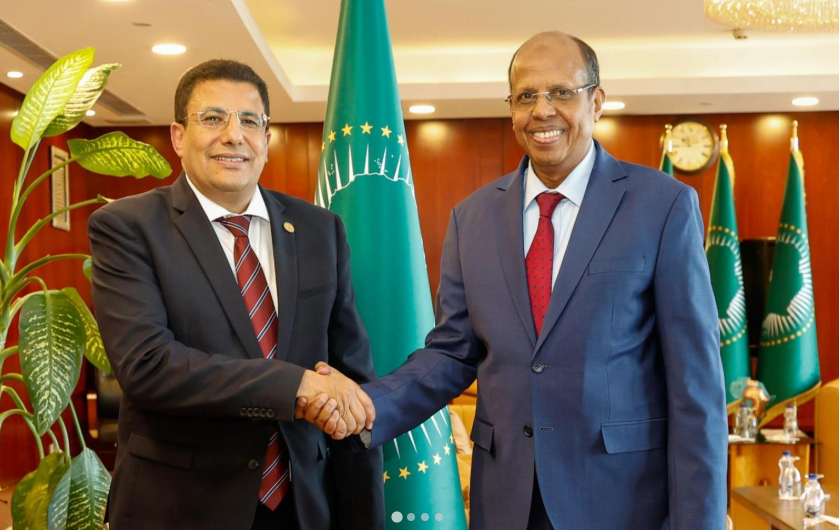
ADDIS ABABA, Ethiopia — African Union Commission Chairperson Mahmoud Ali Youssouf has met with Pan-African Parliament President Fateh Boutbig to discuss institutional reforms, parliamentary effectiveness and stronger cooperation among the African Union’s governing bodies.
The discussions focused on improving the Pan-African Parliament’s ability to carry out its responsibilities, including revisions to its Rules of Procedure and closer coordination with other African Union organs.
The meeting comes ahead of the Parliament’s next ordinary session, scheduled for December 1–17, 2026, when parliamentary representatives are expected to continue their work on continental governance and institutional priorities.
Strengthening the Pan-African Parliament’s Institutional Capacity
During the meeting, President Boutbig outlined several proposals intended to strengthen the Parliament’s operational effectiveness and its contribution to African integration.
Among the initiatives discussed was the establishment of a parliamentary research centre that could provide lawmakers with technical analysis, policy research and institutional support.
Such a centre could help parliamentarians examine complex continental challenges involving economic integration, regional security, infrastructure development and the implementation of African Union policies.
Boutbig also proposed additional training programmes designed to improve parliamentary capacity and strengthen the effectiveness of representatives participating in the institution’s work.
These initiatives remain proposals, and their implementation would depend on the necessary institutional decisions, resources and approvals.
Revising the Rules of Procedure
Another important subject was the revision of the Pan-African Parliament’s Rules of Procedure.
These rules govern the Parliament’s internal operations, including parliamentary debates, committee activities, decision-making processes and institutional responsibilities.
Revising the rules could provide an opportunity to improve procedural clarity, accountability and administrative efficiency.
The discussions also highlight the broader challenge facing the African Union: ensuring that its institutions operate effectively while maintaining coordination across continental and regional structures.
The Pan-African Parliament was established to promote the participation of African peoples in continental governance and integration. However, its legislative authority remains limited under its existing institutional framework.
Consequently, improvements to parliamentary procedures do not automatically expand its legislative powers. Any significant change to those powers would require the appropriate legal and institutional processes.
Expanding Cooperation on Conflict Prevention
The meeting also addressed opportunities for greater parliamentary involvement in conflict prevention.
Boutbig outlined proposals for strengthening cooperation between the Pan-African Parliament and other AU institutions working on peace and security.
The African Union’s continental peace and security architecture includes the Peace and Security Council and other mechanisms responsible for conflict prevention, mediation and crisis response.
Closer parliamentary engagement could provide additional opportunities for dialogue, oversight and political consultation concerning conflicts affecting African countries.
Parliamentary representatives may also contribute perspectives from their respective national legislatures, helping connect continental peace initiatives with domestic political institutions.
However, the proposals discussed should not be interpreted as the establishment of new conflict-prevention powers or mechanisms. Those outcomes would require further institutional action.
December Parliamentary Session Approaches
The Pan-African Parliament’s next ordinary session is scheduled to take place from December 1 through December 17, 2026.
The session provides an upcoming opportunity for parliamentarians to consider institutional priorities and continue discussions concerning the Parliament’s role within the African Union.
The precise decisions to be taken during the session will depend on its formally adopted agenda and parliamentary proceedings.
The December gathering will also provide an opportunity to assess whether the reform proposals discussed between Youssouf and Boutbig move toward concrete institutional consideration.
Why This Matters for African Integration
The African Union’s long-term integration ambitions depend not only on decisions made by heads of state and government but also on the effectiveness of the institutions responsible for supporting those decisions.
The Pan-African Parliament occupies a distinctive position within this framework because it provides a continental forum for parliamentary representatives from AU member states.
Stronger research capabilities, improved parliamentary procedures and closer institutional coordination could help the Parliament contribute more effectively to the African Union’s Agenda 2063 objectives.
These objectives include strengthening democratic governance, promoting peace and security, expanding economic integration and building more effective continental institutions.
Nevertheless, institutional effectiveness cannot be measured solely by the announcement of reform proposals.
Meaningful progress will depend on whether those proposals receive approval, secure funding, become operational and produce measurable improvements in parliamentary performance.