
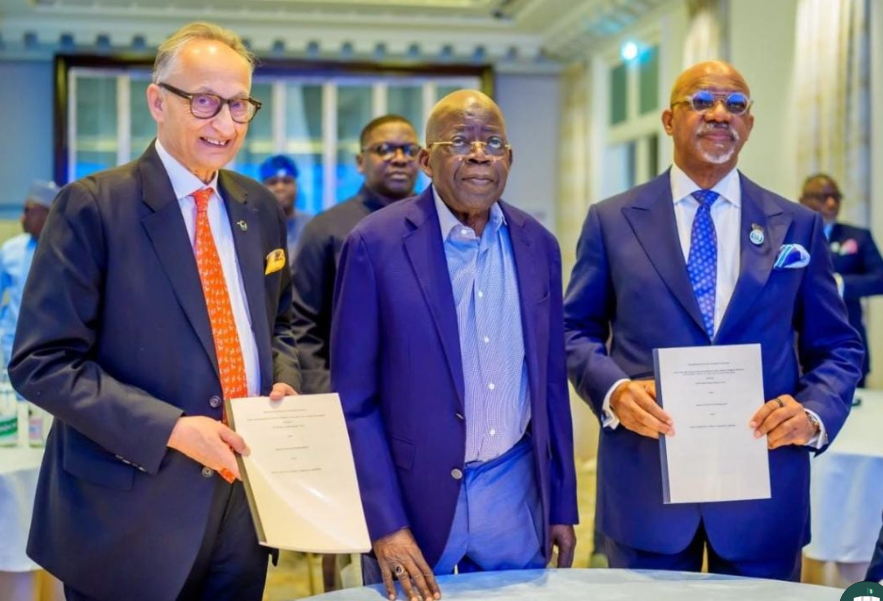
PARIS, France — September 24, 2026 — Nigeria has taken another step toward expanding its maritime and logistics infrastructure following the signing of agreements between the Ogun State Government and global ports operator DP World for the development of the Gateway Deep Seaport and the Ogun State Blue Marine Special Economic Zone.
The agreements were signed in Paris, where Nigerian President Bola Ahmed Tinubu assured investors that the Federal Government would provide regulatory clarity, policy stability and institutional support as the projects move from agreements toward implementation.
According to Nigeria’s State House, the agreements envisage an initial investment exceeding $7 billion and combine a major deep-water port with a large industrial and special economic zone.
A New Deep-Water Gateway
The proposed Gateway Deep Seaport, located at Ogun Waterside, is expected to feature a four-kilometre berth and an 18-metre draft, allowing it to accommodate larger deep-draft vessels used in international shipping.
Nigeria’s presidency says the project is intended to help relieve pressure on the heavily congested Apapa and Tin Can Island ports in Lagos, while potentially reducing logistics costs and delays affecting importers, exporters and consumers.
The port would be developed alongside the proposed Ogun State Blue Marine Special Economic Zone, which is planned across approximately 10,000 hectares. The government’s vision is to integrate maritime infrastructure with manufacturing, processing, logistics and export-oriented industries rather than developing the port as an isolated cargo facility.
At full development, the Nigerian presidency projects that the two projects could generate more than 50,000 direct jobs, in addition to indirect employment opportunities. Those figures remain projections and will depend on financing, construction and eventual implementation.
Connecting the Port to Nigeria’s Transport Network
One of the most important questions surrounding major African port projects is what happens after cargo leaves the waterfront.
President Tinubu said the Federal Government intends to facilitate road, rail and power connectivity for the development. He specifically identified the Lagos–Calabar Coastal Highway as important to the commercial viability of the Gateway port and economic zone.
The 28-kilometre Ogun State section of the planned 700-kilometre highway is expected to connect the development more effectively with Lagos, Nigeria’s interior and potentially wider African markets.
That connectivity could ultimately determine the project’s regional significance. A modern deep-sea port can increase vessel and cargo capacity, but its impact on trade depends heavily on efficient road and rail networks, customs procedures and connections to production centers and neighboring markets.
The AfCFTA Dimension
The project also has potential implications beyond Nigeria.
The Nigerian government explicitly presented the Gateway Deep Seaport as a potential logistics gateway serving the African Continental Free Trade Area (AfCFTA) and its continental market.
That makes the development particularly significant from the perspective of African economic integration.
AfCFTA seeks to expand intra-African commerce, but reducing tariffs alone cannot create an integrated African market. Goods must also be able to move efficiently between factories, ports, borders and consumers.
West Africa continues to face significant infrastructure and logistics constraints. Congested ports, inadequate transport corridors, border delays and weak connections between maritime infrastructure and inland markets can increase the cost of moving goods across the region.
If the Gateway Deep Seaport is eventually connected effectively to Nigeria’s road and rail networks—and those networks link efficiently into regional corridors—the project could provide additional infrastructure supporting trade between Nigeria and other African economies.
Potential Significance for ECOWAS
There is also a broader West African integration dimension.
Nigeria is the region’s largest economy and sits at the center of important coastal and inland trading routes. Increasing its maritime capacity could provide additional options for regional supply chains, particularly if port development is accompanied by improved cross-border transport infrastructure and more efficient customs systems.
That could complement the objectives of both ECOWAS regional economic integration and AfCFTA continental integration.
However, constructing a modern port is only part of that equation.
For the project to become a genuine regional trade gateway, cargo will need to move efficiently beyond Ogun State. That means connections with highways, rail networks, industrial centers, border crossings and regional transport corridors will be critical.
From Agreement to Implementation
The signing represents an important milestone, but the project is still at a stage where implementation will determine its ultimate impact.
President Tinubu said the federal government would provide regulatory and institutional support and called on Ogun State and investors to maintain momentum as the projects advance.
The next questions will therefore concern financing, regulatory approvals, construction timelines, supporting infrastructure and how quickly the port and economic zone can move from planning into physical development.
For Nigeria, the project represents an attempt to address longstanding port and logistics constraints while expanding maritime and industrial capacity.
For West Africa, the larger question is whether infrastructure projects such as the Gateway Deep Seaport can increasingly become regional assets rather than simply national projects.
And for the African Continental Free Trade Area, that distinction matters.
Africa’s integration ambitions will ultimately depend not only on treaties and declarations, but on the ports, railways, highways, border systems and logistics networks capable of moving African goods across African borders.
The Gateway Deep Seaport could become one piece of that emerging network—but its continental importance will depend on what happens after the agreements signed in Paris move into implementation.