
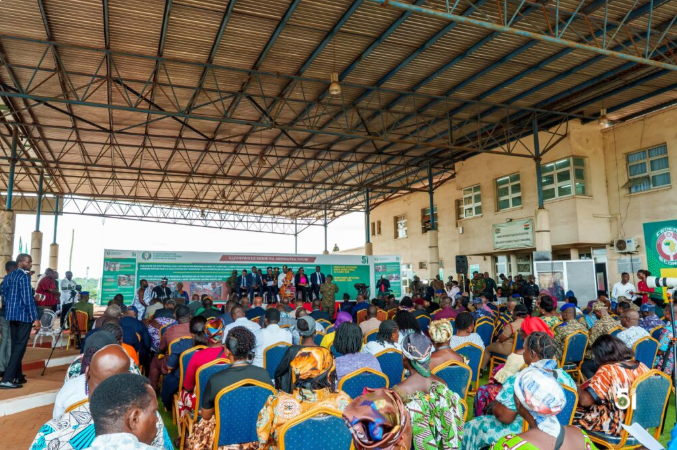
August 19, 2026 — The Economic Community of West African States (ECOWAS) is taking its regional integration agenda directly to the people who experience cross-border movement every day, holding a high-level dialogue and sensitisation exercise at the Noépé–Akanu Joint Border Post between Ghana and Togo.
ECOWAS announced on August 18 that the initiative brought together border officials, cross-border traders, transporters, women, young people and other stakeholders from Ghana, Togo and Benin.
The engagement focused attention on one of the most practical aspects of West African integration: the ability of citizens and goods to move efficiently between member states.
Bringing Integration to the Border
The ECOWAS principle of free movement is intended to make it easier for citizens of member states to travel, reside, and conduct economic activities across participating countries. However, the effectiveness of regional agreements is ultimately determined by what happens at actual border crossings.
By engaging directly with traders, transport operators and border personnel, ECOWAS can better understand practical challenges that may interfere with regional movement, including border delays, customs procedures, documentation requirements and other obstacles affecting travelers and businesses.
Joint border posts such as Noépé–Akanu are particularly important because they are designed to improve coordination between neighboring countries and make border processing more efficient.
For small-scale traders, especially women who make up a significant part of West Africa’s cross-border trading economy, improvements at border crossings can mean less time waiting, lower transportation costs and more reliable access to regional markets.
Integration That Citizens Can Experience
The dialogue also demonstrates that regional integration is not limited to meetings among presidents, ministers and ECOWAS officials.
For an ordinary citizen traveling between Ghana and Togo, a truck driver transporting goods across the region or a trader selling products in neighboring countries, the border is where ECOWAS integration becomes real.
Efficient border management can help increase intra-regional commerce, strengthen regional supply chains and support the broader ECOWAS objective of creating a more connected West African economic community.
The involvement of stakeholders from Ghana, Togo and Benin also highlights the importance of cooperation along regional trade and transportation corridors rather than addressing border challenges solely from a national perspective.
As ECOWAS continues to promote the free movement of people and goods, initiatives such as the Noépé–Akanu dialogue provide an opportunity to identify the gap between regional policies and citizens’ everyday experiences.
Ultimately, the success of West African integration will depend not only on agreements signed by governments, but on whether people and businesses can actually cross borders safely, predictably and efficiently.