
BRAZZAVILLE/KINSHASA — August 17, 2026 — The Economic Community of Central African States (ECCAS) is continuing work toward one of Central Africa’s most significant proposed infrastructure projects: a combined road-and-rail bridge across the Congo River linking Brazzaville in the Republic of Congo with Kinshasa in the Democratic Republic of Congo.
The two national capitals sit directly across the Congo River from each other, yet passengers and freight currently depend largely on river transportation to travel between them. A permanent bridge would create a direct road and rail connection between the neighboring capitals and could become an important link in Central Africa’s regional transportation network.
ECCAS highlighted the project on its official portal following technical work conducted in Kinshasa in July, demonstrating that the long-discussed project remains part of the regional integration agenda.
ECCAS Delegation Meets Republic of Congo Government
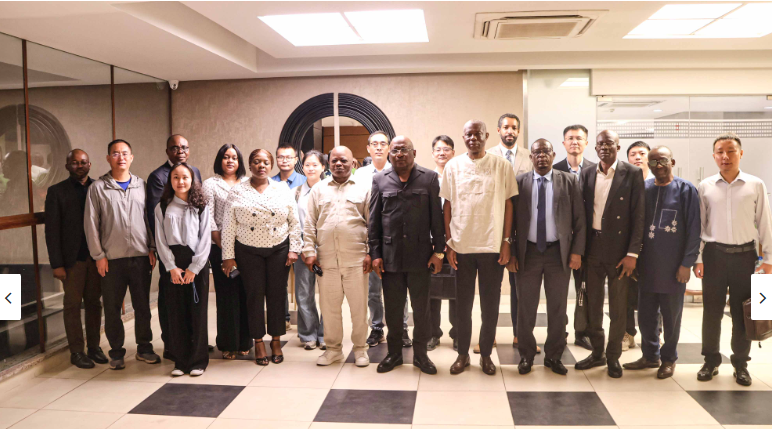
Momentum around the project was reinforced when an ECCAS delegation recently met with the Republic of Congo’s minister responsible for the Economy, Planning, Statistics, Prospective and Regional Integration.
According to ECCAS, discussions included the Brazzaville–Kinshasa road-and-rail bridge, with further activity connected to the project expected in October 2026.
The engagement illustrates the importance of cooperation between ECCAS institutions and national governments if large cross-border infrastructure projects are to move from planning to construction.
Connecting Two Capitals
The proposed bridge is particularly significant because of the unusual geography of Brazzaville and Kinshasa.
Although the two capitals are separated only by the Congo River, the absence of a permanent road connection limits the movement of vehicles, freight and passengers between them.
A bridge could fundamentally change that relationship.
Businesses could potentially move goods more efficiently between the Republic of Congo and the Democratic Republic of Congo, while travelers would gain an alternative to existing river crossings.
For small businesses and cross-border traders, improved transportation could reduce some of the logistical difficulties associated with moving products between the two cities.
More Than a Bridge
The project also has implications beyond Brazzaville and Kinshasa.
ECCAS’s mandate includes promoting cooperation and regional integration across Central Africa in economic, financial, social, scientific, technical and other areas.
Transportation infrastructure is critical to that goal.
Central Africa possesses significant natural resources and a large potential consumer market, but inadequate connections between countries remain an obstacle to greater regional trade.
A road-and-rail bridge could therefore serve as part of a broader network connecting national transportation corridors rather than functioning simply as a crossing between two cities.
Improved infrastructure could also complement the objectives of the African Continental Free Trade Area (AfCFTA) by making it physically easier to move African goods between markets.
Regional Integration People Can See
For ordinary citizens, infrastructure projects are among the most visible examples of regional integration.
Treaties and regional agreements can establish the legal framework for cooperation, but roads, railways, bridges and border facilities determine whether people and businesses can actually take advantage of those agreements.
A permanent Brazzaville–Kinshasa connection could improve passenger movement, support cross-border commerce and provide new opportunities for transportation and logistics businesses.
The project remains a major undertaking, and continued political coordination, financing and technical preparation will be essential before its potential benefits can be fully realized.
But its significance is clear: connecting two of Africa’s closest capital cities could help connect more of Central Africa’s economies to one another.