
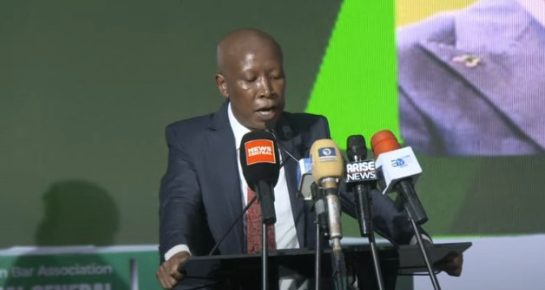
Few political figures on the African continent generate as much controversy as South African opposition leader Julius Malema.
To his supporters, he is a fearless Pan-Africanist willing to challenge the political establishment. To his critics, he is a divisive populist whose rhetoric often inflames racial and political tensions. Many people have profound disagreements with Malema’s domestic politics, his style of leadership, and some of his policy positions.
Yet on one issue he raised during his speech at the Nigerian Bar Association’s Annual General Conference in Enugu, many of those same critics will find it difficult to disagree with him.
Malema called for a borderless Africa, a common African currency, a single African Parliament, one military command, and ultimately one African presidency.
Whether one believes these objectives are achievable in the near future is another debate altogether. But the direction he outlined is one that Africa should seriously pursue.
His speech comes at a time when events across the world are exposing the dangers of Africa’s dependence on external powers.
Only months ago, the Trump administration dismantled USAID, abruptly ending decades of American foreign assistance as it had traditionally existed. Predictably, critics warned that Africa would face a humanitarian catastrophe. There is no question that many important health programs suffered immediate disruption.
At the time, however, I argued that the decision could ultimately become a blessing in disguise.
Not because aid is inherently bad.
Not because Africa does not value partnerships.
But because no continent that seeks genuine independence can continue financing essential public services through the generosity of foreign governments whose priorities can change after every election.
Recent developments have reinforced that argument.
The United States is now returning with a different approach to health assistance—one based on bilateral agreements that openly advance American strategic and commercial interests. Washington has made clear that its foreign assistance is designed to promote American priorities first.
No one should be surprised by that.
Every sovereign nation acts in its own national interest.
The United States does.
China does.
The European Union does.
India does.
The question is whether African governments are prepared to do the same.
That is why Malema’s message deserves careful consideration.
Africa is home to more than 1.5 billion people. It possesses approximately 30 percent of the world’s known mineral reserves, vast agricultural land, enormous renewable energy potential, and one of the youngest populations on Earth. The continent’s combined economy exceeds $3 trillion.
Yet despite these extraordinary advantages, many African countries still depend heavily on foreign aid to finance healthcare, education, and even basic government services.
That model is neither sustainable nor consistent with the aspirations of a continent seeking greater influence in global affairs.
Malema’s call for deeper African integration is rooted in an idea that predates him by decades.
Kwame Nkrumah envisioned a United States of Africa. Julius Nyerere believed African unity was essential to development. Even the founders of the African Union recognized that the continent would carry greater weight if it acted collectively rather than as dozens of fragmented states competing against one another.
The African Union has already taken important steps in this direction.
The African Continental Free Trade Area is creating the world’s largest free trade area by number of participating countries.
The Africa Centres for Disease Control and Prevention has demonstrated during and after the COVID-19 pandemic that continental institutions can coordinate responses to major health emergencies.
The Pan-African Parliament exists, even though its legislative authority remains limited.
The African Passport and the Protocol on Free Movement aim to make it easier for Africans to travel, work, and do business across borders.
These are not radical fantasies.
They are existing African Union initiatives that require stronger political commitment.
Of course, significant obstacles remain.
Fifty-four sovereign governments have different political systems, legal traditions, security concerns, currencies, and economic priorities.
Creating a single presidency or common currency tomorrow would be unrealistic.
Even the European Union—which is often viewed as the world’s most advanced regional bloc—has spent decades integrating and still faces challenges.
But difficulty should not become an excuse for inaction.
Africa’s future depends less on whether it can achieve complete political union overnight and more on whether it can steadily deepen cooperation in trade, infrastructure, healthcare, education, technology, and security.
Imagine an Africa where businesses move goods without unnecessary border delays.
Imagine African airlines operating seamlessly across the continent.
Imagine pharmaceuticals manufactured in Africa for African markets.
Imagine African universities collaborating on scientific research instead of relying primarily on foreign institutions.
Imagine investors seeing Africa as one integrated market rather than 54 separate economies.
That vision would transform the continent.
Those who dismiss Malema simply because they disagree with him politically risk overlooking an important truth.
A good idea does not become a bad idea because of the person who presents it.
Likewise, disagreement with a politician’s broader agenda should not prevent honest consideration of proposals that could benefit an entire continent.
Africa’s greatest challenge has never been a lack of resources.
It has been a lack of integration, coordination, and long-term strategic thinking.
If the continent truly wants to reduce dependence on foreign aid, protect itself from shifting geopolitical priorities, and create lasting prosperity, then African leaders must think beyond national borders and begin acting more like partners than competitors.
On that point, Julius Malema has started a conversation that Africa cannot afford to ignore.