
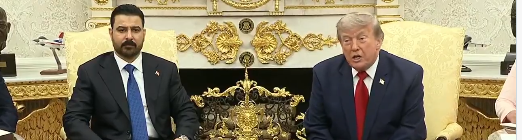
WASHINGTON, D.C. — President Donald Trump welcomed Iraqi Prime Minister Mohammed Shia al-Sudani to the White House on Tuesday for high-level bilateral talks aimed at strengthening ties between Washington and Baghdad amid continuing tensions across the Middle East.
The two leaders greeted each other outside the White House before proceeding inside for meetings expected to focus on security cooperation, regional stability, counterterrorism efforts, economic relations, and the future of the U.S.-Iraq strategic partnership.
The meeting comes at a time when Iraq finds itself balancing relationships with both the United States and neighboring Iran while seeking greater stability after years of conflict and political uncertainty. U.S. officials have repeatedly emphasized Iraq’s importance in maintaining security in the region and preventing the resurgence of terrorist organizations such as ISIS.
According to officials familiar with the discussions, the agenda includes continued military cooperation, support for Iraqi security forces, energy investment, and broader diplomatic coordination on regional crises.
The visit generated widespread discussion on social media, with supporters viewing the meeting as an opportunity to deepen cooperation while critics questioned the direction of U.S. policy in the Middle East.
One user on X wrote:
“A strong U.S.-Iraq relationship is essential for stability in the Middle East. Dialogue is always better than disengagement.”
Another commentator posted:
“Security cooperation should remain the priority. Iraq has made progress, but regional threats remain.”
Others highlighted the economic dimension of the visit.
“Trade, energy, and investment deserve as much attention as military cooperation. Long-term partnerships are built on economic growth.”
Some users expressed caution about the meeting’s potential outcomes.
“Diplomatic meetings are important, but the real measure will be whether today’s discussions produce tangible results for both countries.”
Another social media post noted Iraq’s difficult geopolitical position.
“Iraq continues to walk a delicate line between regional powers. Strong diplomacy will be critical for maintaining its sovereignty.”
Political analysts say the meeting underscores Washington’s continuing interest in Iraq despite shifting U.S. priorities elsewhere. Iraq remains a key partner in counterterrorism operations and plays an increasingly important role in regional energy markets and Middle Eastern diplomacy.
The talks are expected to conclude with statements from both leaders outlining areas of cooperation and reaffirming commitments made under the U.S.-Iraq Strategic Framework Agreement.
While no major policy announcements were made before the meeting began, officials from both governments indicated that the discussions are intended to reinforce bilateral ties at a time of significant geopolitical uncertainty across the Middle East.
Observers will now be watching closely to see whether the talks yield concrete agreements on security cooperation, economic investment, and regional coordination as both countries navigate an increasingly complex strategic landscape.