
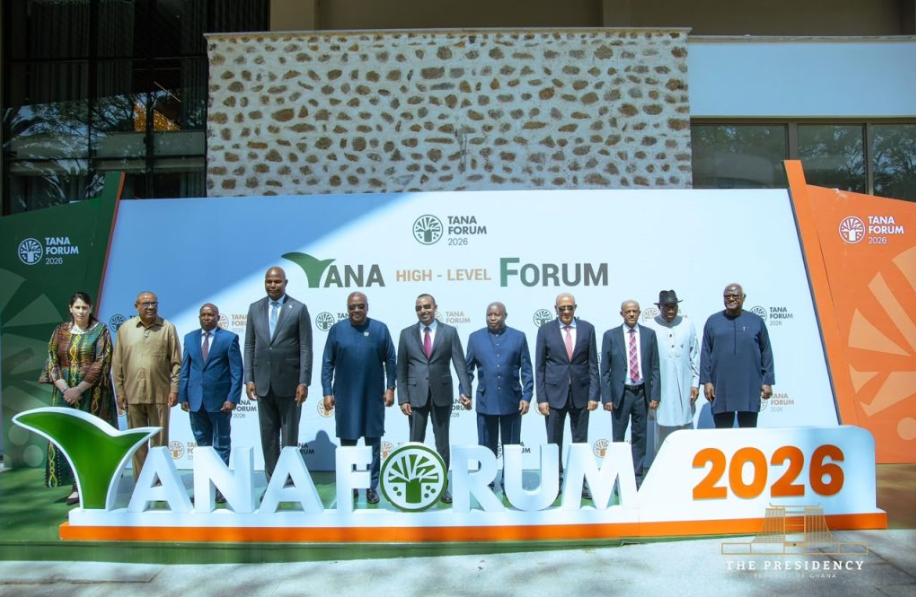
ACCRA, GHANA — Ghanaian President John Dramani Mahama has outlined a proposed regional security arrangement aimed at strengthening cooperation between countries in the Sahel and the Gulf of Guinea, while emphasizing that Africa’s long-term security depends on economic opportunity, inclusive development and stronger regional institutions.
Speaking at the Tana High-Level Forum on Security in Africa, where he presented the 2026 State of Peace and Security in Africa Report, Mahama argued that military responses alone cannot resolve the continent’s security challenges.
He identified economic inequality, unfair resource exploitation and the exclusion of communities from economic opportunities as underlying conditions that can contribute to instability.
A New Sahel–Gulf of Guinea Security Framework
Central to Mahama’s proposals is the Sahel Gulf of Guinea Accord, a proposed regional security architecture designed to strengthen defence cooperation between willing African countries.
According to Ghana’s Presidency, the proposed arrangement would replace the Accra Initiative and establish a renewed framework for regional security coordination.
The proposal comes amid continuing security concerns across the Sahel and growing questions about cooperation between West African coastal states and their northern neighbours.
Mahama also emphasized the importance of maintaining dialogue with Burkina Faso, Mali and Niger, three countries that have withdrawn from the Economic Community of West African States (ECOWAS) and formed the Alliance of Sahel States (AES).
Continued engagement with these countries could prove essential to addressing security threats that extend beyond national borders.
However, the proposed accord remains an initiative rather than an established regional security institution. Its membership, operational structure and implementation arrangements will require further clarification.
Economic Integration as a Foundation for Peace
Beyond regional defence cooperation, Mahama presented economic integration as an essential component of Africa’s peace and security strategy.
He argued that regional cooperation must extend beyond increasing trade volumes to addressing the economic conditions that contribute to instability.
His priorities include expanding intra-African trade, strengthening domestic manufacturing, creating employment opportunities for young people and women, and improving African financing for peace operations.
This approach connects regional security to the broader objectives of the African Union’s Agenda 2063 and the African Continental Free Trade Area (AfCFTA).
By expanding economic opportunities and strengthening connections between national economies, African countries could address some of the structural pressures that contribute to conflict.
Implications for ECOWAS and African Integration
The proposed Sahel Gulf of Guinea Accord raises important questions about the future of regional cooperation in West Africa.
The withdrawal of Burkina Faso, Mali and Niger from ECOWAS has complicated established arrangements for political dialogue, economic integration and security coordination.
A new coalition involving Sahelian and coastal countries could provide an additional channel for cooperation despite those institutional divisions.
However, its effectiveness would depend on participating governments establishing clear responsibilities, sustainable financing and practical mechanisms for coordinating security operations.
The relationship between the proposed accord, ECOWAS and the AES will also be important in determining whether the arrangement strengthens regional cooperation or creates overlapping institutions.
The Bigger African Integration Question
Mahama’s proposals reflect a growing recognition that Africa’s security and economic development challenges are closely connected.
Regional infrastructure, industrial development, employment opportunities and cross-border commerce can contribute to stability, while insecurity can disrupt trade routes, discourage investment and weaken regional institutions.
For the African Union and its Regional Economic Communities, the challenge is to translate these connections into coordinated policies that deliver measurable results.
When the Dust Settles (WDS) Perspective
President Mahama’s proposal highlights an important dimension of African integration: regional cooperation cannot succeed through trade agreements alone if insecurity continues to undermine economic activity.
The proposed Sahel Gulf of Guinea Accord could become an important mechanism for reconnecting security cooperation across an increasingly divided West African region.
Its significance will ultimately depend on whether governments can move beyond political declarations and establish functioning institutions capable of addressing shared security challenges.
The central question is whether African countries can build security arrangements that protect national sovereignty while strengthening the economic and institutional cooperation necessary for lasting regional stability.
For Africa’s wider integration experiment involving 55 sovereign nations, the connection between peace, economic development, and regional cooperation remains fundamental.