
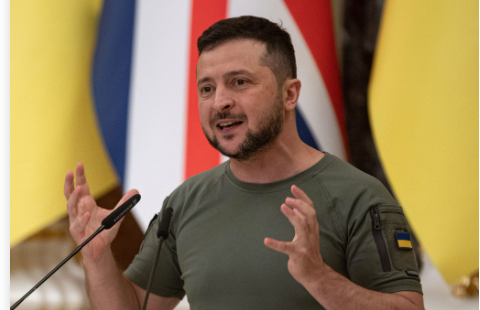
Ukrainian President Volodymyr Zelensky said Monday that Kyiv stands ready to assist the United States in addressing Iran’s growing use of drone technology, signaling Ukraine’s willingness to step forward as other American partners have yet to fully commit to Washington’s call for support.
Speaking to the New York Post, Zelensky indicated that Ukraine moved quickly to offer help, stressing that his government is prepared to contribute to the protection of U.S. personnel and civilians. He noted that Ukrainian specialists have already been sent to the Middle East to assess and counter Iranian drone activity, leveraging experience gained through years of conflict with Russia.
Zelensky’s remarks come as U.S. President Donald Trump has pressed allies—including China, France, Japan, South Korea, and the United Kingdom—to deploy naval assets to safeguard the Strait of Hormuz. The waterway remains vital to global energy markets, carrying roughly 20 percent of the world’s oil supply, and has recently been threatened by Iranian actions targeting commercial shipping.
However, despite Kyiv’s proactive stance, a White House official stated that American forces do not currently require Ukrainian assistance in drone defense. President Trump has maintained that the U.S. leads in drone technology, emphasizing the sophistication of its systems. Administration officials further reported that ongoing operations, identified as “Operation Epic Fury,” have sharply reduced the effectiveness of Iranian missile and drone strikes.
Zelensky nonetheless highlighted Ukraine’s extensive experience in counter-drone warfare, particularly against Iranian-designed Shahed drones. He pointed out that such weapons have already inflicted casualties in the current conflict, referencing a recent strike near Camp Arifjan in Kuwait that killed six American service members.
According to Zelensky, modern warfare is undergoing a fundamental shift, with drones increasingly displacing traditional missile systems. He cited economic efficiency as a driving factor, noting that while missiles can cost millions per launch, drones are far less expensive to produce. He added that Russia is currently deploying hundreds of drones daily against Ukraine, with expectations of even greater numbers in the future.
In response, Ukraine has developed more affordable defensive solutions, including interceptor drones capable of neutralizing incoming threats. Zelensky asserted that Ukraine has emerged as a leader in this technological domain and suggested that its knowledge could strengthen U.S. and allied defense capabilities.
As part of a broader partnership, Zelensky proposed a joint initiative to construct what he described as the world’s largest drone production facility. Under this plan, the United States would supply funding and industrial resources, while Ukraine would contribute its operational expertise and technological advancements.
He also suggested that American forces could benefit from training in Ukraine, where they could gain firsthand experience in navigating drone-intensive battlefields—conditions Zelensky described as markedly different from past conflicts.
At the same time, Zelensky warned that Russia could gain strategically from escalating tensions between the United States and Iran. He cautioned that a prolonged Middle East conflict might shift international focus away from Ukraine, reducing pressure on Moscow.
Reaffirming Ukraine’s position as a U.S. ally, Zelensky stressed the importance of continued cooperation in pursuit of stability and peace. He also cautioned that rapid technological progress—particularly in artificial intelligence-driven drone systems—could significantly reshape future conflicts.
“War comes when you are weak,” Zelensky said. “Not when you are strong.”
The situation reflects a broader shift in military strategy, as analysts increasingly view drone warfare not as a supplementary tool but as a central component of modern combat, posing new challenges even for the world’s most advanced militaries.