
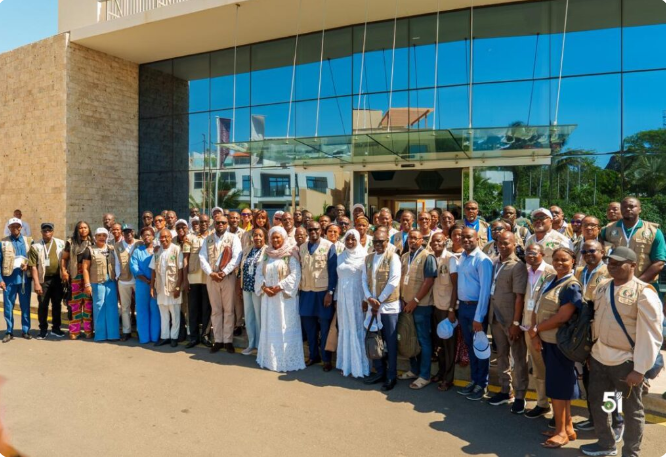
PRAIA, Cabo Verde — The Economic Community of West African States (ECOWAS) has praised the peaceful and orderly conduct of Cabo Verde’s presidential election, issuing a preliminary declaration following the deployment of its Election Observation Mission across the island nation.
The presidential election, held on November 15, was contested by six candidates, with incumbent President José Maria Neves of the African Party for the Independence of Cabo Verde (PAICV) emerging as the clear frontrunner. His main challenger was Joana Rosa, a former Minister of Justice and candidate of the Movement for Democracy (MpD), the country’s principal opposition party.
According to ECOWAS, the election took place within Cabo Verde’s established democratic framework and reflected the country’s longstanding commitment to constitutional governance, political pluralism, and peaceful electoral competition. The regional bloc deployed both long-term and short-term observers across all nine inhabited islands to monitor the process.
The ECOWAS mission, led by former Gambian Vice President Fatoumatta Jallow-Tambajang, reported that polling operations were generally conducted in a calm atmosphere. Observers noted that electoral officials carried out their duties professionally while voters were able to exercise their democratic rights without significant disruption.
In its preliminary assessment, ECOWAS commended the National Electoral Commission, security services, political parties, civil society organizations, and citizens for contributing to a peaceful electoral environment. The mission emphasized that the election reaffirmed Cabo Verde’s reputation as one of Africa’s most stable democracies.
Official provisional results showed President Neves securing nearly 64 percent of the vote, comfortably ahead of Rosa, who garnered approximately 32 percent. The remaining four candidates received small shares of the vote, making a second-round runoff unnecessary.
ECOWAS urged all candidates and stakeholders to continue demonstrating political maturity and respect for democratic institutions as the electoral process concludes. The organization also encouraged the use of established legal mechanisms to address any electoral grievances.
The regional bloc stated that a comprehensive final report containing detailed observations and recommendations will be released after the completion of all post-election procedures. ECOWAS reaffirmed its commitment to supporting democratic governance, credible elections, and political stability across West Africa.
For many observers, the election represents another milestone in Cabo Verde’s democratic journey, reinforcing the country’s status as a model of electoral stability and peaceful political competition in the ECOWAS region.