
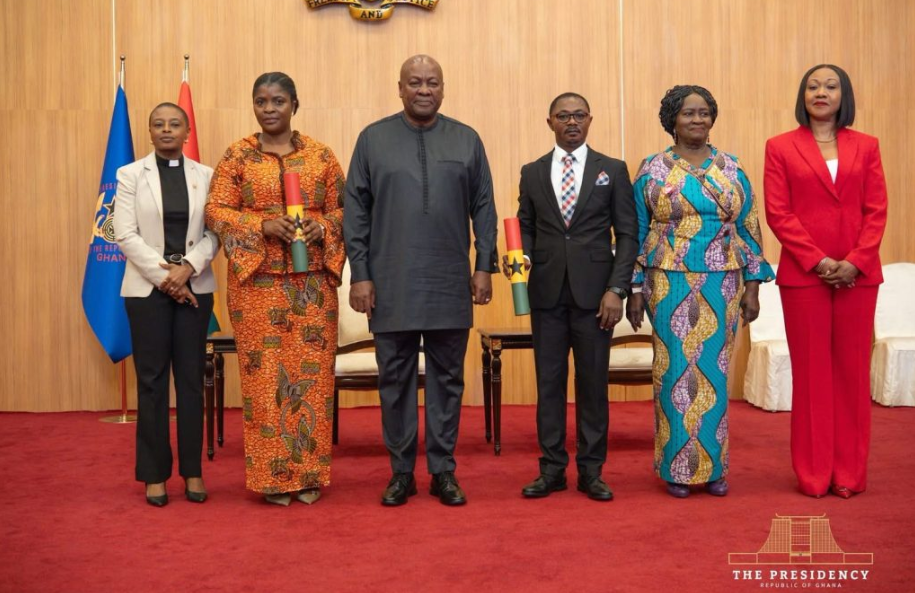
ACCRA, GHANA — Ghanaian President John Dramani Mahama has administered the oath of office to two newly appointed deputy chairpersons of the country’s Electoral Commission, emphasizing the importance of institutional independence, impartiality, and public confidence in the electoral process.
The newly appointed officials, Joseph Kwaku Asamoah and Emilia Afi Agbenyo, assume responsibilities within one of Ghana’s most important democratic institutions.
During the swearing-in ceremony, President Mahama urged the officials to uphold the Constitution, maintain professional independence, and ensure that electoral laws are applied equally to all political parties and candidates.
His remarks underscored the responsibility of the Electoral Commission to administer elections fairly and maintain public trust in Ghana’s democratic system.
Strengthening Electoral Independence and Accountability
The Electoral Commission plays a central role in organizing and supervising Ghana’s elections, maintaining electoral procedures, and protecting the integrity of the voting process.
President Mahama emphasized that electoral officials must carry out their responsibilities without political favoritism or interference.
Equal application of electoral laws is particularly important in maintaining confidence among political parties, candidates, and voters.
The appointments present an opportunity to strengthen administrative leadership within the Commission, although their impact will ultimately depend on the institution’s performance and adherence to established legal standards.
Electoral Technology and Voter Accessibility
President Mahama also encouraged the responsible use of technology in electoral administration.
Digital systems can improve voter registration, election management, and the efficiency of electoral procedures. However, their use requires appropriate safeguards to protect information, maintain transparency, and prevent technical failures from undermining public confidence.
The President also highlighted the importance of ensuring that voters with disabilities can participate fully in elections.
Accessible polling facilities, appropriate voting arrangements, and inclusive electoral information are essential to protecting equal voting rights.
Transparent communication with the public was another priority, particularly in explaining electoral procedures and addressing concerns that could affect confidence in election results.
Why This Matters for African Democracy
Ghana has an established history of competitive multiparty elections and peaceful transfers of political power, making its electoral institutions important to the country’s democratic development.
The independence and credibility of those institutions remain essential to sustaining public confidence.
Across Africa, strong electoral administration contributes to political stability, democratic accountability, and the legitimacy of elected governments.
For Ghana, the appointment of two deputy chairpersons offers an opportunity to reinforce professional standards and improve electoral administration.
However, institutional credibility cannot be established through appointments or public commitments alone.
The central question is whether Ghana’s Electoral Commission will continue strengthening impartiality, transparency, technological reliability, and voter accessibility in ways that build lasting public trust.
The effectiveness of the new leadership will ultimately be measured by how consistently the Commission applies electoral laws, protects voting rights, and administers elections in a fair and transparent manner.