
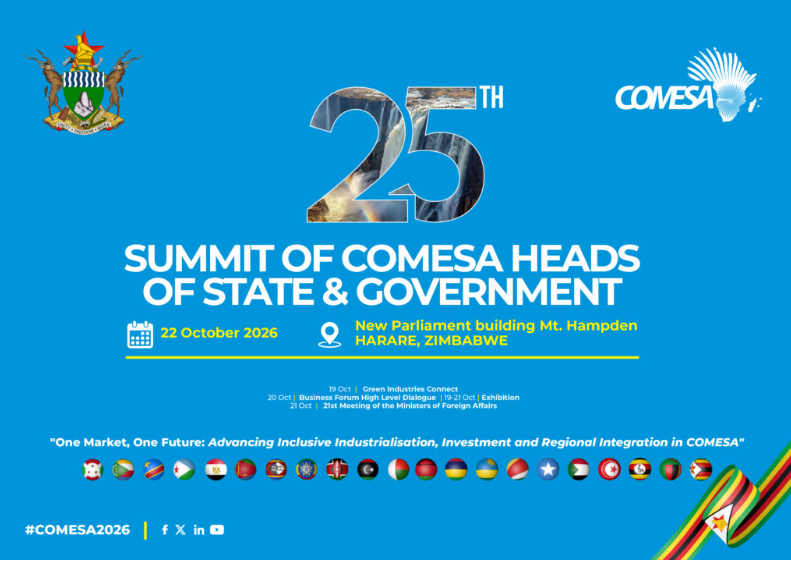
HARARE, Zimbabwe — October 9, 2026 — The Common Market for Eastern and Southern Africa (COMESA) has announced preparations for its 25th Heads of State and Government Summit, scheduled for October 19–22, 2026, in Harare, Zimbabwe. The gathering is expected to mark an important stage in the regional organization’s efforts to deepen economic integration, strengthen industrial development and expand trade among its member states.
A major highlight of the summit will be the launch of the COMESA Medium-Term Strategic Plan 2026–2030, a five-year framework designed to guide regional economic cooperation and development.
The strategy will focus on several interconnected priorities, including industrialization, regional value chains, trade expansion, infrastructure connectivity and digital transformation.
The upcoming summit presents COMESA leaders with an opportunity to move beyond broad regional commitments and establish measurable objectives capable of producing tangible economic benefits for businesses, governments and citizens across Eastern and Southern Africa.
Industrialization and Regional Value Chains Take Center Stage
One of the central priorities of the 2026–2030 strategic plan is expected to be strengthening industrialization and developing regional value chains.
For decades, many African economies have relied heavily on exporting raw materials while importing manufactured goods, limiting opportunities for domestic value addition, industrial employment and technological development.
COMESA’s new strategy offers an opportunity to address these structural challenges by encouraging member states to coordinate industrial policies, improve production capacity and strengthen cross-border manufacturing networks.
Regional value chains could enable businesses in different COMESA countries to participate in various stages of production, from raw-material processing to manufacturing, distribution and export.
Such cooperation could strengthen regional competitiveness while reducing dependence on external markets for essential manufactured products.
However, realizing these ambitions will require coordinated national policies, investment in productive infrastructure and stronger partnerships between governments and private-sector institutions.
Expanding Trade and Reducing Regional Barriers
Trade expansion is another major component of the proposed strategic framework.
Despite the economic potential of Eastern and Southern Africa, businesses continue to encounter challenges associated with transportation costs, customs procedures, regulatory differences and other barriers to cross-border commerce.
The summit provides an opportunity for COMESA leaders to examine how regional trade arrangements can be strengthened and how member states can accelerate the implementation of existing integration commitments.
Improved customs cooperation, simplified trade procedures and greater regulatory alignment could make it easier for businesses to operate across national borders.
Small and medium-sized enterprises could particularly benefit from reforms that reduce administrative costs and improve access to regional markets.
The success of these measures, however, will depend on whether governments implement regional agreements consistently within their domestic legal and regulatory systems.
Infrastructure Connectivity and Digital Transformation
Infrastructure development will also feature prominently in COMESA’s next five-year agenda.
Reliable transportation networks, energy systems and telecommunications infrastructure are essential for connecting regional markets and supporting industrial growth.
Inadequate infrastructure can increase production costs, delay shipments and discourage investment, particularly in landlocked countries that depend on neighboring states for access to international ports.
Greater regional coordination could help accelerate cross-border infrastructure projects, improve logistics networks and strengthen economic connections among member states.
Digital transformation represents another important priority.
Digital trade platforms, electronic customs systems, interoperable payment services and modern telecommunications networks could improve the efficiency of regional commerce.
Digitalization could also create opportunities for entrepreneurs, technology companies and financial institutions seeking to expand their operations across national borders.
Nevertheless, progress will require investment in digital infrastructure, cybersecurity, technical capacity and regulatory cooperation.
COMESA’s Strategy Within Africa’s Broader Integration Agenda
The forthcoming summit also carries significance beyond COMESA itself.
As one of the African Union’s eight recognized Regional Economic Communities, COMESA plays an important role in advancing continental economic integration.
Its activities contribute to the broader objectives of the African Union’s Agenda 2063, which envisions an integrated, prosperous and economically competitive Africa.
The new strategic plan could also complement implementation of the African Continental Free Trade Area (AfCFTA), particularly through improvements in trade facilitation, industrial development and regional infrastructure.
COMESA’s geographical reach makes coordination especially important because several of its member states also participate in other regional economic organizations.
Aligning regional initiatives and national development priorities could help reduce duplication, improve policy consistency and strengthen the implementation of continental integration commitments.
The summit therefore represents more than a routine gathering of regional leaders. It provides an opportunity to examine how COMESA’s priorities can contribute to Africa’s wider ambition of creating a more connected continental economy.
From Strategic Commitments to Measurable Results
Although the launch of the Medium-Term Strategic Plan 2026–2030 will represent an important policy milestone, its long-term significance will depend on implementation.
Regional organizations frequently establish ambitious development frameworks, but progress can be constrained by inadequate financing, institutional weaknesses, competing national priorities and inconsistent implementation.
For COMESA, the critical challenge will be translating its five-year strategy into practical projects supported by sufficient resources and clear institutional responsibilities.
Measurable indicators will be particularly important in evaluating progress.
These could include increases in intra-regional trade, improvements in border-crossing efficiency, growth in regional manufacturing activity, expansion of digital trade systems and completion of priority infrastructure projects.
Regular monitoring and public reporting would also help governments and regional institutions assess whether commitments are producing the intended economic outcomes.
A credible implementation framework could strengthen investor confidence and demonstrate that regional economic integration is capable of delivering measurable benefits.
A Defining Opportunity for Regional Economic Cooperation
The October 19–22 summit comes at a time when African countries are increasingly examining how regional cooperation can strengthen economic resilience, expand markets and support industrial transformation.
For COMESA, the next five years could provide an important opportunity to accelerate economic integration through coordinated investments, stronger institutions and improved policy implementation.
The strategic plan’s emphasis on industrialization, trade, infrastructure and digital transformation reflects the interconnected nature of regional development.
Industrial expansion requires reliable energy and transportation. Increased trade depends on efficient borders and compatible regulations. Digital transformation requires both infrastructure and coordinated policy frameworks.
Progress in one area will therefore depend heavily on advances in others.
As leaders prepare to gather in Harare, the central question is not simply what COMESA intends to accomplish between 2026 and 2030, but how member states will finance, coordinate and implement those ambitions.
The ultimate measure of success will be whether the new strategy produces stronger regional industries, more efficient cross-border trade, improved infrastructure and meaningful economic opportunities for the people of Eastern and Southern Africa.
For COMESA and the wider African integration agenda, the Harare summit offers an opportunity to demonstrate that regional cooperation can move from strategic declarations to measurable economic transformation.