
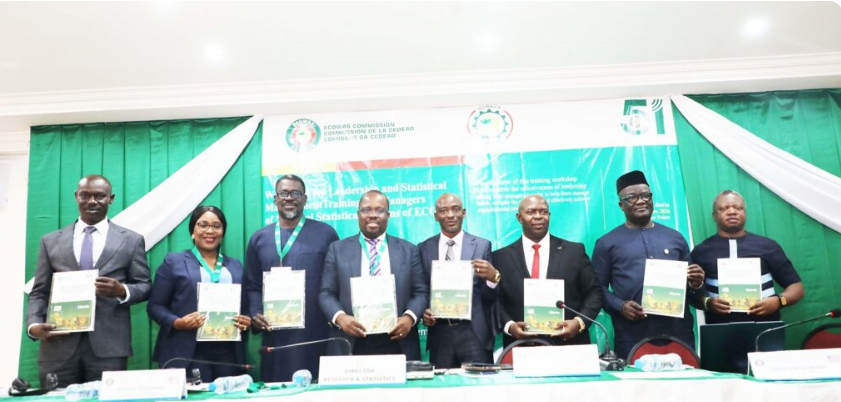
MONROVIA, Liberia — October 9, 2026 — The Economic Community of West African States (ECOWAS) is conducting a five-day regional training programme in Monrovia, Liberia, aimed at strengthening statistical systems, improving data quality and promoting greater consistency in economic information across West Africa.
The training, scheduled for October 5–9, 2026, brings together statistical leaders and technical representatives from ECOWAS member states and Mauritania, alongside officials from national statistical offices, regional monetary institutions and the ECOWAS Commission.
The initiative forms part of the World Bank-supported Harmonisation and Improvement of Statistics in West and Central Africa programme, which seeks to strengthen statistical capacity and improve the production of reliable, comparable data across participating countries.
Building a Common Statistical Foundation for West Africa
One of the persistent challenges facing regional economic integration in West Africa is the lack of fully harmonized statistical information across national economies.
Although countries regularly publish information on inflation, employment, trade, investment and economic growth, differences in statistical methodologies, reporting standards and data collection systems can make regional comparisons difficult.
These differences can complicate the work of policymakers attempting to evaluate economic performance, identify regional investment opportunities or measure progress toward integration objectives.
By strengthening statistical coordination, ECOWAS is seeking to improve the foundation upon which regional economic policies and development strategies are developed.
Reliable statistics are particularly important for evaluating cross-border trade, identifying economic disparities and assessing the effectiveness of regional programmes.
Supporting Regional Trade and Economic Policy
The training comes as West African countries continue efforts to strengthen economic cooperation and deepen regional market integration.
For ECOWAS, comparable economic data can help policymakers better understand trade relationships, investment flows, inflation trends and employment conditions across member states.
Such information is essential for evaluating the implementation of regional agreements and identifying obstacles to economic integration.
For example, inconsistent trade statistics can make it difficult to determine the actual volume of goods moving between neighboring countries. Similarly, differences in inflation measurement can complicate comparisons of economic conditions and assessments of regional monetary policy.
Improved statistical harmonization could help address these challenges by supporting more consistent data collection, reporting and analysis.
The participation of regional monetary institutions also underscores the importance of reliable information for economic surveillance, financial planning and monetary coordination.
World Bank Support for Stronger Statistical Systems
The World Bank-supported initiative reflects a broader effort to improve statistical capacity across West and Central Africa.
Strengthening national statistical institutions can help governments produce more timely and credible economic information while improving their ability to monitor development outcomes.
The involvement of national statistical offices and regional institutions is particularly important because statistical harmonization requires coordination between the organizations responsible for collecting and publishing economic information.
Regional training programmes provide opportunities for technical specialists to exchange knowledge, strengthen professional capacity and promote common statistical practices.
Over time, these efforts could improve the availability and comparability of economic information used by governments, regional organizations, investors and development partners.
Why Statistical Harmonization Matters for African Integration
The significance of the Monrovia training extends beyond improving statistical procedures.
Regional economic integration depends on the ability of participating countries to understand their collective economic performance and make decisions using consistent information.
The African Union’s Agenda 2063 and the African Continental Free Trade Area (AfCFTA) both envision stronger economic connections among African countries.
However, measuring progress toward those objectives requires reliable data on trade, infrastructure, investment, employment and industrial development.
For ECOWAS, harmonized statistics could provide a stronger basis for assessing regional economic policies and identifying areas requiring additional investment or institutional reform.
The inclusion of Mauritania in the training also highlights the potential importance of statistical cooperation beyond ECOWAS membership, particularly where neighboring economies maintain significant trade and financial relationships.
From Regional Commitments to Measurable Results
The Monrovia programme illustrates an important but often overlooked dimension of African regional integration: the development of the technical and institutional systems needed to support political and economic commitments.
Regional organizations frequently announce ambitious plans involving trade liberalization, infrastructure development, industrialization and economic cooperation.
Yet determining whether those initiatives are achieving their objectives requires credible and comparable statistical evidence.
Without consistent information, governments may struggle to distinguish between policy commitments and measurable economic progress.
Statistical harmonization therefore provides an important foundation for accountability, evidence-based policymaking and regional development planning.
For ECOWAS, the challenge will be translating the knowledge and technical cooperation developed through the training into sustained improvements in national statistical systems and regional reporting practices.
A Critical Step Toward Evidence-Based Regional Integration
As the five-day programme reaches its scheduled conclusion on October 9, the broader significance of the initiative lies in its potential to strengthen how West African countries measure and evaluate economic integration.
The training itself does not guarantee that statistical systems will become fully harmonized. Continued institutional cooperation, technical investment and implementation of common standards will be necessary.
Nevertheless, the initiative represents a practical effort to strengthen the information systems upon which regional economic cooperation depends.
For ECOWAS, the message is clear: successful economic integration requires more than agreements, declarations and political commitments. It also requires reliable information to measure progress, identify weaknesses and guide decisions.
As West Africa continues pursuing deeper economic integration, stronger statistical systems could become one of the essential tools for turning regional ambitions into measurable results.
LADVmedia.com | When the Dust Settles
Editorial note: This article is based on the supplied programme information. The training’s final outcomes and any agreements reached on October 9 have not been independently confirmed.