
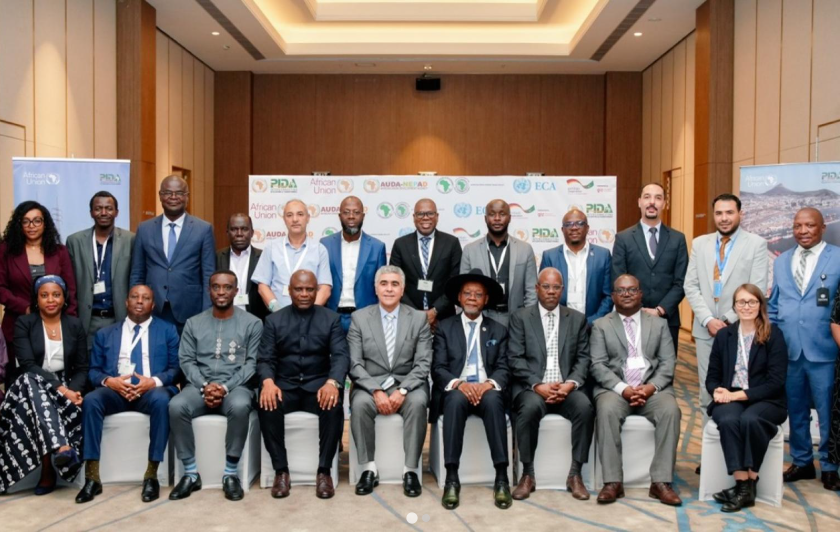
ADDIS ABABA, Ethiopia — The African Union (AU) has launched a mid-term review of the Second Priority Action Plan under the Programme for Infrastructure Development in Africa (PIDA-PAP 2), marking an important step toward assessing whether the continent’s ambitious infrastructure commitments are translating into measurable progress.
The review will examine 69 regional infrastructure projects valued at approximately US$160.7 billion, covering four critical sectors: transportation, energy, transboundary water resources, and information and communications technology.
Rather than focusing solely on announcing new infrastructure initiatives, the assessment will evaluate the implementation of existing projects, identify obstacles preventing their completion, and explore measures to accelerate delivery.
The initiative represents an important opportunity for the African Union to strengthen accountability and ensure that regional infrastructure investments produce tangible economic and social benefits.
Evaluating Progress Across Four Critical Sectors
PIDA is one of the African Union’s flagship continental infrastructure development frameworks, designed to address infrastructure deficiencies that continue to restrict economic growth, regional trade and integration.
The second Priority Action Plan, covering 2021–2030, identifies infrastructure investments intended to improve connectivity between African countries and support the continent’s long-term development objectives.
The mid-term review will assess progress in four interconnected sectors.
Transportation: Regional highways, railway networks, ports and transportation corridors are essential for reducing the cost of moving goods and people across African borders. The review will help determine whether priority transportation investments are advancing toward completion.
Energy: Cross-border electricity transmission networks and regional energy infrastructure are critical for expanding access to reliable power, supporting industrial development and strengthening regional electricity markets.
Water: Shared water infrastructure and transboundary water-management systems play an important role in agricultural productivity, climate resilience, water security and cooperation between neighboring countries.
Information and Communications Technology: Regional broadband networks and communications infrastructure are essential for digital connectivity, cross-border commerce, financial technology and Africa’s expanding digital economy.
Progress in these sectors is closely connected to the African Continental Free Trade Area (AfCFTA), which seeks to establish a more integrated continental market.
Without reliable transportation, electricity and digital connectivity, African businesses may struggle to take full advantage of expanded market access.
Identifying Financing Gaps and Implementation Challenges
A central objective of the review is to determine why some regional infrastructure projects advance while others encounter prolonged delays.
The assessment will examine financing constraints, implementation difficulties and institutional challenges that may be preventing projects from achieving their intended outcomes.
Infrastructure development across multiple sovereign states can be particularly complicated because participating countries must coordinate national priorities, regulatory requirements, financing arrangements and construction schedules.
For example, a regional railway or electricity transmission project may depend on several governments completing different sections of infrastructure within compatible timelines.
Delays in one participating country can affect the economic viability and operational effectiveness of the entire regional investment.
The review therefore offers an opportunity to identify where stronger coordination, additional investment or corrective measures may be required.
Importantly, the estimated US$160.7 billion represents the reported value of the projects under examination, not necessarily funding already secured or expenditure completed.
African Institutions and Regional Economic Communities Participate
The review brings together several institutions responsible for supporting Africa’s infrastructure development and regional integration.
They include the African Union Development Agency–New Partnership for Africa’s Development (AUDA-NEPAD), the African Development Bank (AfDB), the United Nations Economic Commission for Africa (UNECA), and Africa’s Regional Economic Communities (RECs).
Each institution contributes a different dimension to the implementation process.
AUDA-NEPAD plays an important role in coordinating continental development initiatives and supporting project preparation and implementation.
The African Development Bank contributes expertise in infrastructure financing, investment mobilization and project development.
UNECA supports economic analysis, regional cooperation and policies designed to strengthen Africa’s development.
The Regional Economic Communities provide an essential connection between continental infrastructure priorities and the national governments responsible for implementing projects.
Their participation is particularly significant because many of Africa’s most important infrastructure investments cross national boundaries.
The eight African Union-recognized Regional Economic Communities—ECOWAS, EAC, ECCAS, SADC, COMESA, IGAD, CEN-SAD and AMU—are central building blocks of the continent’s integration architecture.
Effective cooperation between these institutions could help reduce duplication, strengthen coordination and improve the delivery of regional infrastructure.
From Infrastructure Declarations to Measurable Results
One of the most significant aspects of the mid-term review is its emphasis on evaluating implementation rather than simply establishing new priorities.
For decades, African governments and regional institutions have recognized the importance of infrastructure connectivity in advancing continental economic integration.
Numerous agreements, development frameworks and regional infrastructure initiatives have been adopted to address transportation bottlenecks, electricity shortages and fragmented markets.
However, the challenge has frequently been translating continental commitments into completed and operational projects.
The PIDA-PAP 2 review provides an opportunity to assess that implementation gap.
It also raises several important questions.
Which projects are progressing according to schedule? Which have secured sufficient financing? Which face institutional or regulatory barriers? And which require additional political coordination to move forward?
Answering these questions could help the African Union and participating institutions establish more realistic implementation priorities for the remainder of the 2021–2030 programme.
The review’s ultimate significance will depend on whether its findings lead to practical corrective actions, improved financing arrangements and measurable progress.
Infrastructure as the Foundation of African Integration
The review also highlights a fundamental reality of African integration: political agreements alone cannot create a functioning continental economy.
The African Continental Free Trade Area may provide a framework for expanding trade, but businesses still require efficient roads, railways, ports, reliable electricity and modern communications networks to operate across borders.
Regional infrastructure is therefore not simply a development objective. It is one of the foundations upon which successful economic integration depends.
A completed cross-border highway can connect producers with new markets. An interconnected electricity network can improve energy reliability across participating countries. A regional digital network can support financial transactions and communications between businesses operating in different national jurisdictions.
These investments can help transform regional cooperation from a political commitment into an economic reality.
They also support the African Union’s Agenda 2063 vision of an integrated, prosperous and peaceful continent.
A Test of Africa’s Ability to Deliver Continental Projects
The mid-term review arrives at an important stage in Africa’s broader integration efforts.
The continent is undertaking an exceptionally ambitious political and economic undertaking: bringing together 55 sovereign African Union member states, each with its own national priorities, institutions and development challenges, under a shared continental integration agenda.
Although regional integration has been pursued elsewhere, the African Union’s effort is distinctive in its geographic scale, institutional diversity and development requirements.
Infrastructure development is among the clearest tests of whether this ambitious experiment can produce meaningful results.
Unlike declarations or agreements, completed infrastructure projects provide visible evidence of cooperation between governments and institutions.
The review of 69 projects therefore presents an opportunity to assess not only the performance of PIDA-PAP 2 but also the effectiveness of the continent’s wider implementation and coordination mechanisms.
What Comes Next?
The immediate task is to evaluate the status of the projects, identify implementation barriers and determine where additional support is required.
The findings could inform future decisions concerning project prioritization, financing strategies, institutional coordination and the allocation of technical resources.
However, the review itself does not guarantee that delayed projects will be completed or that financing gaps will be resolved.
Its success will ultimately be measured by whether the assessment leads to specific actions and whether those actions improve the delivery of infrastructure across participating African countries.
For the African Union, the central question is increasingly moving beyond what infrastructure Africa intends to build.
The more consequential question is what has actually been built, what remains unfinished, and what African institutions and governments are prepared to do to close the gap.
The PIDA-PAP 2 mid-term review could become an important instrument for answering that question—and for determining whether Africa’s infrastructure ambitions can be translated into measurable progress toward continental integration.