
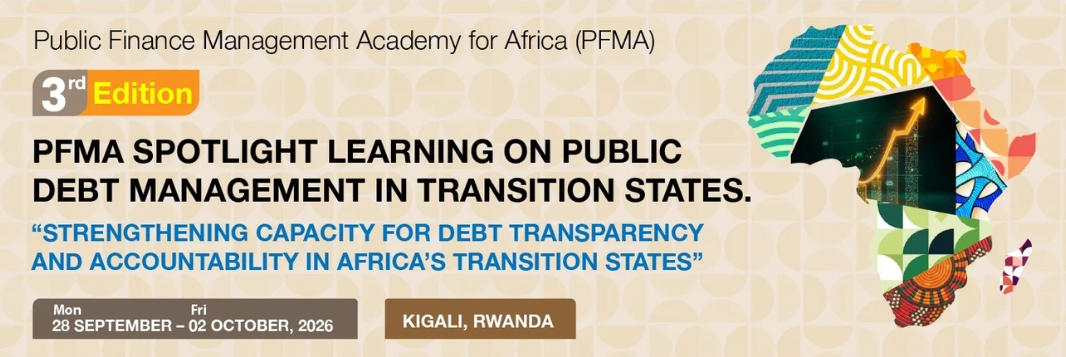
KIGALI, Rwanda — September 28, 2026 — The African Development Bank Group is bringing officials from 22 African transition states together in Kigali this week for an intensive programme aimed at strengthening public debt management as governments across the continent confront growing fiscal pressures and increasingly complex borrowing environments.
The Bank’s Public Finance Management Academy for Africa begins its third Spotlight Learning Programme on Public Debt Management in Transition States today, September 28, and will continue through October 2, 2026.
The programme focuses on strengthening debt transparency, accountability and sustainable debt management, while improving the institutional capacity of African governments to make informed borrowing and fiscal decisions.
Participants include officials from government debt-management offices, national treasuries, central banks and public-audit institutions, bringing together agencies responsible for borrowing, managing public finances and overseeing government accountability.
Why Debt Management Matters
The programme comes at an important time for African economies.
Governments across the continent face the difficult task of financing infrastructure, education, healthcare, energy, transportation and other development priorities while maintaining sustainable public finances.
Borrowing itself is not necessarily the problem.
Governments routinely use debt to finance long-term investments that cannot always be funded entirely through annual tax revenues.
The challenge is ensuring that borrowing is affordable, transparent, properly structured and directed toward investments capable of supporting long-term economic development.
When debt-service obligations become too large, governments can find themselves using an increasing share of public revenue to repay existing obligations rather than financing new development priorities.
For countries already dealing with economic, political or institutional vulnerabilities, those pressures can become particularly difficult to manage.
Focus on Africa’s Transition States
The African Development Bank’s programme specifically targets transition states, where governments may face additional institutional and economic challenges associated with fragility, conflict, political transitions or other forms of vulnerability.
Twenty-two African transition states are represented in Kigali.
Strengthening debt-management institutions in these countries can be particularly important because fiscal shocks can have wider consequences when government institutions and public finances are already under pressure.
The programme therefore goes beyond simply examining how much money governments borrow.
It addresses the institutions and systems responsible for deciding when governments should borrow, how borrowing should be structured, how risks should be evaluated and how debt obligations should be reported and monitored.
Transparency at the Center of Debt Management
Debt transparency is another major focus of the programme.
Governments need accurate and comprehensive information about their financial obligations in order to make effective fiscal decisions.
That includes understanding existing debt, repayment schedules, interest costs, currencies in which obligations are denominated, guarantees provided to state-owned enterprises and other potential liabilities.
Transparency also allows legislatures, audit institutions and citizens to better understand the financial commitments governments are making.
Incomplete or fragmented debt information can make it more difficult to assess a country’s true fiscal position and can increase the risk of unexpected financial pressures.
By bringing together treasuries, central banks, debt-management offices and audit institutions, the Kigali programme recognizes that sustainable debt management requires coordination across government rather than responsibility resting with a single ministry or agency.
Borrowing and Africa’s Development Challenge
Africa’s debt debate is closely connected to a larger development question.
The continent requires substantial investment in infrastructure.
Roads must be constructed.
Electricity generation and transmission systems must expand.
Ports and railways require modernization.
Digital infrastructure must grow.
Governments must also finance education, healthcare, water systems and other essential public services.
Many African governments therefore cannot simply stop borrowing.
Instead, the more important question is whether countries can borrow strategically while maintaining fiscal sustainability.
That requires governments to examine the cost of financing, maturity periods, currency risks and the expected economic benefits of projects financed through debt.
Borrowing for infrastructure that improves productivity, expands trade or increases government revenue can have very different long-term consequences from borrowing that produces limited economic returns.
Effective debt management therefore becomes part of development planning itself.
Building African Institutional Capacity
The African Development Bank’s Public Finance Management Academy reflects a broader effort to strengthen public-sector institutions across the continent.
Training officials who actually manage national debt can help governments build expertise internally rather than relying entirely on outside advisers.
That institutional capacity is particularly important as African governments increasingly encounter a wider range of financing options.
Countries may borrow through domestic bond markets, international capital markets, multilateral development institutions, bilateral lenders and other financing arrangements.
Each type of financing can carry different interest rates, maturity structures, currency exposures and legal obligations.
Understanding those differences can help governments evaluate not simply whether financing is available, but whether the financing is appropriate for the country’s fiscal position.
A Continental Issue
Although the Kigali programme focuses on 22 transition states, the questions being discussed have significance across Africa.
Debt sustainability can influence a government’s ability to invest in development, respond to economic shocks and maintain essential public services.
It can also affect regional and continental development ambitions.
Projects supporting cross-border transportation, electricity interconnections, digital networks and regional trade frequently require substantial long-term financing.
Africa’s regional integration agenda therefore depends not only on ambitious infrastructure plans but also on governments possessing the financial-management capacity necessary to fund those projects sustainably.
As initiatives such as the African Continental Free Trade Area seek to deepen economic integration, stronger national public-finance institutions can provide part of the foundation needed to support those ambitions.
From Training to Implementation
The Kigali programme will continue through October 2.
But the larger question will come after participants return to their respective countries.
Training programmes can strengthen technical knowledge, but their ultimate impact depends on whether that knowledge translates into stronger national institutions, improved debt reporting, better borrowing decisions and greater accountability.
For African governments confronting large development needs alongside significant fiscal pressures, sustainable debt management is increasingly becoming more than a technical financial issue.
It is becoming a central question of development policy.
Africa needs investment.
Many governments will still need financing to provide that investment.
The challenge is ensuring that today’s borrowing does not unnecessarily restrict tomorrow’s development choices.
That is the issue officials from 22 African transition states will be confronting in Kigali this week—and why strengthening Africa’s capacity to manage public debt may prove just as important as expanding access to development finance itself.
The African Development Bank Group’s Public Finance Management Academy for Africa is organizing the official programme, with the Kigali session scheduled for September 28–October 2, 2026, and participation from 22 transition states.